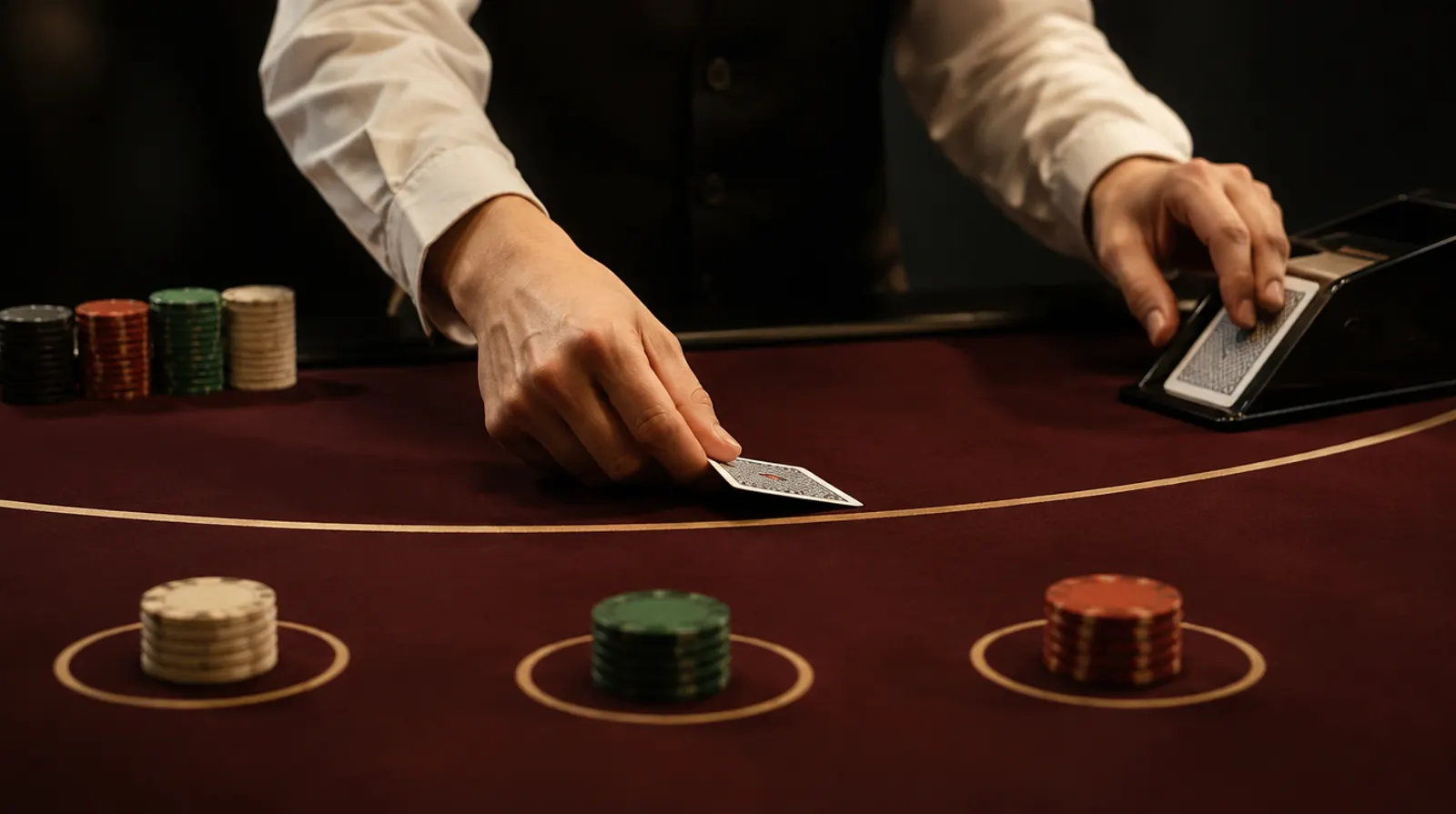
Cashback Blackjack is a Playtech Live blackjack game in which you can cash out your hand mid-round for an amount the game calculates from the cards on the table. It is an eight-deck game open to an unlimited number of players, with five choices on each decision (Cashback, Hit, Stand, Double or Split) and six side bets. The cashback is not a loyalty rebate on losses: it is a buy-out of your current hand, and the offer is designed to sit below what the hand is worth on average.
Playtech launched the live version on 5 June 2020 with the Greek operator Betano/Stoiximan, and it was still on regulator approval lists in 2026. This guide, updated in October 2026, explains how the cashback works, when taking it makes sense, the base rules and side bets, how it compares with similar games, and where US players can find a cash-out blackjack table. For rules and strategy common to every table, see our live blackjack guide.
Cashback Blackjack at a Glance
| Feature | Detail |
|---|---|
| Studio | Playtech Live |
| Live launch | 5 June 2020, first with Betano/Stoiximan; previously an RNG game |
| Decks | Eight |
| Players | Unlimited: everyone plays the same dealt hand and makes their own decisions |
| Decisions | Cashback, Hit, Stand, Double or Split |
| Cashback rules | Amount based on the cards on the table, may change each action round; offered on both hands after a split; not offered after a double; main bet only |
| Side bets | 21+3, Buster Blackjack, Dealer Pair, Lucky Lucky, Player Pair, Top 3 |
| Still offered in 2026? | Yes: on the Philippine regulator’s approved Playtech Live list (16 July 2026) and Switzerland’s ESBK register (1 October 2026) |
| Table limits | Set by each casino |
How Cashback Blackjack Works
The table runs like other “unlimited” live blackjack games. One hand is dealt for everyone, and each player makes their own decisions on the shared cards through the on-screen buttons. Playtech’s launch release called it the studio’s fifth scalable blackjack variant, after Unlimited Blackjack, Quantum Blackjack, All Bets Blackjack and Majority Rules Speed Blackjack.
- Bet. Place your main bet and any side bets before the timer runs out.
- The deal. The dealer deals the common player cards and the dealer’s up card. Side bets that depend on the first cards settle at this point.
- Action rounds. In each action round you choose Cashback, Hit, Stand, Double or Split. The cashback figure is shown on the button and is recalculated from the cards on the table each round.
- Cash out or play on. If you take the cashback, your main bet is settled at that amount and you sit out the rest of the hand. If you keep playing, the hand settles normally against the dealer.
Three rules shape the decision. A split gives you two hands, and cashback is offered on both of them. A double ends the cashback option for that hand, because you have committed to one more card. Cashback only buys out the main bet; side bets are resolved and paid separately.
The Cashback Offer Explained
Older descriptions of this game, including the previous version of this page, presented the cashback as a reward that returns a share of your losses. It is not. Every blackjack hand has an expected value: the average result if that exact situation were played out many times. A strong hand, such as 20 against a dealer 6, is worth more than your stake on average. A weak hand, such as hard 16 against a dealer 10, is worth much less. The cashback button turns that value into a fixed amount you can take right now.
Playtech says only that the amount is calculated from the cards on the table. Like the early-payout offers at other studios, it is designed so the house keeps an edge, which means a cash-out offer should be expected to sit somewhat below the hand’s true value. Taking it therefore usually costs you a little money on average in exchange for certainty.
A worked example
The numbers below are illustrative, not Playtech’s actual offers, but they show how to think about any cash-out button. Say you bet $100 and hold hard 16 against a dealer 10. Played with basic strategy, that hand loses a little over half your bet on average, so it is worth roughly $46 to you. If the button offers $42, taking it locks in a $58 loss instead of an average $54 loss. You pay about $4 for certainty.
Now take 20 against a dealer 6. That hand wins most of the time and is worth well over $100 on average. If the button offers, say, $160 back on a $100 bet, you lock in a $60 profit and give up a little of the average value in exchange for removing the chance that the dealer draws to 21.
The rule of thumb that follows: the cashback is a variance tool, not an edge. It never improves the long-run return of a hand you would otherwise play correctly, because the offer is priced below the hand’s value. It can be sensible when you would rather bank a result, for example near the end of a budgeted session.
When players tend to use it
- Locking in a strong hand against a weak dealer card when you want to protect a session profit.
- Cutting losses on a bad hand, much like surrender. Ordinary surrender returns half your bet; a cashback offer on hard 16 against a 10 may be close to that.
- After a split, when one hand is strong and the other weak, since each hand gets its own offer.
Cashback versus surrender
Surrender is the cash-out most blackjack players already know. Where late surrender is offered, you give up half your bet after the dealer checks for blackjack, and basic strategy uses it only on a handful of hands. For eight decks with the dealer standing on soft 17, the Wizard of Odds chart surrenders these:
| Your hand | Surrender against |
|---|---|
| Hard 16 (not a pair of 8s) | Dealer 9, 10 or Ace |
| Hard 15 | Dealer 10 |
Those are exactly the spots where a cashback offer is most tempting. A useful test: if the button offers less than half your bet on one of these hands, playing on with basic strategy is usually the better deal; if it offers close to half, it works much like surrender. On strong hands the comparison runs the other way, because there the offer is always below the hand’s average value.
The habit to avoid is taking the button on every hand. Because each cash-out gives up a small slice of value, using it constantly adds a steady extra cost on top of the base house edge.
Base Game Rules and House Edge
Playtech’s public material confirms eight decks and the five decision options but does not publish the full rule card. Rule summaries of the live game report that the dealer stands on all 17s, blackjack pays 3:2, doubling after a split is allowed and surrender is not offered, and quote a main-game RTP of about 99.5% with perfect basic strategy. Check the help screen at your casino, because rules and limits can be configured per operator.
| Rule | Reported setting | Effect on the player |
|---|---|---|
| Decks | Eight (confirmed by Playtech) | Slightly worse than fewer decks |
| Dealer on soft 17 | Stands | Better for the player than hitting soft 17 |
| Blackjack pays | 3:2 | Standard; avoid any table paying 6:5 |
| Double after split | Allowed | Helps the player |
| Surrender | Not offered | Cashback partly fills this role |
| Main-game RTP | About 99.5% with basic strategy | House edge about 0.5% |
Basic strategy for an eight-deck game where the dealer stands on soft 17 is close to the standard chart. A few core plays:
| Your hand | Dealer 2 to 6 | Dealer 7 to Ace |
|---|---|---|
| Hard 17 or more | Stand | Stand |
| Hard 13 to 16 | Stand | Hit |
| Hard 12 | Stand against 4 to 6, hit against 2 and 3 | Hit |
| Hard 11 | Double | Double against 7 to 10, hit against an Ace |
| Hard 10 | Double | Double against 7 to 9, hit against 10 or Ace |
| Pair of Aces or 8s | Split | Split |
Our charts for when to hit and when to split cover every hand. Insurance, if offered, is a separate side wager with a high house edge in an eight-deck game; our guide to blackjack insurance explains why to decline it.
The Six Side Bets
Cashback Blackjack carries the full set of Playtech side bets. All of them are optional, settle independently of the cashback, and carry a much higher house edge than the main game. Paytables can differ between casinos, so check the game’s help screen for the exact payouts.
| Side bet | What it pays on |
|---|---|
| 21+3 | A poker hand (flush, straight, three of a kind, straight flush, suited trips) formed by your first two cards and the dealer’s up card |
| Player Pair | Your first two cards forming a pair, with more for coloured or perfect pairs |
| Dealer Pair | The dealer’s first two cards forming a pair |
| Lucky Lucky | Your two cards plus the dealer’s up card totalling 19, 20 or 21, with the top prizes for special 21 combinations |
| Top 3 | Three of a kind, a straight flush or suited three of a kind from your two cards plus the dealer’s up card |
| Buster Blackjack | The dealer busting, paying more the more cards the dealer’s busted hand contains |
Buster Blackjack has the biggest potential win of the six, according to Playtech’s launch release. Our guide to 21+3 works through that bet’s paytables and house edge.
How It Compares With Similar Games
| Game | Studio | Cash-out feature | Players |
|---|---|---|---|
| Cashback Blackjack | Playtech Live | Cashback on each action round, main bet only | Unlimited |
| Blackjack Early Payout | VIG | Early Payout offer each time a card is dealt to you | Seated tables |
| Infinite Blackjack | Evolution | None | Unlimited |
| Standard live blackjack | Most studios | None (surrender at some tables) | Seven seats plus Bet Behind |
The closest relative is VIG’s Blackjack Early Payout, which applies the same buy-out idea at a seated table. The Wizard of Odds found its offers are usually worth about 98% of the hand’s value, and our Blackjack Early Payout review covers it in detail. Evolution’s Infinite Blackjack uses the same one-hand-for-everyone format without the cash-out.
Who Cashback Blackjack Suits
The game fits players who like standard blackjack but want an exit on a bad hand, or who are trying to protect a session result. Because the table never fills up, it also suits anyone who dislikes waiting for a seat. It is a poorer fit for players chasing the lowest possible cost: the main game is already close to the best live blackjack rules, and every cash-out you take nudges the cost upwards. If you already play basic strategy well, the cashback adds a decision without adding value; if you are still learning, practise the standard chart first, then treat the button as an occasional tool.
Playing on Mobile
The unlimited format suits phones well, because there is no seat to wait for and the decision buttons sit in one row. Playtech’s live client runs in the casino’s browser lobby or app on iOS and Android, and the current cashback amount appears on its button during each action round. Decision timers are short, so a stable connection matters, and the table rules in the help screen explain what happens to a hand if you miss a decision.
Can US Players Play Cashback Blackjack?
Only at a state-licensed casino that carries it, and titles vary by casino. Eight states have legalised online casinos; seven markets are live (New Jersey, Pennsylvania, Michigan, West Virginia, Connecticut, Delaware and Rhode Island), and Maine legalised a tribal-only market (LD 1164: became law without the governor’s signature in January 2026, effective 29 July 2026) that has not launched as of October 2026. Playtech’s live casino page lists dedicated studio space in Michigan, New Jersey and Pennsylvania, plus a Las Vegas operation run with MGM, but Playtech does not publish which titles run in each state. Check the live blackjack section of your state-licensed casino.
The offshore sites that accept Americans do not carry Playtech Live. The nearest equivalent there is VIG’s Blackjack Early Payout, which Bovada, Ignition and MyBookie listed in their live lobbies in October 2026. Those sites hold no US state licence, so there is no state regulator to complain to and your funds are not protected. Our ranking of the top live casino software providers shows which studios serve which markets.
Blackjack has a low house edge, but it is still a game you lose over time. If gambling stops being fun, call or text 1-800-MY-RESET (1-800-697-3738) or visit ncpgambling.org, and see our responsible gambling page for limits and self-exclusion.
Frequently asked questions
How does Cashback Blackjack work?
It is eight-deck live blackjack for unlimited players with an extra Cashback button. In each action round you can take a cash amount for your hand, calculated from the cards on the table, instead of hitting, standing, doubling or splitting.
Is Cashback Blackjack a rebate on losses?
No. The cashback buys out your current hand for a set amount. It is not a percentage of past losses and has nothing to do with casino loyalty rewards.
Should you take the cashback in blackjack?
Only when you value certainty more than a small amount of expected value. The offer is priced below what the hand is worth on average, so taking it on every hand adds to the house edge.
Can you take cashback after doubling or splitting?
Not after doubling: once you double, cashback is no longer offered for that hand. After a split, cashback is offered separately on both hands.
What is the RTP of Cashback Blackjack?
Rule summaries put the main game at about 99.5% with perfect basic strategy, a house edge of about 0.5%. Taking cashback offers lowers your return slightly, and the side bets return less than the main game.
Where can US players find a cash-out blackjack game?
State-licensed casinos may carry Playtech’s tables, but titles vary. At offshore sites, VIG’s Blackjack Early Payout offers a similar buy-out; those sites have no US state licence.