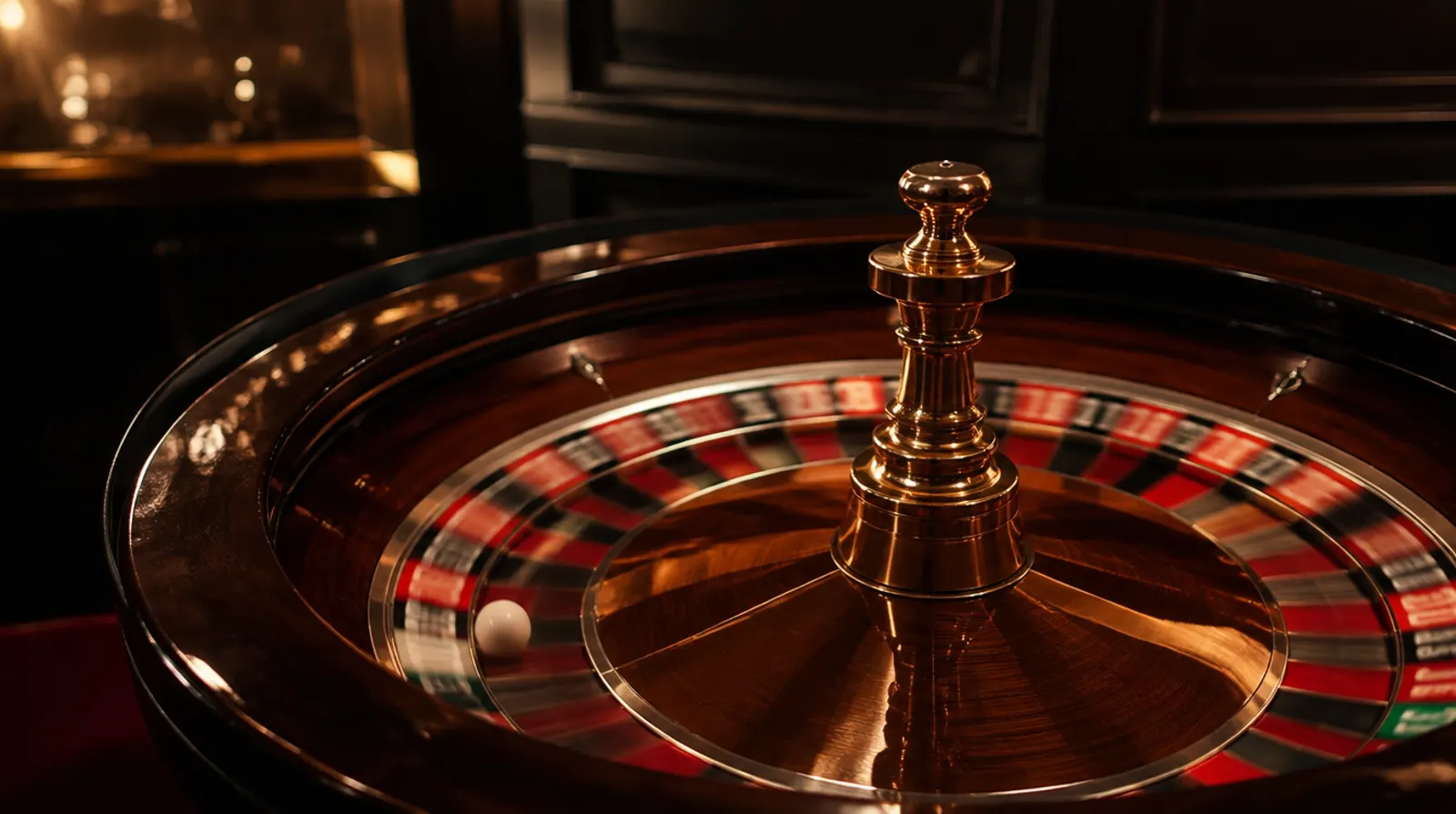
No roulette bet combination changes the house edge. On a European single-zero wheel every chip you place, alone or as part of a system, loses 2.70% of its value on average; on an American double-zero wheel it loses 5.26%. Combining bets changes only how often you win and how big the wins and losses are. This page lays out the popular combinations (James Bond, the 3/2 system, two dozens, the Romanosky and the racetrack call bets), shows the maths for each one, and explains the few choices that really do lower what roulette costs you.
Updated October 2026. Every figure below is calculated from the standard payout table and checked against Wizard of Odds and the house edges in our live roulette guide.
Why Combine Bets at All
A single straight-up bet wins once in 37 spins. Spread chips over 25 or 30 numbers and you win most spins instead, which feels safer and makes a session last longer between big losses. That is the real appeal of a combination: it smooths out the ride and lets you shape the results to suit your taste.
What it cannot do is improve the long-run return. The old version of this page said that combining bets could “slightly increase your chances of making small profits in the long run”. That is wrong. A combination raises your win rate per spin, but the wins are small and the losing spins are large, and the two balance out at exactly the house edge. Each section below proves it bet by bet.
The Rule Behind Every Combination
Roulette pays every bet as if the zero were not there. A straight-up bet has 37 pockets to beat on a European wheel, so fair odds would be 36:1, but the casino pays 35:1. Splits pay 17:1 where fair would be 17.5:1. The shortfall is the same proportion on every standard bet: each $1 you stake returns $36 for every 37 spins on average, so you lose $1 in 37, or 2.70%.
Because the loss is proportional to each chip, it simply adds up across a layout. Put $14 on one bet and $6 on two others, and the expected loss is 2.70% of $20, whichever bets they are. The extreme case makes this obvious. Place $1 on all 37 numbers and you win every spin: the winning number pays $35 plus its $1 back, so you collect $36 for $37 staked and lose exactly $1, which is 2.70%, on every single spin. Full coverage just turns the house edge into a fixed fee.
The only exceptions are bets priced differently on the same wheel: the American Top Line (0, 00, 1, 2, 3) at 7.89%, straight-up bets on Lightning Roulette at 2.90%, and even-money bets on French tables with La Partage at 1.35%. They change the cost because the bet itself is priced differently, not because of how it is combined.
Roulette Bet Combinations Compared
The table summarises the combinations covered on this page. “Win chance” is the share of spins that end with a net profit on a single-zero wheel. The house edge column is the same in every row, which is the whole point.
| Combination | Units staked | Numbers covered | Win chance (European) | Net result per spin | House edge (European / American) |
|---|---|---|---|---|---|
| James Bond (19-36, six line 13-18, zero) | 20 | 25 | 67.57% | +8, +10 or +16; lose 20 | 2.70% / 5.26% |
| 3/2 system (red + second column) | 5 | 26 | 70.27% | +1 or +7; lose 5 | 2.70% / 5.26% |
| Two dozens | 2 | 24 | 64.86% | +1; lose 2 | 2.70% / 5.26% |
| Romanosky (two dozens + two corners) | 8 | 32 | 86.49% | +1; lose 8 | 2.70% / 5.26% |
| Red + second dozen | 2 | 24 | 32.43% (another 32.43% break even) | +1, +3 or 0; lose 2 | 2.70% / 5.26% |
| Voisins du Zéro (call bet) | 9 | 17 | 45.95% | +9 or +15; lose 9 | 2.70% / n/a |
| Tiers du Cylindre (call bet) | 6 | 12 | 32.43% | +12; lose 6 | 2.70% / n/a |
| Orphelins (call bet) | 5 | 8 | 21.62% | +13 or +31; lose 5 | 2.70% / n/a |
| Jeu Zéro (call bet) | 4 | 7 | 18.92% | +14 or +32; lose 4 | 2.70% / n/a |
| All 37 numbers straight up | 37 | 37 | 0% | lose 1 every spin | 2.70% / 5.26% (38 chips) |
Call bets follow the single-zero wheel order, so American tables generally do not offer them in the same form.
The James Bond Betting Strategy
Named after Ian Fleming’s spy, the James Bond system is one of the best-known flat (non-progressive) combinations. It uses 20 units per spin, or any multiple of 20. PokerNews describes it with a $200 example and a scaled-down $20 version:
- 14 units on high (19-36), which pays 1:1
- 5 units on the six line 13-18, which pays 5:1
- 1 unit on zero, which pays 35:1
That covers 25 of the 37 numbers. You lose only when the ball lands on 1 to 12.
James Bond outcomes on a European wheel ($20 per spin)
| Ball lands on | Pockets | What pays | Net result |
|---|---|---|---|
| 19-36 | 18 | $14 high bet wins $14; $6 lost elsewhere | +$8 |
| 13-18 | 6 | $5 six line wins $25; $15 lost elsewhere | +$10 |
| 0 | 1 | $1 straight up wins $35; $19 lost elsewhere | +$16 |
| 1-12 | 12 | nothing | -$20 |
Now weigh each outcome by how often it happens over 37 spins: 18 × $8 = $144, plus 6 × $10 = $60, plus 1 × $16 = $16, for $220 won. Twelve losing spins cost 12 × $20 = $240. Net result: -$20 per 37 spins, or -$0.54 per spin on a $20 stake. That is 2.70%, the same as a plain bet on red.
The appeal is that you win two spins in three. The catch is the shape: a typical win is $8 to $10, while a loss costs $20. Three losing spins in a row, which happens with probability (12/37)³, about 3.4% of the time, wipe out the profit from seven or eight wins.
James Bond on an American wheel
There is no single-zero pocket to cover on its own, so players usually put the last unit on the 0-00 split, which pays 17:1. The numbers 19-36 and 13-18 pay as before, but a 0 or 00 now returns only $18 for the $20 stake (-$2), and 1 to 12 still loses $20. Over 38 spins: 18 × $8 + 6 × $10 – 2 × $2 – 12 × $20 = -$40, or -$1.05 per spin. The edge is 5.26%, about double the European cost, and the win chance falls to 24 in 38 (63.16%).
James Bond at a French table with La Partage
French rules help here because 14 of the 20 units sit on an even-money bet. When zero hits, the zero chip wins $35, La Partage returns half of the $14 high bet ($7) and the six line loses $5, so that spin nets +$23 instead of +$16. Over 37 spins the total becomes $144 + $60 + $23 – $240 = -$13, an edge of 1.76%. You can check it another way: 14/20 of the stake at 1.35% plus 6/20 at 2.70% gives the same 1.76%. This saving comes from the rule on even-money bets, not from the system.
The 3/2 System
Each spin of the 3/2 (or 3:2) strategy uses five units: three on a colour and two on the column that holds mostly the opposite colour. 888casino lists it among its “coverage systems” and works it out to the same 2.70% loss. Two standard layouts exist:
- 3 units on red plus 2 units on the second column. The second column (2, 5, 8 and so on up to 35) holds eight black numbers and only four reds (5, 14, 23, 32).
- 3 units on black plus 2 units on the third column, which holds eight reds and four blacks (6, 15, 24, 33).
3/2 outcomes (3 on red, 2 on the second column)
| Ball lands on | Pockets | Net result |
|---|---|---|
| Red number in the second column (5, 14, 23, 32) | 4 | +7 units (red +3, column +4) |
| Any other red number | 14 | +1 (red +3, column -2) |
| Black number in the second column | 8 | +1 (red -3, column +4) |
| Remaining black numbers | 10 | -5 |
| Zero | 1 | -5 |
That is 26 winning pockets out of 37 (70.27%), or 26 of 38 (68.42%) on an American wheel. Over 37 spins you win 4 × 7 + 22 × 1 = 50 units and lose 11 × 5 = 55, a net loss of 5 units on 185 staked. Five divided by 185 is 2.70%. On a double-zero wheel the 00 pocket adds a twelfth losing pocket and the cost rises to 5.26%. With La Partage the zero spin costs 3.5 units instead of 5, which brings the edge down to 1.89%.
Two Dozens and the Romanosky
Betting two dozens at once is the simplest high-coverage combination. With $10 on the first dozen and $10 on the second, any number from 1 to 24 pays $20 on one bet and loses $10 on the other, for +$10. The other 13 pockets (25 to 36 plus zero) lose $20. Over 37 spins: 24 × $10 – 13 × $20 = -$20, which is 2.70% of the $740 staked.
The Romanosky system pushes coverage further. Borgata’s guide describes it as eight equal units: three on each of two dozens and one on each of two corners in the remaining dozen. In a common version, three units go on the first dozen, three on the second, one on the 25-26-28-29 corner and one on the 32-33-35-36 corner. That covers 32 of 37 numbers, leaving 0, 27, 30, 31 and 34 open.
- A dozen hit wins 3 × 2 = 6 units, against 5 units lost on the other bets: +1.
- A corner hit wins 8 units, against 7 units lost on the other bets: +1.
- One of the five open pockets costs all 8 units.
Borgata quotes an 86.49% chance of winning each spin, which matches 32/37. Over 37 spins that is 32 wins of one unit and 5 losses of eight: 32 – 40 = -8 units on 296 staked, or 2.70% again. A single miss erases eight wins, and the system is built so that you only ever win one unit at a time.
Red Plus a Dozen
Some players pair an even-money bet with a dozen or column so that a few numbers win both bets. Take $10 on red and $10 on the second dozen (13 to 24). That dozen contains six reds: 14, 16, 18, 19, 21 and 23.
- Red number in the second dozen (6 pockets): +$10 on red, +$20 on the dozen, net +$30.
- Black number in the second dozen (6 pockets): -$10 + $20, net +$10.
- Any other red number (12 pockets): +$10 – $10, net $0.
- Any other black number, or zero (13 pockets): -$20.
Over 37 spins: 6 × $30 + 6 × $10 – 13 × $20 = -$20, or $0.54 per $20 spin. Our roulette hub uses the same example to show that spreading chips changes how often you win, not what the game costs.
Call Bets: Racetrack Combinations
Call bets (also called announced or French bets) are ready-made combinations that cover a section of the single-zero wheel rather than a block of the layout. Most live tables show them on a “racetrack” panel. The chip layouts below follow Wizard of Odds’ sector-bet breakdown.
| Call bet | Chips | How the chips are placed | Numbers covered |
|---|---|---|---|
| Voisins du Zéro | 9 | 2 on the 0-2-3 trio, 1 each on splits 4/7, 12/15, 18/21, 19/22, 32/35, 2 on the 25-26-28-29 corner | 17 (from 22 to 25 around zero) |
| Tiers du Cylindre | 6 | 1 each on splits 5/8, 10/11, 13/16, 23/24, 27/30, 33/36 | 12 (from 27 to 33, opposite zero) |
| Orphelins | 5 | 1 straight up on 1, 1 each on splits 6/9, 14/17, 17/20, 31/34 | 8 (1, 6, 9, 14, 17, 20, 31, 34) |
| Jeu Zéro | 4 | 1 each on splits 0/3, 12/15, 32/35, 1 straight up on 26 | 7 (12, 35, 3, 26, 0, 32, 15) |
| Neighbours (for example 0 and two each side) | 5 | 1 straight up on each of five adjacent wheel numbers | 5 |
Worked maths for each call bet
Voisins du Zéro. A split hit returns 18 chips for the 9 staked (+9), a corner hit returns 2 × 9 = 18 (+9), and a trio hit returns 2 × 12 = 24 (+15). Over 37 spins: 14 × 9 + 3 × 15 – 20 × 9 = -9 chips on 333 staked, or 2.70%.
Tiers du Cylindre. Each of the 12 numbers sits in one split, so a hit returns 18 chips for 6 staked (+12). Over 37 spins: 12 × 12 – 25 × 6 = -6 chips on 222, or 2.70%.
Orphelins. Number 17 sits in two splits, so it returns 36 chips (+31), the same as the straight-up on 1. The other six numbers return 18 (+13). Over 37 spins: 2 × 31 + 6 × 13 – 29 × 5 = -5 chips on 185, or 2.70%.
Jeu Zéro. A split hit returns 18 for 4 staked (+14) and 26 returns 36 (+32). Over 37 spins: 6 × 14 + 32 – 30 × 4 = -4 chips on 148, or 2.70%.
Call bets are handy for players who like betting on wheel sections, and they make no difference to the price. Their main side effect is size: Voisins needs nine chips per spin, so a $5 chip means $45 a spin. On Lightning Roulette, straight-up wins pay 29:1 unless a multiplier lands, so the straight-up parts of Orphelins, Jeu Zéro and Neighbours bets run at 2.90% while splits and corners stay at 2.70%. Our Lightning Roulette guide has the pay table.
Win Rate Is Not the Same as Being Ahead
High-coverage combinations win most spins, but that does not mean you are likely to finish a session in profit. We calculated the exact probability of being ahead after 10, 50 and 100 spins for several combinations on a European wheel, counting every possible sequence of results rather than running a simulation.
| Combination | Wins per spin | Ahead after 10 spins | Ahead after 50 spins | Ahead after 100 spins |
|---|---|---|---|---|
| Red only (1 unit) | 48.65% | 34.4% (another 24.5% exactly even) | 36.9% | 35.5% |
| Two dozens | 64.86% | 51.0% | 38.1% | 37.0% |
| James Bond | 67.57% | 43.4% | 39.4% | 34.7% |
| 3/2 system | 70.27% | 41.7% | 41.1% | 34.5% |
| Romanosky | 86.49% | 60.0% | 31.5% | 28.6% |
| Tiers du Cylindre | 32.43% | 41.6% | 45.9% | 40.5% |
| Orphelins | 21.62% | 50.3% | 48.3% | 45.3% |
Look at the Romanosky row. It wins 86% of spins and gives you the best chance of being up after 10 spins, yet after 100 spins it is the combination most likely to leave you behind. Small, frequent wins mean low variance, and with low variance the house edge shows through sooner. Orphelins wins only about one spin in five, but its occasional +31 hits keep the results more spread out, so a larger share of sessions finish in profit. In both cases the average loss is identical per dollar staked. The difference is only how the results are scattered around that average.
This is the honest way to choose a combination: pick the pattern of wins and losses you enjoy, and size it so the average cost fits your budget.
What Actually Lowers the Cost of Roulette
Bet selection is irrelevant on a standard wheel, so focus on the things that do move the numbers.
- Play a single-zero wheel. Every combination above costs 2.70% on a European wheel and 5.26% on an American one. That switch roughly halves the price of anything you do.
- Use French rules for even-money bets. La Partage or En Prison cuts even-money bets to about 1.35%. Combinations weighted towards red/black, odd/even or high/low gain most, which is why the James Bond falls to 1.76% at a French table.
- Keep the Top Line out of your layouts. The American five-number bet costs 7.89%. Pair $10 on it with $10 on red and the combined edge is 6.58% (the average of 7.89% and 5.26%), the worst result on this page.
- Watch total stake and speed. Cost per hour is house edge × total chips per spin × spins per hour. A nine-chip Voisins at $5 a chip on a 50-spin-an-hour table costs about $60.80 an hour on average; the same bet on an 80-spin auto wheel costs about $97.30.
- Set limits first. Decide your session budget and stop point before the first spin.
The full house-edge tables for each wheel are in our roulette house edge guide, and our list of types of roulette tables explains which variants use which rules.
Combinations and Casino Bonus Rules
High-coverage layouts are exactly what bonus terms are written to stop, so check the rules before you play a combination with bonus money. At the four offshore sites we review for US players, the terms in October 2026 say:
- Bovada and Ignition: software roulette counts 5% towards wagering and live dealer games 0%. Bets placed without risk, such as red and black on the same spin, do not qualify, and casino bets are capped at 20% of the deposit while a bonus is active.
- MyBookie: roulette counts 0% towards bonus rollover.
- BetOnline: casino bonuses exclude roulette, and its rules ban opposite-side betting, including red and black together or covering 25 or more roulette numbers in one spin, with or without a bonus. The James Bond covers exactly 25 numbers, and the 3/2 and Romanosky cover more.
These operators are offshore and hold no US state licence, so there is no state regulator to complain to if a dispute over a voided bet arises, and player funds are not protected the way they are at a state-licensed casino. Our roulette bonus guide compares the terms in detail.
Combining Bets With a Staking System
Some players run a combination with a progression on top, for example doubling the whole James Bond layout after every loss. No staking system changes the house edge either, and here is the arithmetic. A James Bond Martingale starting at $20 bets $20, $40, $80, $160 and $320. Each spin loses with probability 12/37, so five losses in a row happen about 0.36% of the time, roughly once in 280 sequences. When it happens you have lost $620, and the next step ($640) is above many table maximums. The many small wins on the other sequences add up to roughly the same amount, and the total cost stays at 2.70% of everything wagered.
The same holds for the Fibonacci roulette strategy, the reverse Martingale and pattern-chasing systems like the dolly marker system. They change how money moves within a session, not where it ends up on average.
How to Work Out Any Combination Yourself
You do not need a calculator app to check a system someone sells online. Four steps are enough:
- Add up the total chips on the layout. Call it S.
- For each pocket on the wheel, work out what comes back: each winning bet returns its payout plus its own stake.
- Subtract S from each return to get the net result for that pocket.
- Average the net results over all 37 (or 38) pockets. Divide by S to get the house edge.
On a standard wheel without the Top Line, Lightning payouts or French rules, the answer will always come out at 2.70% (single zero) or 5.26% (double zero). If a system claims otherwise, it has left a pocket out or assumed a payout the table does not offer.
Where to Play Roulette
Eight states have legalised online casinos; seven markets are live (New Jersey, Pennsylvania, Michigan, West Virginia, Connecticut, Delaware and Rhode Island), and Maine legalised a tribal-only market (LD 1164: became law without the governor’s signature in January 2026, effective 29 Jul 2026) that has not launched as of October 2026. In those seven states, a state-licensed casino is the safer choice. Elsewhere, the sites that accept US players are offshore. Our live roulette guide covers the tables and operators.
Roulette Bet Combinations FAQ
What is the best roulette bet combination?
No combination has better odds than any other on the same wheel. Every standard combination carries a 2.70% house edge on a European wheel and 5.26% on an American wheel. The best you can do is play a single-zero wheel and, for even-money bets, a French table with La Partage (1.35%).
Does the James Bond strategy work?
It wins about 67.6% of spins on a European wheel, but each win is $8 to $16 on a $20 stake while each loss costs $20. Over 37 spins you expect to lose $20, which is the standard 2.70% house edge.
Can you cover the whole roulette table and win?
No. Betting $1 on all 37 numbers returns $36 every spin, so you lose $1 (2.70%) each time. On an American wheel, 38 chips return $36, a loss of $2 (5.26%).
What roulette bet combination wins most often?
Of the common systems, the Romanosky (three units on each of two dozens plus two corners) wins most often, on 32 of 37 numbers (86.49%). Each win is only one unit, while a loss costs eight, so the long-run cost is still 2.70%.
Are call bets like Voisins du Zéro better than inside bets?
No. Voisins, Tiers, Orphelins and Jeu Zéro are bundles of splits, corners, trios and straight-ups, so they carry the same 2.70% edge as those bets placed one by one. They only make it quicker to cover a wheel section.
Can I use roulette combinations with a casino bonus?
Often not. Bovada and Ignition count live roulette at 0% and do not count risk-free bets such as red and black together, MyBookie counts roulette at 0%, and BetOnline excludes roulette from casino bonuses and bans covering 25 or more numbers in one spin.
Is roulette 100% luck?
The result of every spin is. No bet, combination or system changes where the ball lands, so each wager keeps the same house edge: 2.70% on a single-zero wheel and 5.26% on a double-zero wheel, with the American five-number bet the exception at 7.89%. The one choice that changes your cost is the table: a European wheel, or a French table with La Partage, which halves the edge on even-money bets to 1.35%. Our guide to types of roulette tables compares them.
If gambling stops being fun, call the National Problem Gambling Helpline at 1-800-MY-RESET (1-800-697-3738).