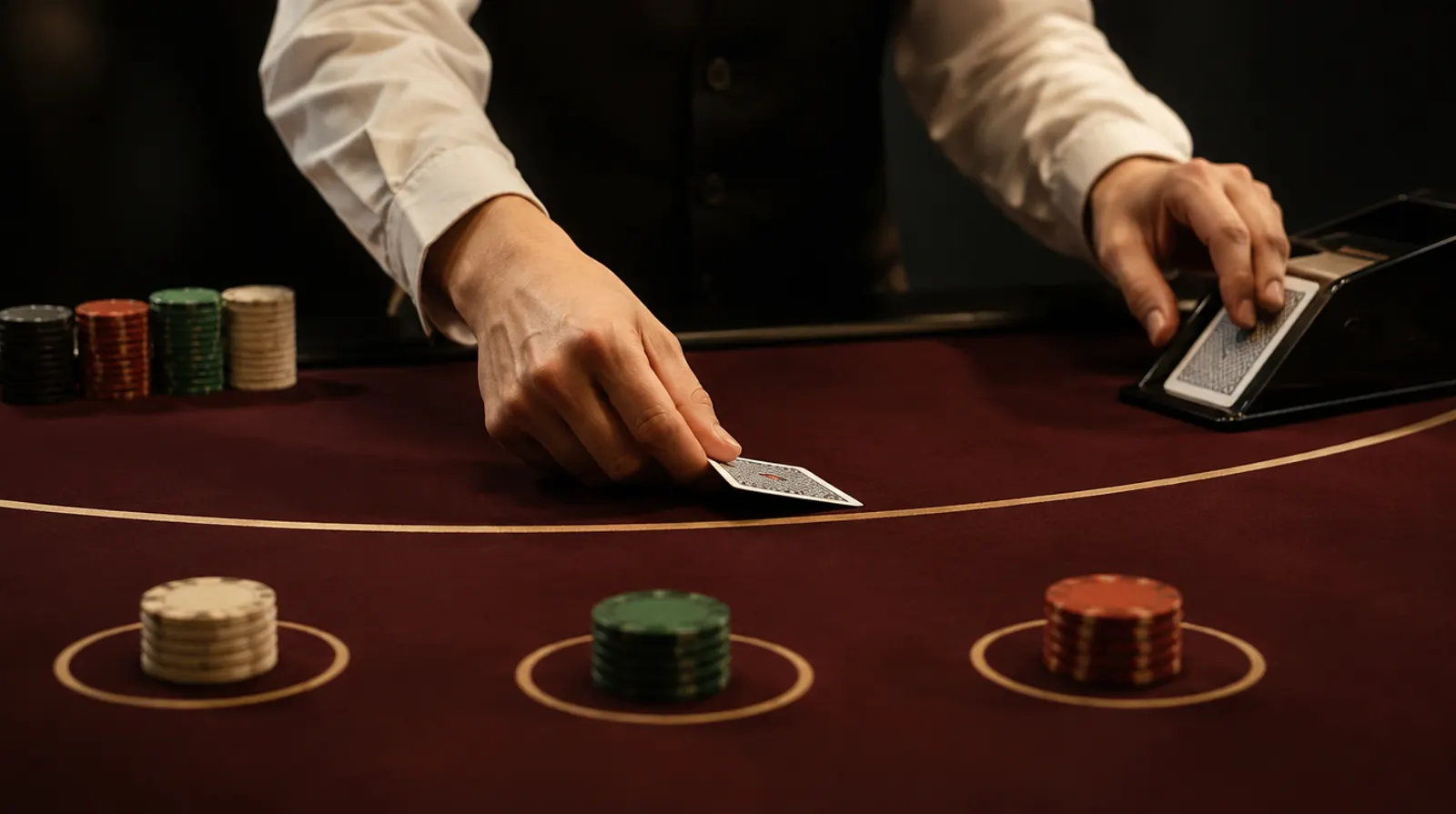
Blackjack dealers do have an advantage, but it is small and it comes from the rules of the game, not from the person dealing. The key reason is order of play: you act first, so if you bust you lose your bet even when the dealer busts afterwards. With basic strategy at a standard 8-deck live table where the dealer stands on soft 17, the house edge is roughly 0.5%, exactly the same as at a land-based table with identical rules.
Updated October 2026. We added the maths behind the dealer’s edge, the win, push and loss rates, dealer bust rates by up card and the effect of each rule, and corrected an old claim that “the house edge grows as you play”. It does not: the edge is fixed by the rules for every hand, and what grows with more hands is the total you are expected to lose.
What Are Live Casino Games?

A live casino game streams a real table to your screen. In live blackjack, a croupier deals physical cards from a shoe in a studio, several cameras film the table, and card recognition software reads each card and shows the totals on your screen. You bet and choose Hit, Stand, Double or Split through on-screen buttons within a short timer, and the game server settles your bet automatically.
Standard online blackjack works differently. It runs on a random number generator (RNG): software shuffles a virtual deck, usually after every hand, and the game moves as fast as you click. Live blackjack brings back the social side, with a real dealer you can chat to and other players at the same table. Our guide to how a live dealer casino works explains the studio side in more detail.
Where Does the Dealer’s Advantage Come From?
The dealer’s edge comes down to one rule that works against you and several that work in your favour. Seen side by side, it is easy to see why the house ends up only slightly ahead.
| Rule | Who it helps | Why |
|---|---|---|
| Players act first; a player who busts loses at once | Dealer | When you and the dealer would both bust, only you lose. This is the source of the house edge. |
| Blackjack pays 3:2 | Player | A natural wins $15 on a $10 bet; the dealer’s natural only takes your $10 |
| Doubling down | Player | You can raise your bet on strong totals such as 11; the dealer cannot |
| Splitting pairs | Player | Turns weak pairs such as 8,8 into two playable hands |
| Surrender (where offered) | Player | Lets you give up half your bet on the worst hands |
| Dealer follows fixed rules | Neither | The dealer must hit 16 or less and stand on 17, so their play is predictable and you can plan around it |
The order of play is what tips the balance. Your decisions come before the dealer reveals their full hand, so every time you take a card on a stiff total like 15 or 16 you risk busting, and that loss stands even if the dealer goes over 21 a moment later. Everything else at the table either favours you or is neutral.
That is also why a dealer has no personal edge to “expand”. The person dealing makes no decisions about their own hand. They hit or stand according to the house rule printed on the felt or in the help screen, so a friendly dealer and a strict one produce exactly the same game.
How Often Does the Dealer Win?
More often than you do, which surprises many players. The Wizard of Odds calculates that a player using basic strategy wins 42.43% of hands, pushes 8.48% and loses 49.09%, under six-deck rules where the dealer stands on soft 17, doubling after a split is allowed, late surrender is offered and Aces may be resplit. Under those rules the house edge is only 0.28%.
How can the dealer win about 6.7 percentage points more hands yet keep less than half a percent of the money? Because not all wins are equal. Your blackjacks pay 3:2 while the dealer’s only take your original stake, and your doubled and split hands put more money on the table in spots where you are the favourite. Those bigger wins make up most of the gap in hand count.
Dealer bust rates show where your chances are best. These figures from the Wizard of Odds apply to an 8-deck game where the dealer stands on soft 17, after the dealer has checked for blackjack:
| Dealer up card | Chance the dealer busts |
|---|---|
| 2 | 35.4% |
| 3 | 37.4% |
| 4 | 39.5% |
| 5 | 41.8% |
| 6 | 42.3% |
| 7 | 26.2% |
| 8 | 24.4% |
| 9 | 22.9% |
| 10 | 23.0% |
| Ace | 16.7% |
This table is the logic behind basic strategy. Against a 4, 5 or 6 the dealer busts more than 39% of the time, so you stand on a hard 13 to 16 and let the dealer take the risk. Against a 7 or higher the dealer busts far less often, so you hit those same totals. Our guide on when to hit in blackjack walks through each decision.
Live Blackjack is More Human: Is This a Good Thing?
Nothing in the maths changes when a human deals. The rules, the shoe and the payouts are what decide the house edge, and live tables publish them in the help screen before you sit down. The human touch adds atmosphere and transparency: you watch every card come out of the shoe, and the round history is shown on screen.
Could a dealer manipulate the game? At a regulated studio it would be very hard. Dealers work under supervision and continuous recording, and regulators enforce the rules: on 18 December 2024 the Pennsylvania Gaming Control Board fined Evolution US, LLC $25,000 after a server failure meant footage from 14 live tables at its Philadelphia studio was not saved for nearly two days. That case concerned lost video, not any manipulated result, and it shows how closely the recordings are policed. Our guide to whether live casinos are rigged covers the safeguards in detail.
Where the risk does sit is with the operator. Fairness of the game and safety of your money are separate questions. Real-money online casinos are regulated in the states where they are live; offshore sites that take US players have no US state licence, there is no state regulator to complain to, and your funds are not protected.
What Is the House Edge in Live Blackjack Games?
Like every casino game, blackjack is built so the casino keeps a share of the money wagered over time. That share is the house edge. With basic strategy, the house edge at a standard 8-deck live table where the dealer stands on soft 17 is roughly 0.5%, which makes blackjack the lowest-edge game in most live lobbies.
Live and RNG blackjack with identical rules carry an identical edge. What differs is speed, and speed decides how much you lose per hour:
| Format | Hands per hour (approx.) | Total wagered at $10 a hand | Expected loss at 0.5% |
|---|---|---|---|
| Live table, 7 seats | 60 | $600 | About $3 |
| RNG blackjack | 300 | $3,000 | About $15 |
A busy 7-seat live table deals roughly 50 to 70 hands an hour, against several hundred on RNG blackjack, so the same stake costs you less per hour at a live table. These figures are simple illustrations (bet multiplied by hands multiplied by edge) and ignore extra money from doubles and splits.
Can You Get Better Blackjack Odds in a Live Dealer Casino?
Yes, by choosing the right table and playing the right way. Rules on the felt matter far more than the setting. The Wizard of Odds measures each rule against a baseline of eight decks, dealer stands on soft 17, double on any first two cards, double after split allowed and splitting to four hands. A plus sign means the rule is worse for you:
| Rule change (vs the 8-deck baseline) | Effect on house edge |
|---|---|
| Blackjack pays 6:5 instead of 3:2 | +1.39% |
| Dealer hits soft 17 (H17) | +0.22% |
| No doubling after a split | +0.14% |
| European no hole card (lose doubles and splits to a dealer blackjack) | +0.11% |
| No resplitting | +0.10% |
| Six decks instead of eight | -0.02% |
| Late surrender | -0.07% |
Three habits keep the dealer’s advantage at its minimum:
- Play basic strategy. Guessing can push the edge to several percent; following the chart brings it down to about half a percent at a standard table.
- Skip insurance. Insurance pays 2:1, but in a fresh 8-deck shoe only about 31% of the remaining cards are ten-value once the dealer shows an Ace, giving the bet a house edge of about 7.5%. Our blackjack insurance guide shows the maths.
- Treat side bets as entertainment. On standard 8-deck Evolution tables, 21+3 has a house edge of 3.70% and Perfect Pairs 4.10%, several times the main game.
The way the dealer’s second card is handled also matters. In the American hole card game the dealer peeks for blackjack before you act; in European no hole card play, the second card comes later and doubled or split money can be lost to a dealer blackjack. Our guide to hole card vs no hole card blackjack explains how to check the rule at a live table.
There are Different Types of Live Blackjack
The variant you choose changes the house edge as well. These are the main live formats, with the return to player (RTP) at optimal play:
| Format | Key rules | RTP (optimal play) |
|---|---|---|
| Classic (Evolution standard) | 7 seats, 8 decks, dealer stands on all 17s, blackjack pays 3:2 | About 99.5% (house edge roughly 0.5%) |
| Infinite Blackjack | Unlimited players, shared first two cards, Six Card Charlie | 99.47% |
| Power Blackjack | 8 decks with 9s and 10s removed; double, triple or quadruple down | 98.8% |
| Free Bet Blackjack | Doubles on hard 9 to 11 and most splits cost nothing extra; dealer 22 pushes | 98.45% for Evolution’s version (CasinoScores); about 98.96% for the six-deck game (Wizard of Odds) |
This variant shows how a rule can hand the dealer a hidden advantage. The free doubles and splits look generous, but when the dealer busts with exactly 22, hands that would have won push instead. The Wizard of Odds puts the six-deck game at about 1.04%, roughly double a good classic table. Our Infinite Blackjack review covers the unlimited-seat format, and the live blackjack hub compares every table type.
Deck count matters less than most players think. Moving from eight decks to six lowers the edge by only about 0.02 percentage points, roughly seventy times less than the cost of a 6:5 payout.
Can You Turn the Advantage Around?
In theory, card counting can give a skilled player the edge, because cards come from a shoe rather than being reshuffled every hand. In practice it is hard to profit online. Eight-deck shoes dilute the count, the cut card is usually placed well before the end of the shoe, and you would need a large bet spread on a table where the casino can see every wager. At Infinite tables everyone shares the same first two cards, and casinos can limit accounts they see as advantage players. Our guide to shuffle tracking covers a related technique and its limits.
Betting systems do not change the dealer’s advantage either. Raising your stake after a loss changes how much you risk, not the 0.5% edge on each hand.
Conclusion
The dealer’s advantage in blackjack is real but small, and it belongs to the rules rather than the person dealing. You act first and lose when you bust, which is enough to give the house a fraction of a percent once 3:2 blackjacks, doubles and splits are counted. A live dealer adds atmosphere and transparency but cannot widen that edge, because the dealer has to follow the same fixed rules for their own hand at every table.
What you control is the table and your play: insist on 3:2, prefer a dealer who stands on soft 17, follow basic strategy and skip insurance. Set a budget before you sit down, too. If gambling stops being fun, call, text or chat with the National Problem Gambling Helpline on 1-800-MY-RESET (1-800-697-3738); our responsible gambling page lists more tools.
FAQ
Do blackjack dealers have an advantage?
Yes, but it is small and it comes from the rules, not the dealer. Because you act first, you lose whenever you bust, even if the dealer busts later. With basic strategy at a standard 8-deck live table where the dealer stands on soft 17, the house edge is roughly 0.5%.
Is the house edge higher in live blackjack than in a land-based casino?
No. It depends on the rules, not on whether the table is filmed. A live table with the same decks, payouts and dealer rules has the same house edge as a casino table. Live play is also slower, so you lose less per hour at the same stake.
How often does the dealer win in blackjack?
According to the Wizard of Odds, a basic strategy player wins 42.43% of hands, pushes 8.48% and loses 49.09% under six-deck rules where the dealer stands on soft 17. The house still has only a 0.28% edge under those rules because blackjacks pay 3:2 and doubles and splits win extra money.
How often does the dealer bust in blackjack?
Roughly three times in ten, a little under 30%, in an 8-deck game where the dealer stands on soft 17, once the dealer has checked for blackjack. The figure ranges from about 42% with a 6 showing to about 17% with an Ace showing, according to the Wizard of Odds.
Can a live dealer cheat or change the result?
It would be very hard at a regulated studio, though no system makes it impossible. The dealer follows fixed rules for their own hand, every card comes from a shoe on camera, and studios in the US states record every game under the state regulator’s rules. Regulators act when rules are broken, and choosing a licensed operator matters more than the dealer.
Which rules give the dealer a bigger advantage?
A 6:5 blackjack payout is the worst, adding about 1.39 percentage points to the house edge. A dealer who hits soft 17 adds about 0.22 points, no doubling after a split about 0.14 and no resplitting about 0.10, according to the Wizard of Odds.
Sources
- Wizard of Odds: blackjack win, push and loss probabilities (42.43% / 8.48% / 49.09%, 6 decks S17, 0.28% edge)
- Wizard of Odds: dealer odds in blackjack under US rules (8 decks, S17, bust by up card)
- Wizard of Odds: blackjack rule variations
- Wizard of Odds: Free Bet Blackjack
- Wizard of Odds: Perfect Pairs
- Evolution: live blackjack games (classic, Infinite, Power, Free Bet)
- Casinos.com: Infinite Blackjack (RTP 99.47%)
- CasinoScores: Free Bet Blackjack RTP
- Pennsylvania Gaming Control Board: live dealer studio operator fined $25,000 (18 December 2024)
- NCPG: National Problem Gambling Helpline 1-800-MY-RESET
Spotted an error? Email [email protected] with the page address. Verified corrections are made with a dated note.