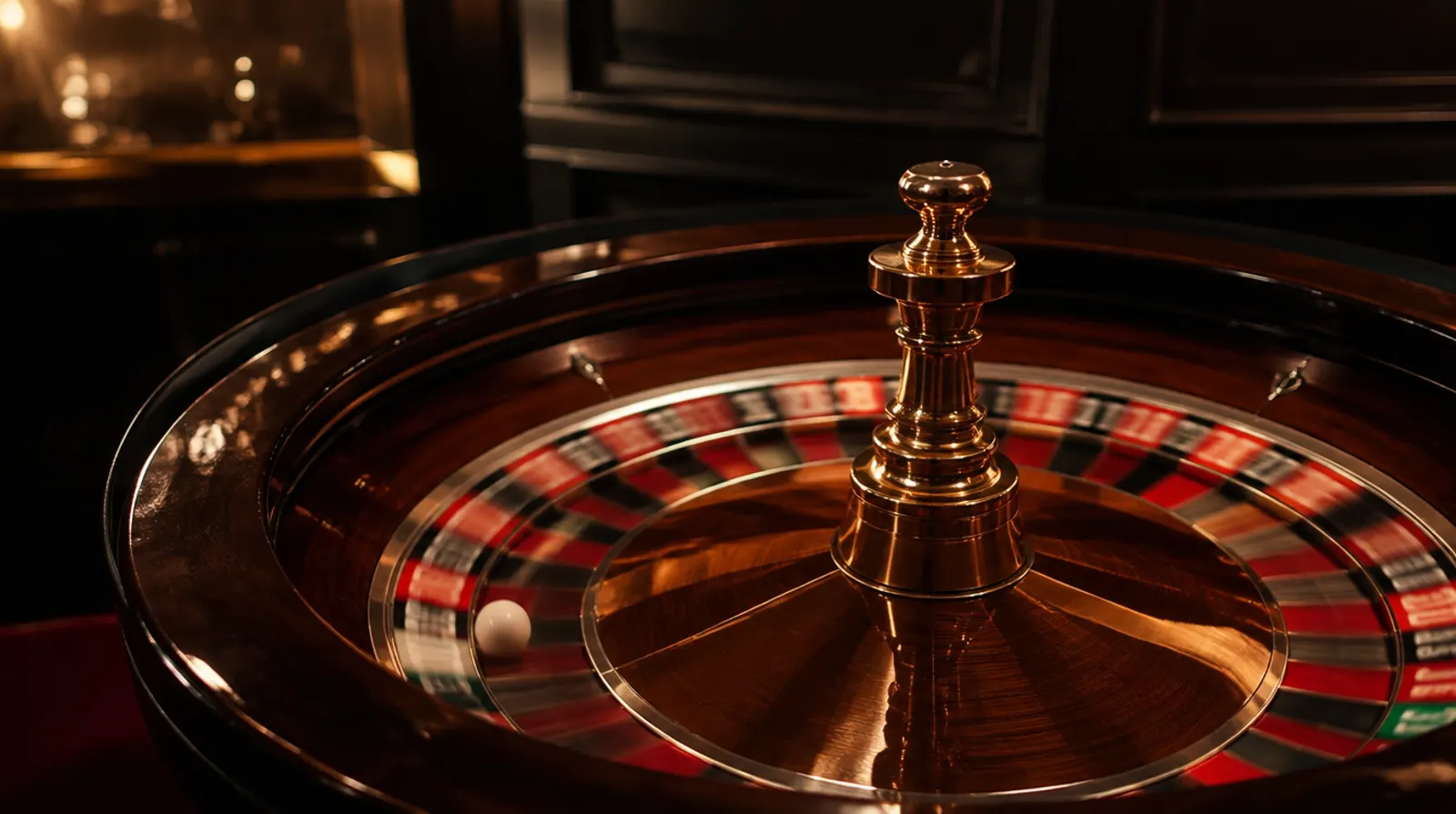
Yes and no. European roulette carries a 2.70% house edge on every bet, which is lower than American roulette (5.26%), most slots, keno and nearly every side bet in the casino. It is higher than blackjack played with basic strategy (about 0.5%), baccarat’s Banker and Player bets (1.06% and 1.24%) and the craps Pass and Don’t Pass lines (1.41% and 1.36%). So roulette sits in the middle of the table: a fair price on a single-zero wheel, a poor one on a double-zero wheel.
This guide sets out the exact maths behind those figures, compares roulette bet by bet and variant by variant with the other games in a live lobby, and turns percentages into dollars per hour so the comparison means something at the table. Every house edge below comes from the Wizard of Odds or the game studio, and matches the figures in our live roulette guide and our other game hubs.
Updated October 2026. We rewrote this page around worked maths, corrected the old baccarat Tie figure (14.36% at 8:1, not 9.5%) and the slot RTP range, and added every main roulette variant.
What the House Edge Means
The house edge is the share of each bet the casino keeps on average over the long run. A 2.70% edge means that for every $100 wagered, the expected loss is $2.70. It says nothing certain about one session: you can win ten spins in a row on a 2.70% game. What it describes is where results converge as the number of bets grows.
Return to player (RTP) is the same number seen from the other side. A 2.70% edge equals a 97.30% RTP, and the two always add up to 100%. Slots are usually quoted as RTP, table games as house edge, but they measure the same thing. Our RTP explainer covers that conversion in more detail.
One point matters a lot for comparisons. In roulette the whole stake is resolved on one spin, so the house edge is measured against exactly what you put down. Games where you can raise mid-hand (Caribbean Stud, Ultimate Texas Hold’em) quote the edge per ante, which overstates the cost against the total amount you actually wager. We flag that where it applies.
Where Roulette’s House Edge Comes From
Roulette payouts are set as if the zero did not exist. A straight-up bet pays 35:1, which would be a fair price on a wheel of 36 numbers. A European wheel has 37 pockets and an American wheel has 38, and that gap is the casino’s whole margin.
The formula works for any standard bet. Take the number of pockets the bet covers (n), the payout (P to 1) and the pockets on the wheel (N). Your average return per $1 is n x (P + 1) / N, and the house edge is 1 minus that figure.
- Straight up on a European wheel: 1 x 36 / 37 = 0.9730, an edge of 2.70% (exactly 1/37).
- Red on a European wheel: 18 x 2 / 37 = 0.9730, the same 2.70%.
- Dozen on an American wheel: 12 x 3 / 38 = 0.9474, an edge of 5.26% (exactly 1/19, or 2/38).
- Top Line (0, 00, 1, 2, 3) on an American wheel: 5 x 7 / 38 = 0.9211, an edge of 7.89%.
Every standard bet returns $36 for every $37 staked on average (European) or $36 for every $38 (American). That is why the house edge does not change from bet to bet on the same wheel, apart from the American Top Line and rules that alter the payout, such as La Partage or Lightning Roulette’s reduced straight-up payout.
Worked example: $10 on a single number
Put $10 on 17 for 37 spins on a European wheel and assume the average result: the number hits once. You win $350 on that spin and lose $10 on the other 36, a net loss of $10 over $370 staked. That is $0.27 per spin, or 2.70% of each $10 bet.
The same 38 spins on an American wheel produce one win of $350 and 37 losses of $10, a net loss of $20 on $380 staked. Each spin costs about $0.53, which is 5.26%. Nothing changed except one extra green pocket, and the cost nearly doubled.
Worked example: La Partage on red
French tables refund half of an even-money bet when the ball lands on zero (La Partage), or hold the bet for the next spin (En Prison). With $20 on red over 37 spins, you expect 18 wins (+$360), 18 losses (-$360) and one zero, which now costs $10 instead of $20. The net is -$10 on $740 staked, or 1/74 of each bet: 1.35%. Under En Prison, where a second zero loses the imprisoned bet, the Wizard of Odds’ maths gives 19/1,369, about 1.39%. Neither rule applies to inside bets, dozens or columns, which stay at 2.70%.
House Edge by Roulette Variant
The number of zeros decides most of the cost. Studio game-show versions shift it slightly by changing payouts to fund multipliers. The table below uses the same figures as our roulette hub.
| Variant | Pockets | House edge | RTP | Notes |
|---|---|---|---|---|
| French (La Partage or En Prison) | 37 | 1.35% on even-money bets | 98.65% | 2.70% on all other bets |
| European | 37 | 2.70% | 97.30% | Same edge on every bet |
| Lightning Roulette (Evolution) | 37 | 2.90% straight up, 2.70% other bets | 97.10% / 97.30% | Straight-up wins pay 29:1 unless the number carries a 50x to 500x multiplier |
| Double Ball Roulette (Evolution) | 37 | About 2.78% to 5.33% | About 94.67% to 97.22% | Outside bets need both balls to land in the group |
| American | 38 | 5.26% | 94.74% | 7.89% on the Top Line bet |
| Mini Roulette | 13 | 7.69% | 92.31% | Numbers 0 to 12, reduced payouts |
| Triple Zero | 39 | 7.69% | 92.31% | Exactly 1/13 on every bet |
Two of these deserve a closer look. Lightning Roulette’s 2.90% on straight-up bets is only marginally worse than a plain European wheel, and it buys the chance of a 500x hit; outside bets are untouched at 2.70%. See our Lightning Roulette guide for the multiplier rules.
Double Ball Roulette is the opposite case. Its straight-up bet costs about 2.78%, close to a normal wheel, but red, black and the other even-chance groups win only when both balls agree. Both balls land on red in 324 of 1,369 possible pairs, and the bet pays 3:1, so a $10 stake returns $12,960 for every $13,690 staked across those pairs: a 5.33% edge, almost exactly an American wheel. Our Double Ball Roulette review lists every bet.
Roulette vs Other Casino Games: The Comparison
Here is how roulette sits against the rest of the casino on the best main bet of each game, with standard rules. Figures are from the Wizard of Odds unless noted, and they match our live dealer games hub.
| Game and bet | House edge | Cheaper or dearer than European roulette? |
|---|---|---|
| Blackjack, 8 decks, 3:2, dealer stands soft 17, basic strategy | About 0.5% | Cheaper |
| Video poker, full-pay Jacks or Better, perfect play | 0.46% | Cheaper |
| Baccarat, Banker (5% commission) | 1.06% | Cheaper |
| Baccarat, Player | 1.24% | Cheaper |
| Craps, Don’t Pass / Pass Line | 1.36% / 1.41% | Cheaper |
| French roulette, even-money bets with La Partage | 1.35% | Cheaper |
| Casino Hold’em, Ante and Call | 2.16% per ante | Similar |
| Ultimate Texas Hold’em | 2.185% per ante | Similar (about 0.53% of total wagered) |
| European roulette, any bet | 2.70% | Baseline |
| Sic bo, Big or Small | 2.78% | Slightly dearer |
| Casino War, going to war on ties | 2.88% | Slightly dearer |
| Three Card Poker, Ante and Play | 3.37% per ante | Dearer |
| Let It Ride | 3.51% | Dearer |
| Dragon Tiger, Dragon or Tiger (8 decks) | 3.73% | Dearer |
| Crazy Time, number bets (Evolution) | About 3.9% to 4.3% | Dearer |
| Caribbean Stud Poker | 5.22% per ante | Dearer (about 2.56% of total wagered) |
| American roulette, any bet except Top Line | 5.26% | Dearer |
| Baccarat, Tie at 8:1 (8 decks) | 14.36% | Far dearer |
| Craps, Any Seven | 16.67% | Far dearer |
| Keno | Roughly 20% to 35% (Wizard of Odds lists 25% to 29% as typical) | Far dearer |
The pattern is clear. European roulette beats roughly half the casino and loses to the games where either your decisions matter (blackjack, video poker) or one bet is priced very close to fair (baccarat Banker and Player, the craps line bets). American roulette sits near the bottom of the table games, only ahead of side bets, propositions and keno.
Roulette vs blackjack
Blackjack is the only common live game where your choices move the edge. With basic strategy at a standard 8-deck live table where the dealer stands on soft 17, the edge is about 0.5%, more than five times cheaper than European roulette. The catch is that the figure needs correct play on every hand. Rules move it too: a 6:5 payout on a blackjack adds about 1.39 percentage points, which turns a 0.5% game into roughly 1.9%, and a dealer who hits soft 17 adds about 0.22. Insurance costs about 7.5% in an 8-deck game. A player who guesses rather than following a strategy chart can easily end up paying more than a roulette player. Our live blackjack guide has the full rules table.
Roulette vs baccarat
Baccarat has no decisions at all, just like roulette, yet its two main bets are far cheaper. Banker wins about 45.86% of hands on 8 decks and Player 44.62%, with ties (9.52%) pushing both bets. The 5% commission on Banker wins brings its edge to 1.06%, and Player costs 1.24%. The Tie bet is the trap: at 8:1 it costs 14.36%, more than five times a European wheel. No-commission tables that pay half on a Banker 6 raise Banker to 1.46%, still well below roulette. Details are in our live baccarat guide.
Roulette vs craps and sic bo
Craps mirrors roulette in having one cheap family of bets and plenty of expensive ones. The Pass Line (1.41%) and Don’t Pass (1.36%) beat European roulette clearly, while one-roll propositions such as Any Seven (16.67%) are among the worst bets in the building. Sic bo, the three-dice game, prices Big and Small at 2.78%, a whisker above a European wheel, and most of its other bets run from about 7% to over 30%. Our live sic bo guide lists every sic bo bet with its edge.
Roulette vs slots
Slots are the comparison most players actually face. The old version of this page said online slots average 95% to 98% RTP; that range is too generous. Most online slots return roughly 94% to 97%, a house edge of about 3% to 6%, and many studios release the same title at several RTP settings so the casino can choose. Land-based machines keep more: the Nevada Gaming Control Board reported a statewide slot win of 7.15% for the 12 months to May 2025, which means slots paid back about 92.85% on average. Legal floors are lower still, for example 83% in New Jersey (N.J.A.C. 13:69E-1.28A).
So European roulette at 2.70% is usually cheaper than a slot, and it is fixed: you know the price before you bet. A slot showing 97% RTP or better can match or beat it, and almost any slot beats a triple-zero wheel. Pace matters even more here, as the next section shows.
Turning the House Edge Into Dollars
A percentage only becomes a cost once you multiply it by how much you bet. The formula is simple: stake per round x rounds per hour x house edge = expected cost per hour. At the same $10 stake and an illustrative 50 rounds an hour, the gaps between games are large.
| Game and bet | House edge | Expected cost per $1,000 wagered | Per hour at $10 x 50 rounds |
|---|---|---|---|
| Blackjack, basic strategy | About 0.5% | About $5 | About $2.50 |
| Baccarat, Banker | 1.06% | $10.60 | $5.30 |
| French roulette, even money | 1.35% | $13.50 | $6.75 |
| Craps, Pass Line | 1.41% | $14.10 | $7.05 |
| European roulette | 2.70% | $27.00 | $13.50 |
| Sic bo, Big or Small | 2.78% | $27.80 | $13.90 |
| Dragon Tiger | 3.73% | $37.30 | $18.65 |
| American roulette | 5.26% | $52.60 | $26.30 |
| Baccarat, Tie at 8:1 | 14.36% | $143.60 | $71.80 |
Speed changes the picture. A croupier-run roulette table manages roughly 40 to 60 spins an hour, and Evolution’s Auto Roulette runs 60 to 80 games an hour. At 80 spins and $10 a spin, a European auto wheel costs about $21.60 an hour, more than a dealer-run American table at 40 spins ($21.04). A slot spun 600 times an hour at $1 a spin wagers $600; at a 96% RTP the expected cost is about $24 an hour, close to American roulette, even though the stake per spin is ten times smaller. Comparing edges is the first step; comparing money wagered per hour is the second.
Does the Bet You Choose Change the Edge?
On a standard wheel, no. Red, a dozen, a corner and a single number all cost 2.70% on a European wheel. What changes is variance: how often you win and how large the swings are.
We worked the binomial odds for a $10 bet repeated on a European wheel. On red, you finish strictly ahead after 10 spins about 34.4% of the time and exactly level another 24.5%. After 100 spins you are ahead about 35.5% of the time, and after 1,000 spins only about 18.8%. A straight-up player has a very different ride: after 37 spins they are ahead only if the number hits at least twice (about 26.4% of the time), yet after 100 spins about 50.9% are ahead, because three hits (worth $1,080) more than cover 100 bets.
The standard deviation tells the same story. One even-money spin has a standard deviation of almost exactly one stake; a straight-up spin has about 5.84 stakes. Over 1,000 spins at $10, the expected loss on either is about $270, but the spread around that figure is roughly $316 on red and about $1,850 on single numbers. Same price, very different swings.
On an American wheel the house edge pulls harder. After 1,000 even-money spins only about 4.5% of players are ahead, against 18.8% on a European wheel. That is the clearest way to see what the second zero costs.
Bet combinations follow the same rule. Covering red plus the second dozen, the James Bond layout or all 37 numbers changes how often you win, never the 2.70%. Our roulette bet combinations guide works through the popular layouts one by one.
Can a Betting System Lower Roulette’s House Edge?
No staking system changes the house edge, because each spin is independent and each bet carries the same expected loss. Systems only reshape results into many small wins and occasional large losses, or the reverse.
The Martingale shows why. You bet $10 on red and double after each loss. A losing even-money bet on a European wheel happens 19 times in 37 (51.35%), so seven losses in a row occur about 0.94% of the time, roughly once in 106 sequences. Seven straight losses cost $10 + $20 + $40 + $80 + $160 + $320 + $640 = $1,270, and the next bet ($1,280) is above the maximum at many tables. The small $10 wins on the other sequences roughly pay for that disaster and no more: over the long run the total still converges on 2.70% of everything wagered. The same holds for the Fibonacci, the reverse Martingale and any “hot number” approach. Our list of common roulette mistakes covers the other traps.
How to Get the Lowest House Edge in Roulette
- Pick a single-zero wheel. European tables cost 2.70% against 5.26% on American ones. The lobby name and the layout (one green pocket or two) tell you which you have.
- Use French rules for even-money bets. La Partage or En Prison cuts red, black, odd, even, high and low to about 1.35%. Confirm the rule in the table’s help screen.
- Skip the American Top Line. At 7.89% it is the worst standard bet on any common wheel.
- Avoid Mini Roulette and triple-zero wheels. Both cost 7.69%.
- Watch the pace. Speed tables and auto wheels deal more spins per hour, so the same edge costs more per session.
- Read the game-show paytable. Lightning-style games are fine for outside bets (2.70%); Double Ball even-chance bets cost about 5.33%.
- Do not count on a bonus. Roulette rarely helps clear wagering at the offshore sites that take US players: Bovada and Ignition count software roulette at 5% and live dealer games at 0%, MyBookie counts roulette at 0%, and BetOnline excludes roulette from casino bonuses.
So Is Roulette a Good Game to Play?
On a single-zero wheel, roulette is a fairly priced game of pure chance. You pay 2.70% for simple rules, no decisions and a result every spin, which is cheaper than slots, keno and most side bets, and about the same as sic bo’s best bets. If your aim is the lowest possible cost per dollar wagered, blackjack with basic strategy, baccarat Banker or Player and the craps line bets all charge less. If you enjoy roulette, the choice that matters is the wheel: an American table makes the same session cost almost twice as much.
Where you can play matters too. Eight states have legalised online casinos; seven markets are live (New Jersey, Pennsylvania, Michigan, West Virginia, Connecticut, Delaware and Rhode Island), and Maine legalised a tribal-only market (LD 1164: became law without the governor’s signature in January 2026, effective 29 Jul 2026) that has not launched as of October 2026. In those seven states, state-licensed casinos carry live roulette, including Evolution tables streamed from US studios. Elsewhere, the sites that accept US players are offshore and hold no US state licence, so there is no state regulator to complain to. The live roulette guide linked at the top of this page covers the tables and where to find them.
Roulette House Edge FAQ
Is the house edge in roulette lower than in other casino games?
It depends on the wheel and the game you compare it with. European roulette at 2.70% is cheaper than American roulette (5.26%), most slots, keno and almost every side bet, but more expensive than blackjack with basic strategy (about 0.5%), baccarat Banker or Player (1.06% and 1.24%) and the craps Pass or Don’t Pass line (1.41% and 1.36%).
What is the house edge on American roulette compared with European roulette?
American roulette has 38 pockets (0 and 00) and a 5.26% house edge on every bet except the five-number Top Line, which costs 7.89%. European roulette has 37 pockets and a 2.70% edge on every bet, so the same stake costs almost twice as much on an American wheel.
Which roulette bet has the lowest house edge?
An even-money bet (red, black, odd, even, 1-18 or 19-36) on a French table with La Partage or En Prison, at about 1.35%. On a plain European wheel every bet costs the same 2.70%, and on an American wheel every bet costs 5.26% except the Top Line at 7.89%.
Which casino game has the lowest house edge?
Among standard table games, blackjack with basic strategy has the lowest, at about 0.5% at a good 8-deck live table (the Wizard of Odds puts liberal Vegas rules at 0.28%). Full-pay Jacks or Better video poker is about 0.46% with perfect play. Baccarat Banker (1.06%) and the craps Don’t Pass line (1.36%) follow.
Can you beat the house edge in roulette?
Not with betting choices. Every standard bet on a given wheel has the same expected loss, and no staking system such as the Martingale changes it. You can only lower the price by choosing a single-zero wheel, preferably a French table with La Partage for even-money bets.
Does roulette have better odds than slots?
Usually, yes. Most online slots return about 94% to 97%, a house edge of roughly 3% to 6%, and Nevada’s slot floors kept 7.15% of money played in the 12 months to May 2025. European roulette keeps 2.70%, although a high-RTP slot can beat an American wheel at 5.26%.
How much does roulette cost per hour?
Multiply stake by spins per hour by the house edge. At $10 a spin and 50 spins an hour, European roulette costs about $13.50 an hour on average, American roulette about $26.30 and French even-money bets about $6.75. Faster auto wheels cost more per hour at the same stake.
If gambling stops being fun, call the National Problem Gambling Helpline at 1-800-MY-RESET (1-800-697-3738).
Sources
- Wizard of Odds: Roulette basics (single, double, triple zero, La Partage)
- Wizard of Odds: House edge of casino games compared
- Wizard of Odds: Blackjack rule variations
- Wizard of Odds: Baccarat basics
- Wizard of Odds: Craps basics
- Wizard of Odds: Sic bo
- Wizard of Odds: Dragon Tiger
- Wizard of Odds: Double Ball Roulette
- Evolution: Lightning Roulette game page
- Nevada Gaming Control Board: Gaming Revenue Report, May 2025
- N.J.A.C. 13:69E (13:69E-1.28A slot RTP minimum)
- Bovada: Bonus terms and conditions
- Ignition: Bonus terms and conditions
- MyBookie: Rollover contribution table
- BetOnline: Casino rules
- Gambling Insider: Maine tribal online casinos (LD 1164)
- NCPG: National Problem Gambling Helpline 1-800-MY-RESET
Spotted an error? Email [email protected] with the page address. Verified corrections are made with a dated note.