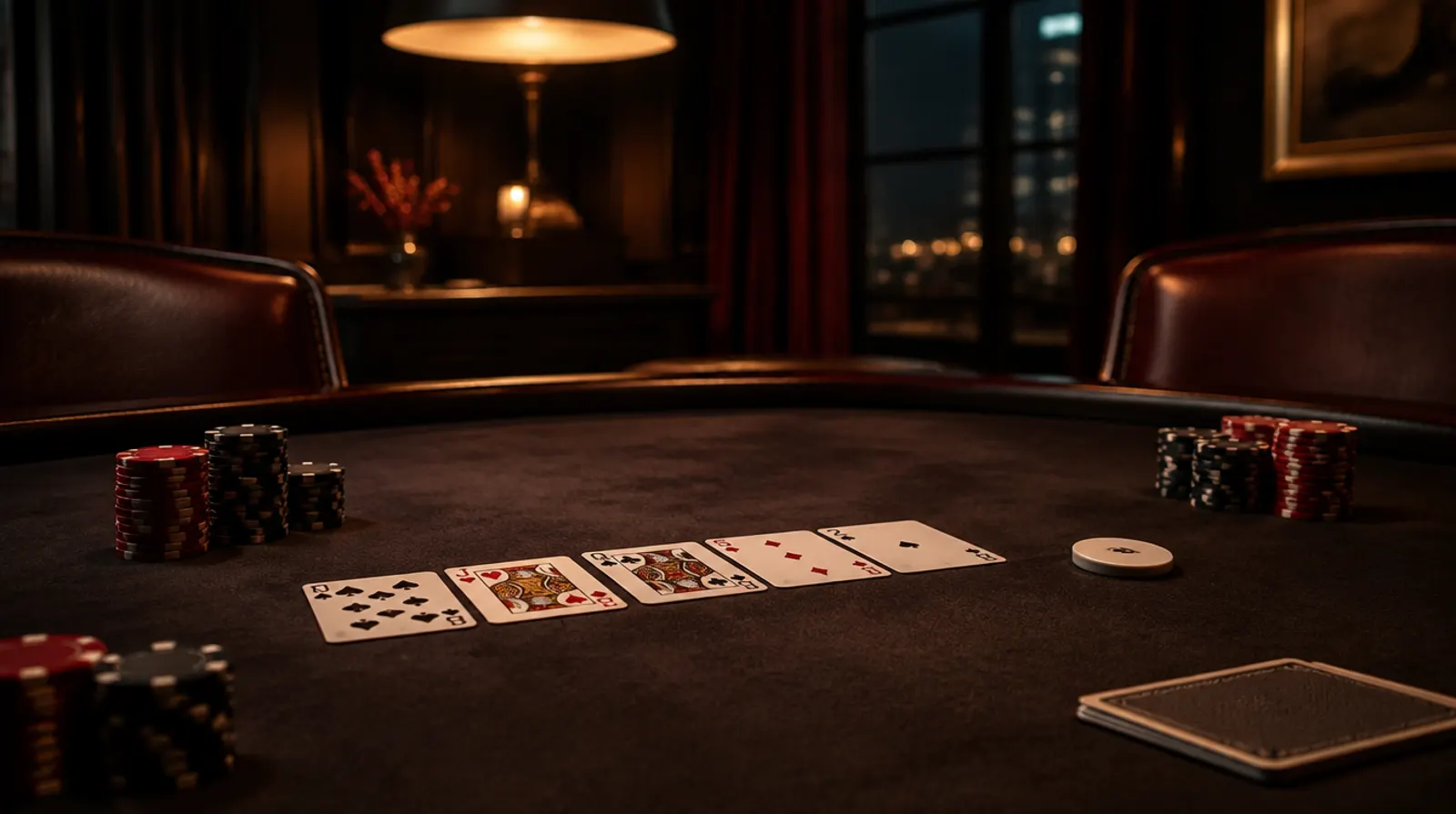
Teen Patti (“three cards” in Hindi) is India’s three-card betting game, close to the British game 3 Card Brag. Each player gets three cards, bets either blind or after looking (“seen”), and the last player left, or the better hand in a two-player show, wins the pot. Hands rank from Trail (three of a kind) at the top, through Pure Sequence, Sequence, Colour and Pair, down to High Card.
This guide covers the traditional game played between players: the deal, the blind and seen betting rules with worked examples, the show and the side show, hand rankings with their odds, and how the house-banked live casino version differs. For wild-card and other versions such as Muflis, AK47 and Joker, see our Teen Patti variations guide.
Teen Patti at a Glance
| Item | Traditional rule |
|---|---|
| Players | Any reasonable number; best with about 4 to 7 |
| Deck | Standard 52 cards, no jokers; Ace high (also low in A-2-3) |
| Ante (“boot”) | Everyone puts one agreed unit into the pot before the deal |
| Deal | Three cards each, face down, one at a time |
| Blind player bets | 1x to 2x the current stake |
| Seen (chaal) player bets | 2x to 4x the current stake |
| Show | Only when two players remain |
| Side show (compromise) | A seen player can ask the previous player to compare hands privately |
Teen Patti Hand Rankings (Sequences)
A hand of a higher type always beats any hand of a lower type, so the lowest Sequence, 4-3-2, beats the best Colour, A-K-J. From highest to lowest:
- Trail, Set or Trio: three cards of the same rank. A-A-A is the best and 2-2-2 the lowest.
- Pure Sequence (straight flush): three consecutive cards of one suit. In the traditional ranking A-2-3 is the highest, then A-K-Q, K-Q-J and down to 4-3-2. K-A-2 is not a sequence.
- Sequence or Run (straight): consecutive cards in mixed suits; A-2-3 again ranks top.
- Colour (flush): three cards of one suit, not in sequence. Ties go to the higher top card, then the second, then the third: A-K-J is best, 5-3-2 is lowest.
- Pair: two cards of the same rank. The pair decides first, then the odd card: A-A-K is best, 2-2-3 is lowest.
- High Card: anything else, ranked card by card. A-K-J of mixed suits is best, 5-3-2 is lowest.
Many apps and some home games rank A-K-Q above A-2-3 in both sequences. Agree which rule you are using before the first deal. Suits never break ties in the traditional game.
How likely is each hand?
From a 52-card deck there are 22,100 possible three-card hands. The counts below are the same as in Three Card Poker, because only the ranking order differs:
| Hand | Combinations | Probability | About 1 in |
|---|---|---|---|
| Trail | 52 | 0.24% | 425 |
| Pure Sequence | 48 | 0.22% | 460 |
| Sequence | 720 | 3.26% | 31 |
| Colour | 1,096 | 4.96% | 20 |
| Pair | 3,744 | 16.94% | 6 |
| High Card | 16,440 | 74.39% | 1.3 |
Notice that a Pure Sequence (48 ways) is actually slightly rarer than a Trail (52 ways), yet the Trail ranks higher. That is tradition, not maths. A Sequence beats a Colour for the right reason: with three cards it is the harder hand to make. About three hands in four are only High Card, so a pair is a better-than-average hand.
How a Round Starts
- Agree the unit. Players agree the boot (the minimum stake), and everyone puts it in the pot.
- Deal. The dealer deals three cards to each player, face down, one card at a time.
- Choose blind or seen. Each player decides whether to look at their cards. You can play blind for as long as you like and look at any later turn, but once you look you are a seen player for the rest of the hand.
- Betting. The player to the dealer’s left acts first, and play continues clockwise for as many circuits as needed. At your turn you either add a bet to stay in, or fold and lose what you have already put in.
Betting Rules: Blind and Seen (Chaal)
Teen Patti betting runs on a “current stake”, which starts at one unit, the boot. How much you must put in depends on whether you have looked at your cards:
- Blind player: bet at least the current stake and at most twice it. The amount you put in becomes the new current stake.
- Seen player: bet at least twice the current stake and at most four times it. Half of what you put in becomes the new current stake.
Seen players pay double because they have more information. That is the whole point of playing blind: it costs half as much to stay in, which puts pressure on players who have looked.
Worked betting example
Four players, A, B, C and D, each put in a 1-unit boot, and D deals. Playing blind, A adds 1 unit. B looks, dislikes the hand and folds. Still blind, C adds 1. After looking, D adds the seen minimum of 2, which leaves the current stake at 1. Next, A puts in 2 without looking, lifting the current stake to 2. Now C looks and folds. Against a stake of 2, D must put in at least 4. Finally A looks, puts in 4 and asks for a show; both hands are turned up and the better one takes the pot.
Unlike poker, there is no “calling to equalise” the bets. Each turn is a fresh bet sized from the current stake, and a showdown between more than two players never happens.
The Show
Two players left and neither willing to fold: that is when a show settles the hand. Under the traditional rules:
- Only when all but two players have folded is a show possible.
- Blind players can call for a show by paying the current stake, whether the opponent is blind or seen, and do not look before paying.
- Seen players cannot demand a show from a blind opponent; they can only keep betting or fold.
- When both players are seen, either one can pay twice the current stake for a show.
- The higher hand wins the pot. If the hands are exactly equal, the player who did not pay for the show wins.
Some groups play that a show costs double the normal minimum bet, so check the house rule before you start.
Side Show (Compromise)
A side show lets a seen player knock out one opponent mid-hand. At your turn, after placing the seen minimum (twice the current stake), you can ask the player who bet immediately before you for a side show. In the traditional rules described by pagat.com, this is allowed when the players are all seen; many apps only require that you and the previous player are both seen.
- The other player can accept or refuse.
- If accepted, the two of you compare cards privately and the lower hand must fold. On equal hands, the player who asked must fold.
- If refused, betting simply continues with the next player.
A side show is cheaper than staying in and lets a strong seen hand thin the field. The risk is that the player you challenge may hold the better cards.
Common House Rules
- Raise limits: certain groups let blind players bet more than 2x and seen players more than 4x the current stake.
- Blind limit: a group may cap blind play at a number of turns, after which you must look.
- Pot limit: apps and home games sometimes cap the pot, and when the cap is reached the remaining hands are compared.
- Wild cards and twists: jokers, Muflis (lowest hand wins), AK47 and similar formats are variations, covered on our variations page.
Live Casino Teen Patti: How It Differs
Live dealer studios run a house-banked game that is much closer to Three Card Poker than to the home game. There is no blind or seen betting, and you play against the dealer, not other players. The Wizard of Odds analyses the Super Spade Games version:
- You place an Ante, receive three cards, then fold or add a Play bet equal to the Ante.
- The dealer needs Queen high to qualify; if not, the Ante pays 1:1 and the Play bet pushes.
- Ranking follows Teen Patti, so three of a kind beats a straight flush.
- An Ante Bonus pays 5:1 for three Aces, 4:1 for other trails, 3:1 for a pure sequence and 1:1 for a sequence.
- Optional Pair Plus (50:1 three Aces, 40:1 other trails, 30:1 pure sequence, 6:1 sequence, 3:1 colour, 1:1 pair) and a 6 Card Bonus.
| Bet (Super Spade Games version) | House edge |
|---|---|
| Ante and Play, Q-6-4 strategy | 3.79% per Ante (element of risk 2.26%) |
| Pair Plus | 6.91% |
| 6 Card Bonus | 15.28% |
The strategy is the same as Three Card Poker: play Queen-6-4 or better and fold the rest. Ezugi also runs a live Teen Patti table, and the Wizard of Odds notes that its “3+3” side bet is the 6 Card Bonus under another name. Our live Teen Patti guide covers the tables and studios.
Is Teen Patti Legal?
In India, the Promotion and Regulation of Online Gaming Act, 2025 (Act No. 32 of 2025, dated 22 August 2025) prohibits offering online money games, which covers real-money online Teen Patti, whatever the skill-versus-chance argument. Its penalties target operators, advertisers and payment providers. A constitutional challenge is pending in the Supreme Court, which listed the batch for final hearing on 6 and 7 October 2026. Offline cash games fall under state gambling laws, which differ between states. Earlier versions of this page called the game “a game of skill” and legal everywhere in India; that is not a safe description today.
In the United States, the home game for small stakes among friends is governed by state law. We did not find Teen Patti in Bovada’s live lobby when we checked in October 2026, and US state-licensed casinos focus on blackjack, roulette, baccarat and poker games. Free social Teen Patti apps remain the easiest way to learn. Teen Patti sits alongside Andar Bahar in our live casino games guide.
Teen Patti Rules FAQ
What is the highest hand in Teen Patti?
Three Aces (A-A-A), the best Trail. Below the Trails come Pure Sequences, where traditional rules rank A-2-3 highest.
What is the difference between blind and seen (chaal)?
Blind means you have not looked at your cards, and you bet 1x to 2x the current stake. Once you look you are seen and must bet 2x to 4x the current stake.
When can you ask for a show in Teen Patti?
Only when two players remain; a blind player can pay the current stake for a show at any time; a seen player cannot demand a show from a blind opponent.
What is a side show in Teen Patti?
A seen player, after betting, asks the previous player to compare hands privately. If they accept, the lower hand folds; on a tie the player who asked folds.
Is Teen Patti the same as poker?
No. It uses three cards, ranks a Trail above a Pure Sequence, and bets are sized from a current stake that differs for blind and seen players. The house-banked casino version is very close to Three Card Poker.
Does Teen Patti use a joker?
Not in the standard game, which uses 52 cards with no wild cards. Jokers and wild cards appear only in variations.
What are the most winning hands in Teen Patti?
From the top: Trail (three of a kind, with A-A-A the best), Pure Sequence (a straight flush), Sequence (a straight), Colour (a flush), Pair and High Card. Strong hands are rare: a Trail comes up in only 0.24% of deals and a Pure Sequence in 0.22%, while about three hands in four are only High Card, so a Pair is already better than average.
Gambling should be entertainment. If it stops being fun, call or text the National Problem Gambling Helpline at 1-800-MY-RESET (1-800-697-3738).
Sources
- Pagat.com (John McLeod): Teen Patti rules, betting, show and compromise
- Wizard of Odds: Teen Patti (house-banked rules, 3.79% house edge, Pairplus 6.91%, 6 Card Bonus)
- Wizard of Odds: Three Card Poker (hand combinations; Ezugi Teen Patti 3+3 side bet)
- India Code: Promotion and Regulation of Online Gaming Act, 2025 (Act No. 32 of 2025)
- Supreme Court of India: order of 5 Aug 2026 listing the Online Gaming Act challenges for 6-7 Oct 2026
- NCPG: National Problem Gambling Helpline (1-800-MY-RESET)
Spotted an error? Email [email protected] with the page address. Verified corrections are made with a dated note.