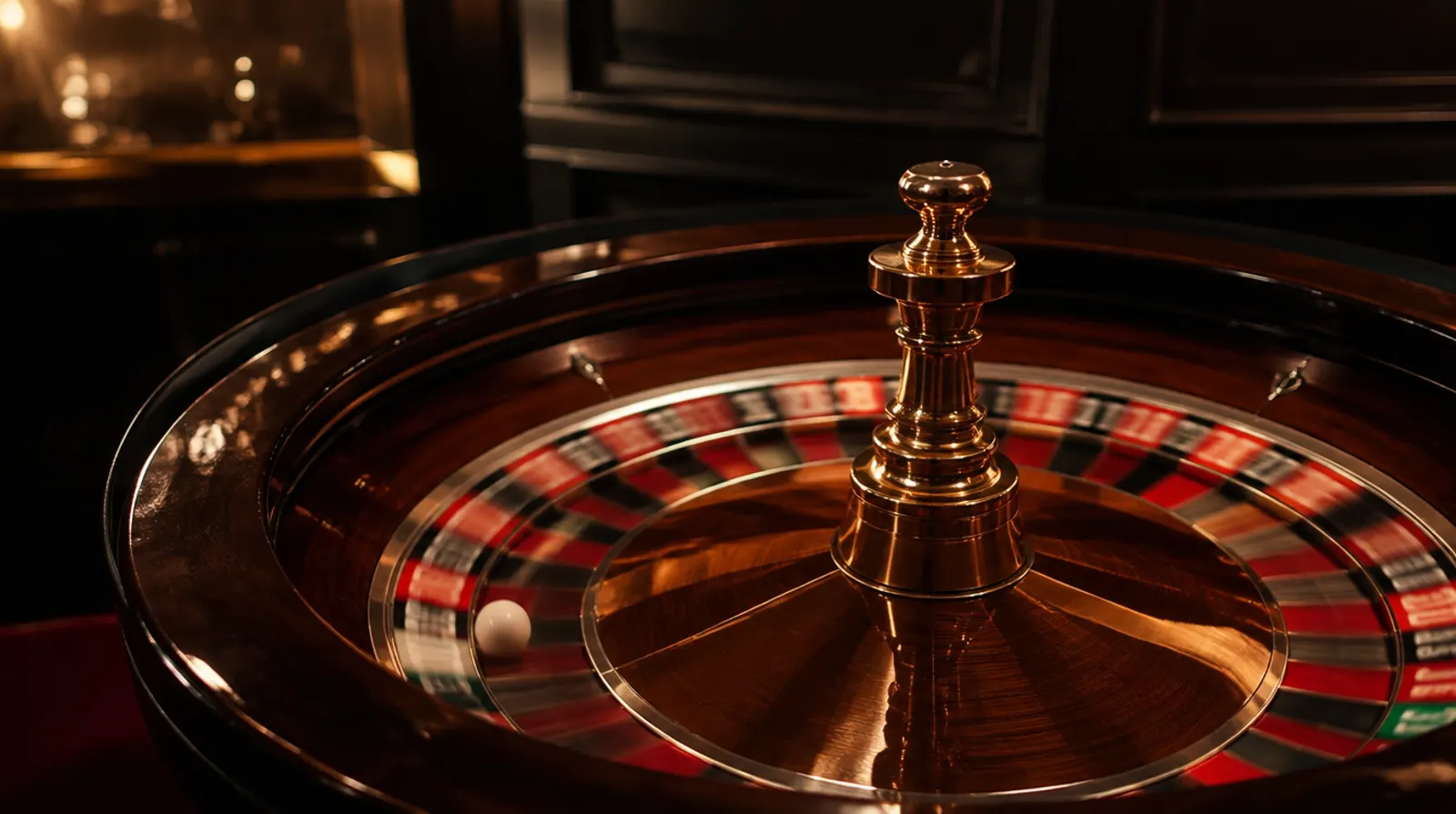
A European roulette wheel has 37 numbers: 1 to 36 plus a single green 0. An American wheel has 38, adding a 00. The numbers 1 to 36 are split evenly into 18 red and 18 black, and they are arranged around the wheel in a fixed, non-sequential order designed to mix high and low, odd and even, and red and black. Every number has the same chance on every spin: 1 in 37 on a European wheel and 1 in 38 on an American one.
This guide shows the full number order on both wheels, explains how the betting layout groups the numbers, covers the racetrack sections such as Voisins du Zéro, and answers the question players ask most: which roulette number hits most often. For bets, variants and house edges in one place, see our live roulette guide.
Updated October 2026. Wheel sequences and section bets checked against standard references; house edges match our roulette hub.
How many numbers are on a roulette wheel?
| Wheel | Numbers | Green pockets | Chance of one number | House edge |
|---|---|---|---|---|
| European (single zero) | 37 | 0 | 1 in 37 (2.70%) | 2.70% |
| French (single zero, La Partage) | 37 | 0 | 1 in 37 (2.70%) | 1.35% on even-money bets, 2.70% on the rest |
| American (double zero) | 38 | 0 and 00 | 1 in 38 (2.63%) | 5.26% (7.89% on the Top Line bet) |
| Triple zero | 39 | 0, 00 and 000 | 1 in 39 (2.56%) | 7.69% |
The payouts stay the same on every wheel: a straight-up number pays 35:1. Each extra zero adds a pocket without adding to the payout, which is exactly where the higher house edge comes from. If you have the choice, a single-zero wheel is always the better game.
Its origin is well documented. In 1843, at the spa casino in Bad Homburg, François and Louis Blanc introduced the single 0 wheel to compete with casinos that used both a 0 and a 00. Later the family moved to Monte Carlo, where the single-zero wheel became the European standard.
The order of numbers on a European wheel
Reading clockwise from zero, a standard single-zero wheel runs:
0, 32, 15, 19, 4, 21, 2, 25, 17, 34, 6, 27, 13, 36, 11, 30, 8, 23, 10, 5, 24, 16, 33, 1, 20, 14, 31, 9, 22, 18, 29, 7, 28, 12, 35, 3, 26
Colours alternate red and black all the way round, with 0 in green. The order also spreads odd and even numbers: you never see three odd or three even numbers in a row on the wheel. High (19 to 36) and low (1 to 18) numbers are mixed too, although not in a strict alternation.
Why such a jumbled order? It keeps any single area of the wheel from being heavy in one kind of bet. A wheel with 1 to 36 in sequence would put all the low numbers on one side, and any physical bias would hit even-money bets far harder.
The order of numbers on an American wheel
Clockwise from 0, a standard double-zero wheel runs:
0, 28, 9, 26, 30, 11, 7, 20, 32, 17, 5, 22, 34, 15, 3, 24, 36, 13, 1, 00, 27, 10, 25, 29, 12, 8, 19, 31, 18, 6, 21, 33, 16, 4, 23, 35, 14, 2
Directly opposite the 0 sits the 00. The American layout pairs numbers differently from the European wheel, so racetrack bets such as Voisins du Zéro are built for single-zero tables and are usually not offered on double-zero games.
Red and black numbers
| Colour | Numbers |
|---|---|
| Red (18) | 1, 3, 5, 7, 9, 12, 14, 16, 18, 19, 21, 23, 25, 27, 30, 32, 34, 36 |
| Black (18) | 2, 4, 6, 8, 10, 11, 13, 15, 17, 20, 22, 24, 26, 28, 29, 31, 33, 35 |
| Green | 0 (and 00 on American wheels) |
A quick memory trick: from 1 to 10 and from 19 to 28, odd numbers are red and even numbers are black. From 11 to 18 and from 29 to 36 it flips, so odd numbers are black and even numbers are red.
A piece of trivia often repeated at the table: the numbers 1 to 36 add up to 666.
How the betting layout groups the numbers
The betting table arranges 1 to 36 in a grid of three columns and twelve rows, with the zero (or zeros) at the head. Every outside bet is simply a way of covering a group of those numbers.
| Bet | Numbers covered | Payout | Win chance (single zero) |
|---|---|---|---|
| Straight up | 1 | 35:1 | 2.70% |
| Split | 2 | 17:1 | 5.41% |
| Street | 3 | 11:1 | 8.11% |
| Corner | 4 | 8:1 | 10.81% |
| Six line | 6 | 5:1 | 16.22% |
| Dozen (1-12, 13-24, 25-36) | 12 | 2:1 | 32.43% |
| Column | 12 | 2:1 | 32.43% |
| Red/Black, Odd/Even, 1-18/19-36 | 18 | 1:1 | 48.65% |
The three columns are: first column 1, 4, 7 and so on up to 34; second column 2, 5, 8 up to 35; third column 3, 6, 9 up to 36. Zero belongs to none of the outside groups, which is why every outside bet loses when the ball lands on green (unless French La Partage or En Prison rules apply).
A few casinos also take a “snake” bet: the 12 red numbers 1, 5, 9, 12, 14, 16, 19, 23, 27, 30, 32 and 34, which zig-zag across the layout and pay 2:1 like a dozen. It is not available everywhere, so check the table before you look for it.
Wheel sections: the racetrack bets
Most live single-zero tables add a “racetrack” panel that mirrors the wheel order. It lets you bet on sections of the wheel rather than areas of the grid. These are called announced or French bets:
| Section | Numbers | How many | Chips |
|---|---|---|---|
| Voisins du Zéro (neighbours of zero) | 22, 18, 29, 7, 28, 12, 35, 3, 26, 0, 32, 15, 19, 4, 21, 2, 25 | 17 | 9 |
| Jeu Zéro (zero game) | 12, 35, 3, 26, 0, 32, 15 | 7 | 4 |
| Tiers du Cylindre (thirds) | 27, 13, 36, 11, 30, 8, 23, 10, 5, 24, 16, 33 | 12 | 6 |
| Orphelins (orphans) | 1, 20, 14, 31, 9 and 17, 34, 6 | 8 | 5 |
Voisins, Tiers and Orphelins together cover all 37 pockets. The chip counts are standard but can vary slightly between studios, so check the racetrack before you confirm. A Neighbours bet is separate: one number plus the two on each side of it, for five chips.
Section bets do not change the odds. Each chip inside them is an ordinary split, street, corner or straight-up bet with the same 2.70% edge. They only make it quicker to cover an arc of the wheel. Our guide to roulette bet combinations works through popular groupings.
Which roulette number hits the most?
None, over the long run. On a fair wheel every number has the same probability on every spin, and past results do not change it. A number that has not appeared for 100 spins is no more “due” than one that hit last spin. Live tables show recent results and “hot” and “cold” statistics, but those displays describe the past; they do not predict the next spin.
Short runs can look very uneven. Over 37 spins of a European wheel, you would expect roughly a third of the numbers not to appear at all, because the chance of any given number missing 37 spins in a row is (36/37) to the power of 37, about 36%. That is ordinary randomness, not a pattern.
Historically, players such as Joseph Jagger in the 1870s exploited physically biased wheels in land-based casinos. Modern live studios use precision wheels that are tested and serviced, and regulated operators must show their games are fair, so wheel bias is not a realistic edge online. We cover more of these beliefs in our roulette myths guide.
Favourite and “unlucky” numbers
Players have favourites for personal reasons: 7 is widely treated as lucky, 8 is considered lucky in Chinese culture, and some avoid 13. None of this changes the maths. Picking a number for luck is harmless as long as you know every number pays 35:1 and carries the same house edge.
Zero is a common exception people misunderstand. Covering 0 does not “protect” an even-money bet: it is simply an extra bet with the same 2.70% edge, so adding it increases your total stake and your expected loss in proportion.
Systems that claim to read the numbers
Many systems try to turn the numbers into a pattern: tracking sectors, betting on “sleepers”, or using a marker to predict the next result. Our review of the dolly marker predicting system explains why that approach cannot work on a fair wheel. Staking systems such as the Martingale do not change the edge either, as our common roulette mistakes guide shows.
If you want the lowest cost per spin, choose a single-zero table, and a French table with La Partage if you play even-money bets. See types of roulette tables for how the main formats compare, and Lightning Roulette for how multiplier games change the straight-up payout.
Roulette is a game of chance with a fixed house edge. Set a budget before you play and use the tools in our responsible gambling guide. In the US, the National Problem Gambling Helpline at 1-800-MY-RESET (1-800-697-3738) is free and confidential.
Frequently asked questions
How many numbers are on a roulette wheel?
A European or French wheel has 37 numbers (0 to 36). An American wheel has 38, adding a 00. Triple-zero wheels have 39.
What is the order of numbers on a roulette wheel?
Clockwise from zero, a European wheel reads 0, 32, 15, 19, 4, 21, 2, 25, 17, 34, 6, 27, 13, 36, 11, 30, 8, 23, 10, 5, 24, 16, 33, 1, 20, 14, 31, 9, 22, 18, 29, 7, 28, 12, 35, 3, 26.
Which roulette number hits the most?
No number hits more often on a fair wheel. Each number has a 1 in 37 chance on a European wheel and 1 in 38 on an American wheel, on every spin, regardless of past results.
Is 0 red or black in roulette?
Neither. Zero (and 00 on American wheels) is green, and it does not count as red, black, odd, even, high or low, so outside bets lose when it comes up unless La Partage or En Prison applies.
What numbers are in Voisins du Zero?
The 17 numbers from 22 to 25 around the zero on a single-zero wheel: 22, 18, 29, 7, 28, 12, 35, 3, 26, 0, 32, 15, 19, 4, 21, 2 and 25, usually played with 9 chips.
What do all the numbers on a roulette wheel add up to?
The numbers 1 to 36 add up to 666. Zero and double zero add nothing.
What's the luckiest number in roulette?
There isn’t one. On a fair wheel every number has the same chance on every spin, 1 in 37 on a European wheel and 1 in 38 on an American one, and past results do not change it. Some numbers are simply more popular with players, such as birthdays and favorite numbers, but a winning straight-up bet pays the same 35 to 1 whichever number it is. Our guide to roulette myths covers the other beliefs about lucky numbers.
Sources
- Wikipedia: Roulette (wheel sequences, Blanc brothers 1843, French bets)
- Wizard of Odds: Roulette basics and house edge
- Evolution: live roulette lobby (racetrack, French Roulette with La Partage)
- Wikipedia: Joseph Jagger
- NCPG homepage (1-800-MY-RESET)
- Wizard of Odds: Roulette house edge
Spotted an error? Email [email protected] with the page address. Verified corrections are made with a dated note.