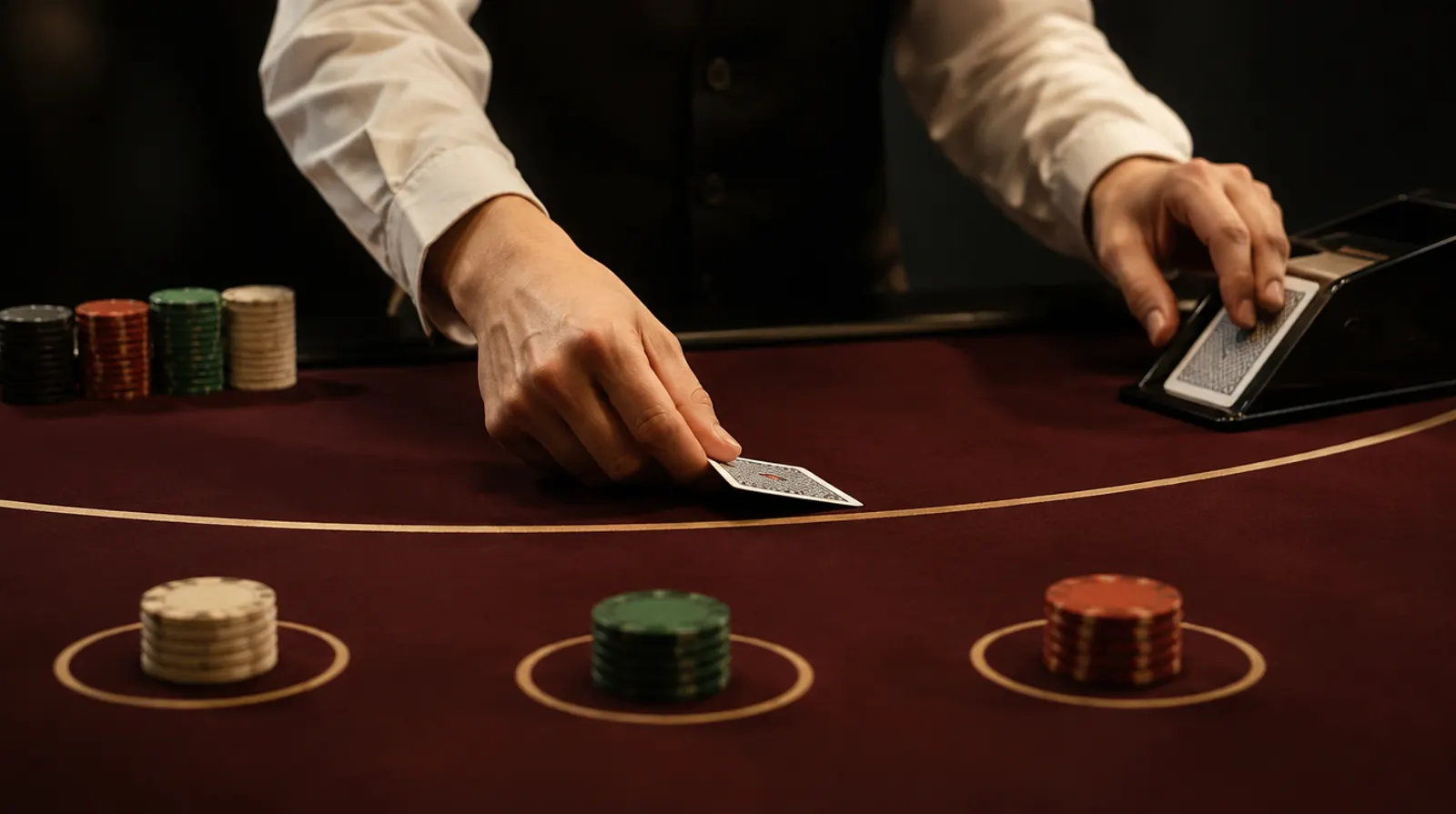
21+3 is an optional side bet at blackjack tables that pays when your first two cards and the dealer’s face-up card form a three-card poker hand: a flush, straight, three of a kind, straight flush or suited three of a kind. It is settled as soon as those three cards are on the table, and it has nothing to do with whether your main hand beats the dealer. On Evolution’s live tables the bet pays from 5:1 for a flush up to 100:1 for suited trips, with a house edge of about 3.70% in an eight-deck shoe according to the Wizard of Odds.
The name comes from the two games it joins: 21 from blackjack and 3 from Three Card Poker. This guide covers the hand types, the pay tables you are likely to meet, what each one costs by deck count, how it compares with Perfect Pairs, and where US players can find it at a live table.
How the 21+3 Side Bet Works
Before the deal, you place a chip on the separate 21+3 betting spot next to your main blackjack bet. Most tables require a main bet before a side bet is accepted, and the side bet has its own, lower maximum. Then the round runs like this:
- Place both bets. Your main blackjack wager goes in the usual circle, and the side bet goes on the spot marked 21+3.
- The deal. You receive two cards and the dealer shows one up card.
- Settlement. Those three cards are read as a poker hand. If they make one of the qualifying hands, the side bet is paid at once; otherwise it is collected.
- The main game continues. You hit, stand, double or split as normal. Nothing you do later changes the side-bet result, and a later bust does not take back a 21+3 win.
Because the result is fixed by the first three cards, there is no strategy for playing the side bet once it is placed. Your only decisions are whether to bet it and how much.
21+3 Hand Rankings
Old guides, including an earlier version of this page, often list the hands in the wrong order. On the standard pay tables a straight pays more than a flush, because with three cards from a multi-deck shoe a flush is the more common hand. From lowest to highest payout on the Evolution table:
| Hand | What it means | Example |
|---|---|---|
| Flush | All three cards share one suit, not in sequence | 2♥ 9♥ K♥ |
| Straight | Consecutive ranks in mixed suits | 7♣ 8♦ 9♠ |
| Three of a kind | Same rank, not all one suit | Q♠ Q♥ Q♣ |
| Straight flush | Consecutive ranks, all in one suit | 4♦ 5♦ 6♦ |
| Suited three of a kind | Three identical cards (same rank and suit), only possible with more than one deck | 8♠ 8♠ 8♠ |
An Ace can be high or low, so Q-K-A and A-2-3 both count as straights. A run cannot wrap around the Ace, which means K-A-2 is not a straight. A pair on its own does not win on the common pay tables.
21+3 Payouts: The Pay Tables in Use
The bet has no single official pay table. Casinos and studios choose one, and that choice decides most of what the bet costs you. These are the versions analysed by the Wizard of Odds that you are most likely to see:
| Hand | Evolution (current) | Classic flat | Evolution (older) | WagerWorks | 21+3 Xtreme |
|---|---|---|---|---|---|
| Suited trips | 100:1 | 9:1 (counts as trips) | 100:1 | 100:1 | 20:1 (counts as trips) |
| Straight flush | 40:1 | 9:1 | 40:1 | 35:1 | 30:1 |
| Three of a kind | 30:1 | 9:1 | 25:1 | 33:1 | 20:1 |
| Straight | 10:1 | 9:1 | 10:1 | 10:1 | 10:1 |
| Flush | 5:1 | 9:1 | 5:1 | 5:1 | 5:1 |
A flat 9:1 on any winning hand was the classic version, first recorded by the Wizard of Odds at the Las Vegas Hilton in April 2001. The current Evolution table (5, 10, 30, 40, 100) is the one most live players meet today, and casino help pages for Evolution blackjack list its RTP at 96.30%. A 2024 Evolution factsheet still shows 25:1 for three of a kind, so the older table may survive on some tables. Whatever this page says, the help screen at your table is the version that counts.
Payouts are quoted “to 1”, so you also get your stake back. A $5 bet that hits a straight at 10:1 returns $55: $50 in winnings plus the $5 bet.
21+3 House Edge by Pay Table and Deck Count
Deck count matters more for 21+3 than for almost any other blackjack bet. Once your two cards are out, a single deck holds few cards that can complete a flush, straight or set, while an eight-deck shoe holds many more. More decks therefore mean more winning hands and a lower house edge. The figures below come from the Wizard of Odds’ 21+3 analysis:
| Pay table | Decks | House edge | RTP |
|---|---|---|---|
| Evolution 5-10-30-40-100 | 8 | 3.70% | 96.30% |
| Evolution table, four decks | 4 | 6.39% | 93.61% |
| Evolution older 5-10-25-40-100 | 8 | 6.29% | 93.71% |
| Classic 9:1 flat | 8 | 2.74% | 97.26% |
| 9:1 flat | 6 | 3.24% | 96.76% |
| Flat 9:1, double deck | 2 | 7.26% | 92.74% |
| Single-deck 9:1 | 1 | 13.30% | 86.70% |
| WagerWorks 5-10-33-35-100 | 6 | 4.14% | 95.86% |
| 21+3 Xtreme 5-10-20-30 | 6 | 13.39% | 86.61% |
For the current Evolution table in a six-deck shoe, our own calculation with the same card-combination method gives a house edge of about 4.6%. Live tables from the big studios normally deal from eight decks, which is why 3.70% is the useful benchmark.
Compare that with the main game. Our live blackjack guide puts the house edge at a standard eight-deck table at roughly 0.5% with basic strategy. Even the cheapest common 21+3 table costs several times more per dollar bet.
Odds of Each 21+3 Hand
The probabilities below are for an eight-deck shoe, taken from the Wizard of Odds’ return table for the Evolution pay table (11,912,160 possible three-card combinations):
| Hand | Probability | About 1 in | Pays |
|---|---|---|---|
| Suited three of a kind | 0.0244% | 4,091 | 100:1 |
| Straight flush | 0.206% | 485 | 40:1 |
| Three of a kind | 0.517% | 193 | 30:1 |
| Straight | 3.09% | 32 | 10:1 |
| Flush | 5.88% | 17 | 5:1 |
| Any winning hand | 9.73% | 10.3 | 5:1 to 100:1 |
| No win | 90.27% | n/a | Bet lost |
So the bet wins roughly once every ten hands, and in most of those wins it pays 5:1 or 10:1. Long losing runs are normal: the chance of losing 20 side bets in a row is about 13% (0.9027 to the power of 20).
Worked Example: What 21+3 Costs Per Hour
Take a live table dealing about 60 hands an hour, the same pace used in our blackjack hub.
- Main game: $10 a hand is $600 wagered an hour. At about 0.5%, the expected loss is around $3.
- Adding $5 on 21+3 every hand: another $300 an hour at 3.70% adds an expected loss of about $11.10.
- Total: roughly $14 an hour, so the side bet, at half the size of the main bet, costs more than three times as much as the blackjack itself.
- Same $5 at a four-deck table: 6.39% of $300 is about $19.20 an hour from the side bet alone.
These are long-run averages. In a single session the side bet swings widely, since one suited trips at $5 pays $500.
21+3 vs Perfect Pairs
Perfect Pairs is the other side bet you will see at most live blackjack tables, and on Evolution tables you can play both. It looks only at your first two cards.
| Feature | 21+3 | Perfect Pairs |
|---|---|---|
| Cards used | Your two cards plus the dealer’s up card | Your two cards only |
| Winning hands | Flush, straight, trips, straight flush, suited trips | Mixed pair, coloured pair, perfect pair |
| Typical pay table | 5:1 / 10:1 / 30:1 / 40:1 / 100:1 | 6:1 / 12:1 / 25:1 |
| Hit rate (8 decks) | About 9.7% | About 7.5% (31 of the 415 cards left after your first card pair it) |
| House edge (8 decks) | 3.70% | 4.10% |
| RTP | 96.30% | 95.90% |
The Wizard of Odds lists the 25-12-6 Perfect Pairs table at a 4.10% house edge with eight decks, rising to 7.95% if the mixed pair pays only 5:1. On the standard Evolution tables, 21+3 is therefore the slightly cheaper of the two. Our hub compares both with Hot 3, Bust It and insurance in its side bets table, and two older side bets have their own guides: Lucky Ladies and Super Sevens.
Is the 21+3 Side Bet Worth It?
As a long-run bet, no. Every common version carries a house edge several times higher than basic-strategy blackjack, and no playing decision can lower it. The bet makes sense only if you value the chance of a 30:1 or 100:1 payout enough to pay extra for it. A few rules keep the cost reasonable:
- Read the pay table first. Three of a kind at 25:1 instead of 30:1 raises the edge from 3.70% to about 6.29% at eight decks.
- Check the deck count. The same pay table costs far more with four or six decks than with eight.
- Keep it small. Size the side bet at a fraction of your main wager, not equal to it.
- Skip insurance either way. At about 7.5% in an eight-deck game, blackjack insurance is worse value still.
- Ignore streak systems. Raising the side bet after losses does not change the 3.70% edge; it only raises the amount exposed to it.
For the odds behind the main game itself, from bust rates to the value of each rule, see our blackjack odds and probability guide.
Where to Play 21+3 Blackjack Live
21+3 is a standard option on Evolution’s classic live tables, alongside Perfect Pairs. Evolution’s Infinite Blackjack and Power Blackjack offer it as one of four side bets (with Any Pair, Hot 3 and Bust It), and First Person Blackjack, Evolution’s RNG game, carries it too. Power Blackjack removes the 9s and 10s from the shoe, which changes the odds of straights and flushes, so check the RTP in that table’s help screen. Our Infinite Blackjack review and Evolution review cover those tables. LuckyStreak’s live blackjack also offers 21+3 and Perfect Pair, as our LuckyStreak review notes.
In the US, eight states have legalised online casinos, and seven markets are live: New Jersey, Pennsylvania, Michigan, West Virginia, Connecticut, Delaware and Rhode Island. Maine legalised a tribal-only market (LD 1164 became law without the governor’s signature in January 2026, effective 29 July 2026) that had not launched as of October 2026. Evolution streams to licensed casinos in these markets from its US studios, and it supplies licensed operators only, so state-licensed casinos are where you will find its 21+3 tables.
The offshore sites we review are a different picture. Bovada’s live blackjack help lists Pairs, Rummy, insurance and a Super 777 progressive as its side bets, and MyBookie’s live tables list Pairs and Rummy. We found no 21+3 bet on the live blackjack tables at Bovada, Ignition, MyBookie or BetOnline, which is why this page has no casino list. Bovada does offer 21+3 on its RNG Classic Blackjack. These offshore operators have no US state licence, each excludes some states, and if something goes wrong there is no state regulator to complain to and your funds are not protected.
21+3 Blackjack FAQ
What does 21+3 mean in blackjack?
It is a side bet that combines blackjack (21) with three-card poker (3). Your first two cards and the dealer’s up card form a three-card hand, and you win if it is a flush, straight, three of a kind, straight flush or suited three of a kind.
What are the odds of winning 21+3?
With eight decks, a winning hand comes up about 9.7% of the time, or roughly once in ten hands. Most wins are flushes (about 5.9%) or straights (about 3.1%).
What is the house edge on 21+3?
It depends on the pay table and the number of decks. Evolution’s 5-10-30-40-100 table has a 3.70% house edge with eight decks, per the Wizard of Odds. The classic 9:1 version ranges from 2.74% with eight decks to 13.30% with one deck.
Does a pair win on 21+3?
Not on the common pay tables. A pair pays only on rare versions, such as one the Wizard of Odds recorded at the Regent in Las Vegas that paid 5:2 on any qualifying hand including a pair.
Can you play 21+3 without a main blackjack bet?
Usually not. Live tables and most casinos require a main bet in the same seat before the 21+3 bet is accepted, and the side bet has its own lower limit.
Is 21+3 better than Perfect Pairs?
On standard eight-deck Evolution tables, slightly. 21+3 has a house edge of 3.70% (RTP 96.30%) against 4.10% (RTP 95.90%) for Perfect Pairs. Both cost far more than the main game played with basic strategy.
Gambling should be entertainment. If it stops being fun, call or text the National Problem Gambling Helpline at 1-800-MY-RESET (1-800-697-3738). Real-money online gambling is 21+ in regulated US states.