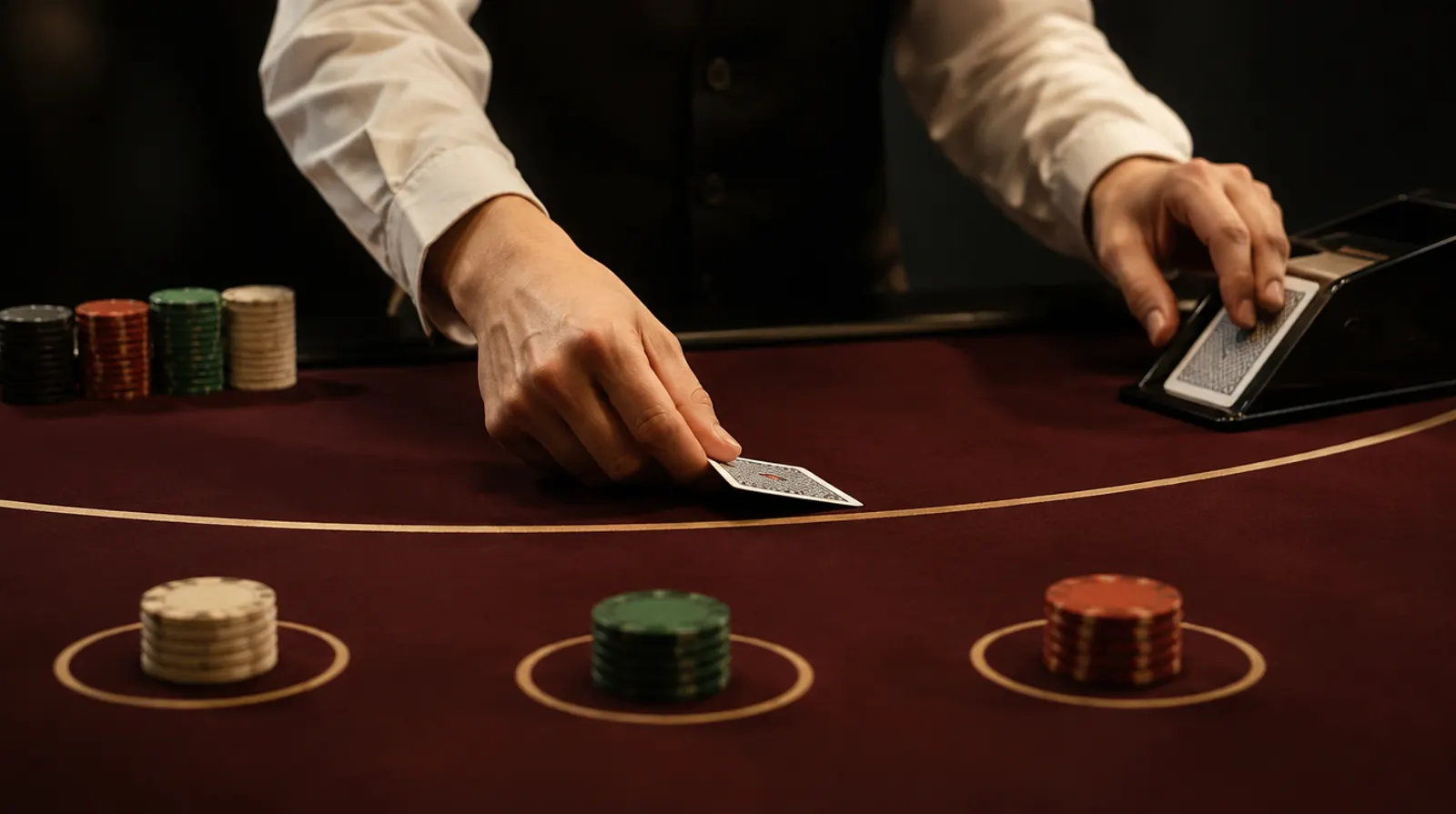
Infinite Blackjack is Evolution’s live blackjack table with no seat limit: every player receives the same first two cards, then makes their own decisions on hit, stand, double and split. It uses eight decks, the dealer stands on soft 17, blackjack pays 3:2, and a Six Card Charlie rule makes any six-card hand of 21 or less an automatic winner. With optimal strategy the RTP is 99.47%, and four optional side bets sit next to the main wager: Any Pair, 21+3, Hot 3 and Bust It.
Evolution announced the game on 26 October 2018 as its first fully scalable live blackjack table. This review covers how the shared hand works, the full rules, each side bet’s pay table and RTP, what a session costs, the earlier NetEnt format it replaced, and where US players can find it.
Infinite Blackjack at a Glance
| Feature | Infinite Blackjack |
|---|---|
| Studio | Evolution |
| Launched | October 2018 |
| Players per table | Unlimited |
| Decks | 8 |
| Dealer rule | Stands on all 17s, including soft 17 |
| Blackjack pays | 3:2 |
| Insurance | Offered on a dealer Ace, pays 2:1 |
| Special rule | Six Card Charlie |
| RTP (optimal strategy) | 99.47%, a house edge of 0.53% |
| Side bets | Any Pair, 21+3, Hot 3, Bust It |
How the Shared Hand Works
At a classic live table seven players each get their own cards, and everyone else waits or uses Bet Behind. Infinite Blackjack removes that limit by dealing one common starting hand. A round runs in five steps:
- Betting. You place a main bet and any side bets before the timer runs out.
- The deal. All players receive the same two cards, and the dealer takes one up card.
- Decisions. Each player chooses to hit, stand, double or split, with no effect on anyone else’s hand.
- Drawing. Players who ask for a card all receive the same next card, while those who stood are finished. This continues until everyone has stood or busted.
- Dealer’s turn. The dealer completes their hand under the fixed rules, and every player is settled against it.
Hands start identical but split apart quickly, because your choices decide which shared cards end up in your hand. Two players who see the same 12 against a dealer 3 can finish with very different results, one standing and one drawing. Infinite Blackjack tables are also shared across casinos: DraftKings notes that players from any operator can join the same table.
Infinite Blackjack Rules
Evolution built the game so that the core blackjack rules did not need to change. When it launched, chief product officer Todd Haushalter said the studio had made a one-to-many game work “without having to make any rule changes”. The rules that matter for strategy are these:
- Eight decks, shuffled and dealt from a shoe.
- Dealer stands on soft 17, which is the better version for players.
- Blackjack pays 3:2, a normal win pays 1:1 and a tie pushes.
- Insurance is offered when the dealer shows an Ace and pays 2:1 if the dealer has blackjack.
- Doubling and splitting are available on your first two cards. Each needs the same stake again, so keep spare balance.
- Six Card Charlie: any hand of six cards without a bust wins automatically, no matter what the dealer goes on to make.
Players tend to forget the Charlie rule. Most of the time you will stand long before six cards, but if a five-card hand sits on a low total, one more card can win without the dealer’s hand mattering. For everything else, standard eight-deck basic strategy applies, and our guide to splitting covers the pair decisions.
RTP and House Edge
Infinite Blackjack’s RTP is listed at 99.47% with optimal strategy (casinos.com and other casino help pages), a house edge of 0.53%. That is close to the roughly 0.5% our live blackjack guide gives for a classic eight-deck table. In practice, the cost of the game depends far more on how you play and which side bets you add than on the base rules.
| Bet | RTP | House edge |
|---|---|---|
| Main game (optimal strategy) | 99.47% | 0.53% |
| 21+3 | 96.30% | 3.70% |
| Any Pair | 95.90% | 4.10% |
| Hot 3 | 94.60% | 5.40% |
| Bust It (1-2-9-50-100-250 table) | 93.82% | 6.18% |
| Insurance (8 decks) | About 92.5% | About 7.5% |
Insurance is a poor bet at any eight-deck table, and our blackjack insurance guide shows the maths.
Infinite Blackjack Side Bets
All four side bets are settled on the first cards dealt, apart from Bust It, which waits for the dealer. Paytables for the first three are those DraftKings publishes for its Infinite Blackjack table in New Jersey; check the help screen at your own casino, because operators can show different versions.
Any Pair
This bet wins when your first two cards are a pair: 25:1 for a suited pair and 8:1 for any other pair. With eight decks, 31 of the 415 cards left after your first card make a pair, and 7 of them match its suit. That gives a 95.90% RTP.
21+3
Your two cards plus the dealer’s up card form a three-card poker hand. The table pays 5:1 for a flush, 10:1 for a straight, 30:1 for three of a kind, 40:1 for a straight flush and 100:1 for suited trips. The Wizard of Odds puts this pay table at a 3.70% house edge with eight decks, and a winning hand appears about once in ten rounds. Our 21+3 guide has the hand odds and the other pay tables in use.
Hot 3
Hot 3 uses the same three cards but adds their values, with an Ace counted as 11 unless that busts the total. A total of 19 pays 1:1, 20 pays 2:1, an unsuited 21 pays 4:1, a suited 21 pays 20:1, and three 7s pay 100:1. Our own eight-deck calculation gives an RTP of 94.60%, matching the figure in our blackjack hub.
Bust It
Bust It pays when the dealer busts, and the payout grows with the number of cards in the busted hand. The pay table quoted with a 93.82% RTP pays 1:1 for three cards, 2:1 for four, 9:1 for five, 50:1 for six, 100:1 for seven and 250:1 for eight or more. Our own eight-deck calculation of the dealer’s bust chances reproduces that 93.82%: the dealer busts about 28.2% of the time, mostly with three cards (17.3%) or four (8.7%). DraftKings’ help page lists 7:1 for a five-card bust, and with that payout the RTP falls to about 90.0%, so check the five-card line before you play.
What a Session Costs: Worked Example
Assume about 60 rounds an hour, the same pace used in our blackjack hub.
- $5 main bet only: $300 wagered an hour at a 0.53% edge is an expected loss of about $1.59.
- Add $1 on each of the four side bets: $60 an hour on each. At 4.10%, 3.70%, 5.40% and 6.18%, the side bets cost roughly $2.46, $2.22, $3.24 and $3.71, or about $11.63 in total.
- Result: $4 of side bets per round raises the expected hourly cost about eight times, from $1.59 to about $13.20.
Those are averages over many hours. The swings are wide, and a single Bust It hit at 250:1 on $1 pays $250. If you enjoy the side bets, keep them small relative to the main wager. No staking system, such as raising your bet after a loss, changes any of these percentages.
Strengths and Weaknesses
| Strengths | Weaknesses |
|---|---|
| Always a seat, at any hour | Less social: you are one of hundreds, not one of seven |
| 99.47% RTP with eight decks and dealer standing on soft 17 | Fixed timer for decisions, so slow players can feel rushed |
| Low minimum bets, often the cheapest live seat in the lobby | Four side bets make it easy to overspend |
| Six Card Charlie adds a small extra way to win | Only at state-licensed casinos in the US |
Common Draw Blackjack: The NetEnt Predecessor
Infinite Blackjack was not the first live table to share one hand among unlimited players. NetEnt Live ran Common Draw Blackjack from its studio in Malta: a six-deck game in which all players shared the same draw while each made their own decisions, with a stated theoretical RTP of 99.5%. It came in low-limit, standard and high-limit versions, and the shared hand made rounds faster than a seven-seat table.
The game no longer exists. Evolution completed its acquisition of NetEnt on 1 December 2020 and, as part of the integration, closed NetEnt’s live offer. Players who liked Common Draw will find the same idea, with more side bets and a Six Card Charlie rule, in Infinite Blackjack, along with Evolution’s other unlimited-seat formats covered in our Evolution review.
Where to Play Infinite Blackjack in the US
Evolution supplies only licensed operators, so in the US its Infinite Blackjack table appears at state-licensed online casinos. DraftKings carries it in its New Jersey live dealer lobby, and FanDuel’s Michigan casino lists it as well. Evolution’s US tables are streamed from seven US studios: three in New Jersey, two in Michigan and one each in Pennsylvania and Connecticut.
Eight states have legalised online casinos, and seven markets are live: New Jersey, Pennsylvania, Michigan, West Virginia, Connecticut, Delaware and Rhode Island. Maine legalised a tribal-only market (LD 1164 became law without the governor’s signature in January 2026, effective 29 July 2026) that had not launched as of October 2026. You must be physically inside one of the live states, and 21 or older, to play.
The offshore sites we review, Bovada, Ignition, MyBookie and BetOnline, do not carry Evolution’s tables, so we do not list a casino here. Their live blackjack comes from smaller studios such as Visionary iGaming. These operators have no US state licence, each excludes some states, and if something goes wrong there is no state regulator to complain to and your funds are not protected. Infinite Blackjack plays well on phones too; our mobile live casino guide covers the apps.
Infinite Blackjack FAQ
How does Infinite Blackjack work?
Every player gets the same first two cards, then decides independently whether to hit, stand, double or split. Players who hit all receive the same next card. The dealer then plays one hand, and each player is settled against it.
What is the RTP of Infinite Blackjack?
It is listed at 99.47% with optimal strategy, a house edge of 0.53%. Side bets are lower, from 96.30% for 21+3 down to 93.82% for Bust It on its standard pay table.
How many decks are used in Infinite Blackjack?
Eight standard decks. The dealer stands on all 17s, including soft 17, and blackjack pays 3:2.
What is the Six Card Charlie rule?
If your hand reaches six cards without going over 21, it wins automatically, whatever the dealer’s final total.
Is Infinite Blackjack rigged?
No. In regulated US states the tables come from Evolution studios approved by state regulators. The house edge is built into the rules and side-bet payouts, so there is no need to manipulate cards.
Can I play Infinite Blackjack for free?
Evolution does not offer free demo play at its live tables, so every round is for real money. To learn the rules first, watch a round without betting or practise basic strategy on an RNG blackjack game.
Gambling should be entertainment. If it stops being fun, call or text the National Problem Gambling Helpline at 1-800-MY-RESET (1-800-697-3738).
Sources
- Evolution: Evolution launches Infinite Blackjack (26 Oct 2018)
- Evolution: Infinite Blackjack game page
- DraftKings Casino: How to play Infinite Blackjack (rules and side-bet paytables)
- FanDuel Casino: Infinite Blackjack (8 decks, dealer stands on 17, Six Card Charlie)
- Casinos.com: Infinite Blackjack (RTP, side bets)
- Wizard of Odds: 21+3 side bet
- Yogonet: Evolution completes acquisition of NetEnt, starts total integration (2 Dec 2020)
- LiveDealer.org: NetEnt live blackjack (Common Draw rules)
- SBC Americas: Maine legalises online casinos (January 2026)
- NCPG: National Problem Gambling Helpline (1-800-MY-RESET)
Spotted an error? Email [email protected] with the page address. Verified corrections are made with a dated note.