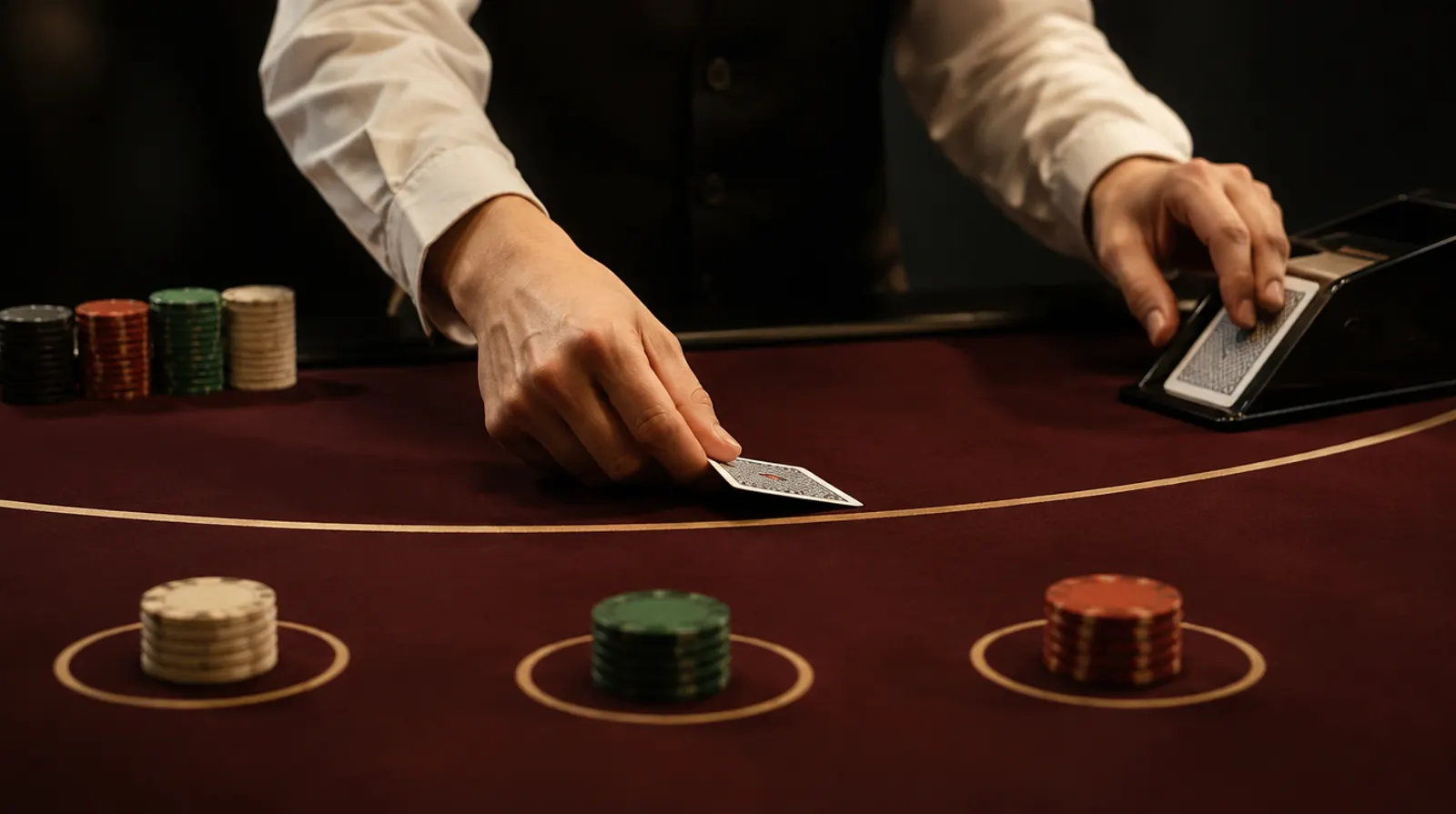
Bet Behind lets you wager on another player’s hand at a seven-seat live blackjack table. You place chips in the Bet Behind spot next to a seated player, they make every decision, and you win or lose exactly as their hand does: a regular win pays 1:1, a blackjack pays 3:2 and a tie pushes. It is the easiest way into a full table, but your return depends on how well the seated player plays. Against a player using basic strategy at a classic eight-deck table, the house edge is roughly 0.5%; behind someone who copies the dealer, it climbs to about 5.7%.
Updated October 2026. We rewrote this guide, corrected the old description of Bet Behind as a free-standing side bet, removed claims we could not support, and checked the rules against Evolution’s own pages, US operator help pages and the Wizard of Odds. The maths matches our live blackjack guide, so the numbers here line up with the rest of the site.
What is Blackjack Bet Behind?
Evolution, the largest live dealer studio, describes the feature in one line: “Bet Behind allows you to place bets behind one or more of the main seven players seated at the table.” Most of its live blackjack tables are built on that seven-seat layout, with Bet Behind switched on for anyone who cannot get a seat. Seated players can also back other seats while playing their own hand.
Strictly speaking, Bet Behind is not a side bet, even though the old version of this page called it one. Perfect Pairs, 21+3 and similar side bets are settled on their own paytables. Your Bet Behind wager, by contrast, is a second main bet on somebody else’s hand, settled at the same 1:1 and 3:2 odds as theirs. The difference matters because side bets carry house edges of 3.7% to 7.5%, while a Bet Behind stake carries the edge of the hand it follows.
The idea comes from land-based casinos, where it is called back betting. In jurisdictions that allow it, up to three players can share one betting position, and only the player in control of the hand is consulted on decisions. Writing in Card Player in June 1999, Arnold Snyder noted that many casinos outside the US, and a few inside, allow back bets, and most cap them so the total on one hand stays within the table maximum.
Evolution added a scalable, multi-player version to its online Live Blackjack in 2014. Its announcement said a “virtually unlimited” number of online players could join, that a waiting player could bet behind all seven seats, and that hot players would be highlighted with a gold medal and score indicators. RNG (software) blackjack has no other players, so the feature exists only at live tables.
Bet Behind at a glance
| Question | Typical answer at a live table |
|---|---|
| Who makes the decisions? | The seated player. You cannot hit, stand, double or split for them. |
| Payouts | Same as the seated hand: win 1:1, blackjack 3:2, push returns your stake |
| House edge | Same as the hand as it is played: about 0.5% with basic strategy at a classic 3:2 table, far more if the player makes mistakes |
| Doubles and splits | Varies by table; some interfaces let you choose whether your stake follows a double or a split |
| Insurance | Offered when the dealer shows an Ace; it is a separate bet with an edge of about 7.5% in an eight-deck shoe |
| How many seats can you back? | One or several; Evolution lets you back all seven |
| Limits | Set by the casino for each table; check the help screen |
| If the seated player disconnects | At BetOnline the hand is completed by basic strategy, partly “to serve those back betting on the hand” |
| Bonus wagering | Live dealer games count 0% at Bovada and Ignition, and MyBookie excludes them |
Bet Behind Rules: Doubles, Splits, Insurance and Side Bets
The basic deal is simple. The awkward moments come when the seated player wants to put more money on the table, because your stake has to do something too.
When the seated player doubles down
A double adds a second stake equal to the first in exchange for exactly one more card. At a land table the back bettor can usually choose whether to add money. Online, it depends on the software: some interfaces ask you, some let you set a standing preference before the round, and some follow the seated player automatically. Open the table’s help screen before you bet, because a double you decline on 11 against a dealer 6 leaves value on the table, while a double you are forced into can stretch a small balance.
When the seated player splits
Splits are where back bettors have the most to think about. Snyder explains that a back bettor who does not match the extra money keeps their original bet on one hand only, while the seated player’s money covers the rest. That can work in your favour. His example is a pair of 7s against a dealer 9: hitting the pair has an expectation of about minus 44%, while the first hand of a split, played on alone, sits at about minus 29%.
The Wizard of Odds has worked out a full strategy for this choice. If the seated player splits for their own benefit and you decide sensibly whether to match, the house edge against you drops by 0.08%. In the less common case where the front player splits to suit the back bettor, the saving rises to 0.20%. Neither figure turns the game in your favour, and many online tables simply do not offer the choice.
Insurance and even money
When the dealer’s up card is an Ace, you will be offered insurance. It pays 2:1 if the dealer has blackjack, but in an eight-deck shoe only about 31% of the unseen cards are tens, which leaves insurance with a house edge of about 7.5%. Decline it, whatever the player you are backing does. Our blackjack insurance guide shows the full calculation.
Side bets on a Bet Behind spot
Whether you can add Perfect Pairs or 21+3 to a Bet Behind wager depends on the table. When they are available, the costs are the same as for a seated player: about 4.1% on Perfect Pairs and about 3.7% on 21+3 (RTP 96.30%). Bovada’s own blackjack page lists Back Bets at 1:1 alongside its live side bets, Pairs at 11:1 and Rummy at 9:1. More on the most common one is in our 21+3 guide.
Payouts and House Edge When You Bet Behind
A Bet Behind stake inherits two things from the seat it follows: the table rules and the player’s decisions. The rules set the floor. A classic Evolution table uses eight decks, the dealer stands on all 17s and blackjack pays 3:2, which gives a house edge of roughly 0.5% with basic strategy. Every rule change and every bad decision moves that number, and you have no say in either.
| Situation at the seat you back | House edge on your Bet Behind stake | Expected loss per 100 hands at $10 |
|---|---|---|
| Basic strategy, classic table (8 decks, dealer stands on soft 17, 3:2) | About 0.5% | About $5 |
| Dealer hits soft 17, player still uses basic strategy | Roughly 0.7% (+0.22 points) | Around $7 |
| Table pays 6:5 on blackjack, player uses basic strategy | Close to 1.9% (+1.39 points) | Nearly $19 |
| Player copies the dealer (hits to 17, never doubles or splits) | About 5.7% | About $57 |
Sources: the 0.5% baseline and the rule adjustments come from the Wizard of Odds rule-variation tables used in our blackjack hub. Copying the dealer was costed in research by Baldwin, Cantey, Maisel and McDermott in 1956, revised to 5.73% by Ed Thorp, as summarised by the Las Vegas Advisor. Most of that cost comes from the double bust: the player busts first and loses even when the dealer would also have busted.
The spread between the first and last rows is the real price of Bet Behind. You are not choosing a game with a different edge; you are choosing a person, and their mistakes come out of your stake as well as theirs.
Worked example: $10 behind a $50 player
Say you back seat 3 with $10 while the seated player bets $50 on a classic table.
- Seat 3 wins with 19 against the dealer’s 18. You are paid 1:1, so your $10 returns $20.
- Blackjack for the seated player. Your payout is 3:2, a $15 profit on your $10.
- Both sides make 20. Push: your $10 comes back.
- A double on 11 against a dealer 6. Follow it and $20 of yours rides on one card; decline and $10 stays on the hand.
- Split 8s against a dealer 10. Matching gives you two $10 hands. Without a match, your $10 stays on the first 8.
- Seat 3 hits hard 17 and busts. That costs you $10, even if the dealer later busts too.
How to Recognise Hot Players?
Live blackjack interfaces show who is winning. Evolution’s 2014 launch highlighted hot players with a gold medal and score indicators, and many tables still show results next to each seat. It is tempting to read those markers as skill. They mostly measure luck.
Here is why. With basic strategy, the Wizard of Odds puts the chance of a net win on any hand at 42.43%, a push at 8.48% and a net loss at 49.09%. Hands from the same shoe are close to independent, so a player’s last five results tell you almost nothing about the next one. Ignoring pushes, any given seat wins three hands in a row about 10% of the time. With seven seats at the table, at least one player will be on a three-hand winning run about 52% of the time, purely by chance. Five in a row happens to a single seat about 2% of the time, and to at least one of seven seats about 14% of the time.
So a “hot” badge is not a reason to follow someone. Decisions are. Spend a few rounds watching before you bet and look for a player who:
- stands on 12 to 16 when the dealer shows 2 to 6 (except hitting 12 against a 2 or 3);
- hits 12 to 16 when the dealer shows 7 or higher;
- always splits Aces and 8s, and never splits 10s or 5s;
- doubles 11 against most up cards and 10 against 2 to 9;
- declines insurance every time.
A player who does all of that is giving you the lowest edge the table allows. One who stands on 12 against a 10, or splits 10s because they feel lucky, is costing you money even while the winning badge glows. Our guides on when to split and on doubling down cover the correct plays in detail.
How to Place the Bet?
- Open the live lobby and choose a seven-seat table. Bet Behind is a feature of the classic layout. Evolution lists it on its standard tables and on Bet Stacker Blackjack, a seven-seat game that charges a 10% fee on main bets.
- Read the help screen. Check the minimum and maximum for Bet Behind, how doubles and splits are handled, and whether side bets are allowed on a back bet.
- Watch a few rounds. Use the checklist above to judge each seated player’s decisions.
- Select a chip and click the Bet Behind spot next to the seat you want. You can usually spread chips across several seats.
- Beat the timer. Betting windows are short, usually 10 to 15 seconds, so set any double or split preferences before the cards come out.
- Watch the hand play out. Your stake is settled with the seated player’s result when the dealer finishes.
Backing several seats does not lower the house edge. It multiplies how much you wager. Put $5 behind each of the seven seats and you have $35 in play every round. At about 60 rounds an hour and a 0.5% edge, that is around $10.50 an hour in expected losses, and more if any of the seven players makes mistakes. Swings also get bigger, because you are effectively playing seven hands at once.
How big are the swings?
An edge tells you the average result. Swings are what you actually feel at the table. The Wizard of Odds puts the standard deviation of a blackjack hand at about 1.14 bets. Behind one seat at $10 a hand for an hour of about 60 rounds, that works out to roughly $88 either way, against an expected loss of about $3. A normal hour can therefore end anywhere from about $90 up to about $90 down without anything unusual happening.
Backing several seats makes this worse than it looks. All seven hands are played against the same dealer hand, so when the dealer makes 21 most of the table loses together, and when the dealer busts most of it wins together. Seven $5 bets behind seven seats swing far more like one $35 bet than seven separate $5 bets. Size your bankroll for the total you put out each round, not for the size of one chip.
Bet Behind vs Taking a Seat vs Infinite Blackjack
If the real goal is simply to play blackjack when the tables are busy, Bet Behind is not the only answer. Unlimited-seat games solve the same problem without handing your decisions to a stranger.
| Option | Who decides | Waiting | Cost with good play |
|---|---|---|---|
| Seated at a classic table | You | Only when all seven seats are taken | About 0.5% house edge |
| Bet Behind | The seated player | None | About 0.5% if the player uses basic strategy; up to about 5.7% if not |
| Infinite Blackjack | You (everyone shares the same first two cards) | None | 99.47% RTP, a 0.53% house edge |
Infinite Blackjack uses eight decks and a Six Card Charlie rule, and lets any number of players join one hand. For most people who just want a seat, it is the better choice. Bet Behind makes most sense when you want to stay at one table or dealer, add a little action between your own hands, or learn by watching a good player.
Common Bet Behind Mistakes
- Chasing the badge. Following whoever won the last three hands is following luck. Judge players by their decisions.
- Staying behind a bad player. If the player you back stands on 12 against a 10 or takes insurance, move your chips to another seat next round. Nothing ties you to one player.
- Forgetting the double and split settings. An automatic follow can double your stake in one click. Set your preference before the betting timer closes.
- Taking insurance because the player does. It is a separate bet with an edge of about 7.5% in an eight-deck shoe, and the seated player’s choice does not bind you.
- Arguing in chat. The seated player is playing their own money and owes back bettors nothing. If you dislike their choices, move your chips rather than complaining; our live table etiquette guide covers the rest.
Bet Behind and Card Counting
Back betting has a long link with advantage play. Counters at land casinos used to watch a shoe without playing, a technique the Stanford Wong books made famous as “wonging”, and step in only when the count turned favourable. Betting behind is one way to do that without taking a seat.
Online, the practical case is weak. Live tables use deep shoes, eight decks at Evolution’s standard tables, with the cut card placed well before the end, so true counts move slowly. Operators also say what they think of counting in their rules. BetOnline’s live casino rules state that “professional card counters are prohibited” and that accounts found counting are subject to immediate closure. Treat Bet Behind as a convenience, not as an edge.
Where Can You Bet Behind in the US?
Eight states have legalised online casinos; seven markets are live (NJ, PA, MI, WV, CT, DE, RI); Maine legalised a tribal-only market (LD 1164: became law without the governor’s signature in January 2026, effective 29 Jul 2026) that has not launched (Oct 2026). In those markets most live blackjack streams from Evolution’s US studios, which serve New Jersey, Pennsylvania, Michigan, Connecticut and West Virginia. Evolution builds its seven-seat tables with Bet Behind, but each casino chooses which tables and limits it runs, so check the lobby in your state.
Outside those states, US players mostly see offshore sites, and the studios are different. Evolution supplies licensed operators only, so these sites use smaller suppliers. Here is what we could confirm from the operators’ own pages in October 2026:
| Site | Live blackjack studio | Bet Behind | Live blackjack from |
|---|---|---|---|
| Bovada | Gold Tier Games and Dynamite Interactive | Yes: its blackjack page lists Back Bets (1:1) on live blackjack | $10 |
| BetOnline | Visionary iGaming and Fresh Deck Studios | Yes: its live casino rules cover back betting | $1 |
| Ignition | Not named in the lobby | Not confirmed | $15 |
| MyBookie | Visionary iGaming | Not confirmed | Not published |
BetOnline’s rules also spell out the main risk of backing someone: “When back betting you are subject to the decisions made by the player sitting in the main seat. You are not entitled to a reimbursement if you do not agree with the decision(s) the player in the main seat selects.”
Bovada, Ignition, MyBookie and BetOnline are offshore with no US state licence. Each excludes some states, there is no state regulator to complain to, and your funds are not protected. Bonus money will not help either: live dealer games count 0% toward wagering at Bovada and Ignition, and MyBookie excludes them from bonus wagering. For table limits at each site, see our live blackjack minimum bet guide.
Pros and Cons of Betting Behind
| Pros | Cons |
|---|---|
| You can play at a full table straight away | Someone else makes every decision, good or bad |
| Same 1:1 and 3:2 payouts as a seated hand | A weak player can push your edge from 0.5% to about 5.7% |
| A low-pressure way to learn by watching | Double and split handling varies and may be automatic |
| Lets you stay with a dealer or table you like | Backing several seats multiplies your stake and your swings |
| Seated players can add action on other seats | No refund if you disagree with a decision |
Bet Behind: Our Verdict
Backing a seat is a fair bet only when the person in it plays well. Back a player who follows basic strategy at a 3:2 table and your stake carries the same roughly 0.5% house edge as theirs. Back someone who plays on hunches and you are paying several times as much for the privilege of watching.
Ignore the hot-streak badges, watch decisions instead, decline insurance, and keep side bets small or skip them. If you only want a seat, try an unlimited table first. For rules, variants and the full strategy charts, the live blackjack guide linked at the top of this page is the place to start.
Bet Behind FAQ
What does bet behind mean in blackjack?
It means placing a wager on another player’s hand. The seated player makes all the decisions, and your bet wins, loses or pushes with their hand at the same payouts: 1:1 for a win and 3:2 for a blackjack.
Is betting behind a good idea?
Only behind a player who uses basic strategy. Then the house edge is about 0.5% at a classic 3:2 table. Behind a player who copies the dealer it rises to about 5.7%, so watch their decisions before you bet.
What happens to my Bet Behind wager if the player doubles or splits?
It depends on the table. Some interfaces let you choose whether to match the double or split, others follow the seated player automatically. If you do not match a split, your original bet usually stays on the first hand only.
Do I get paid 3:2 if the player I back gets blackjack?
Yes. Your Bet Behind stake is settled exactly like the seated hand, so a blackjack pays 3:2 at a standard table. At a table that pays 6:5 on blackjack, your back bet is paid 6:5 too, which is one more reason to avoid those tables.
Can you bet behind more than one player?
Yes. Evolution lets you back one or more of the seven seated players, including all seven, and seated players can also bet behind other seats. Each extra seat adds to the amount you wager, not to your edge.
Can I bet behind at a land-based casino?
Sometimes. Back betting is common in many casinos outside the US and allowed in a few US casinos. Where it is allowed, the total on one hand usually cannot exceed the table maximum.
Can I use a bonus to bet behind?
Not usefully at the main offshore sites. Live dealer games count 0% toward bonus wagering at Bovada and Ignition, and MyBookie excludes them, so Bet Behind wagers will not clear a bonus there.
Gambling should be entertainment, not a way to make money. If it stops being fun, call or text the National Problem Gambling Helpline at 1-800-MY-RESET (1-800-697-3738), or read our responsible gambling guide.
Sources
- Evolution: Live Blackjack (seven seats, Bet Behind, Perfect Pairs, 21+3)
- Evolution press release (2014): scalable multi-player Bet Behind added to Live Blackjack
- Evolution: Bet Stacker Blackjack (Bet Behind, 10% fee on main bets)
- Wizard of Odds: splitting strategy for back players (0.08% / 0.20%)
- Wizard of Odds: blackjack rule variations
- Wizard of Odds: blackjack win/push/loss probabilities and standard deviation (appendix 4)
- Las Vegas Advisor: mimic-the-dealer house edge (Baldwin et al. 1956, Thorp 5.73%)
- Arnold Snyder, Back Betting at Blackjack (Card Player, June 1999), via Las Vegas Advisor
- Wikipedia: Blackjack (back betting, up to three players per position)
- Bovada: blackjack games (live providers; Back Bets 1:1, Pairs 11:1, Rummy 9:1) via US proxy, 6 Oct 2026
- BetOnline: Live Casino Rules (back betting, basic strategy on timeout, card counters prohibited)
- Bovada: bonus terms and conditions (live dealer 0%)
- Ignition: bonus terms and conditions (live dealer 0%)
- Gambling Insider: Maine tribal online casinos, LD 1164
- NCPG: National Problem Gambling Helpline 1-800-MY-RESET
Spotted an error? Email [email protected] with the page address. Verified corrections are made with a dated note.