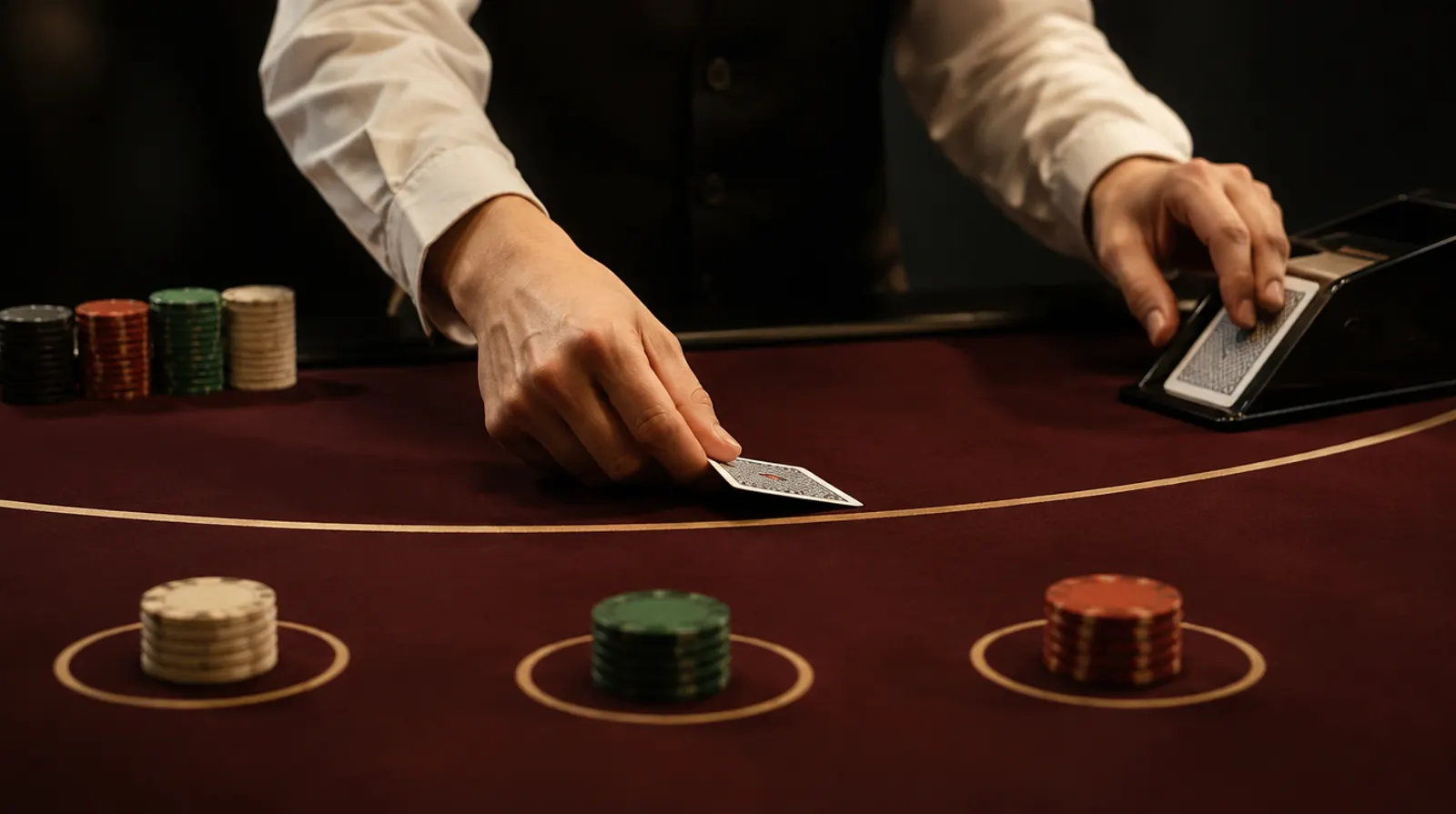
Blackjack has the best odds of any table game in a live casino if you play it correctly. With basic strategy at a standard 8-deck table where blackjack pays 3:2 and the dealer stands on soft 17, the house edge is roughly 0.5%, so you lose about 50 cents per $100 wagered over the long run. Per hand, a basic strategy player wins about 42.4% of the time, pushes about 8.5% and loses about 49.1%, according to the Wizard of Odds.
Updated October 2026. We rebuilt this guide around published probabilities instead of general advice. The old version said that standing on 13 against a dealer 6 means you will “almost certainly win” (the dealer busts only about 42% of the time from a 6), that a dealer Ace in the hole means you have already lost, and that knowing the odds gives you an advantage over the house. Basic strategy lowers the edge; it does not remove it. Every figure below comes from the Wizard of Odds or from our own arithmetic, shown step by step, and matches our live blackjack guide.
Blackjack Odds at a Glance
| Number | Value | Conditions |
|---|---|---|
| House edge with basic strategy | About 0.5% | 8 decks, 3:2, dealer stands on soft 17 |
| Hands won / pushed / lost | 42.43% / 8.48% / 49.09% | 6 decks, basic strategy (Wizard of Odds) |
| Chance of being dealt blackjack | About 4.75% (1 in 21) | 8 decks |
| Dealer busts | About 29.6% overall | 8 decks, stands on soft 17, after the peek |
| Insurance house edge | About 7.5% | 8 decks |
| Cost of a 6:5 blackjack payout | +1.39 percentage points | Against a 3:2 table |
| Standard deviation per hand | About 1.14 units | Wizard of Odds |
The Goal of Blackjack
The aim is to beat the dealer, not to reach 21. You win by finishing with a higher total than the dealer without going over 21, or by staying in the hand while the dealer busts. Cards 2 to 10 count at face value, Jacks, Queens and Kings count as 10, and an Ace counts as 1 or 11. A two-card 21 (an Ace plus a ten-value card) is a blackjack and pays 3:2 at a standard table; other winning hands pay 1:1, and equal totals push, so your stake comes back.
The dealer has no choices. At most live tables the dealer must hit 16 or less and stand on all 17s. That fixed rule is why the dealer’s outcomes can be calculated so precisely, and why your decisions are the only part of the game where skill changes the odds.
Odds vs Probability: Reading the Numbers
Probability is the share of all outcomes in which something happens, written as a percentage or fraction. Odds compare the outcomes where it happens against the outcomes where it does not. A blackjack has a probability of about 4.75%, or 1 in 21; expressed as odds, that is about 20 to 1 against.
Payouts are quoted as odds too. A blackjack paid at 3:2 returns $15 profit on a $10 bet, while 6:5 returns only $12. That $3 difference on one hand in 21 is why the payout rule matters more than any other on the table.
Probability of Your Starting Hand
An 8-deck shoe holds 416 cards: 32 Aces and 128 ten-value cards (10, J, Q, K). From those counts you can work out the chance of any two-card start. These are our own calculations from a full shoe:
| Starting hand | Calculation | Probability |
|---|---|---|
| Blackjack (Ace + ten-value) | 2 x (32/416) x (128/415) | About 4.75% |
| Hard 20 from two ten-value cards | (128/416) x (127/415) | About 9.42% |
| Any pair of the same rank | 31/415 (second card matches the first) | About 7.47% |
| Pair of Aces | (32/416) x (31/415) | About 0.57% |
The same arithmetic explains insurance. When the dealer shows an Ace, 415 cards remain unseen and 128 of them are tens, so the dealer completes a blackjack about 30.8% of the time. Insurance pays 2:1, which would only break even at 33.3%.
The House Edge in Blackjack
A casino offers blackjack because the rules give it a small, permanent advantage. The main source is the order of play: you act first, and if you bust you lose your bet straight away, even when the dealer goes on to bust as well. That “double bust” is the house’s edge. Everything else in the rules, from the 3:2 payout to doubling and splitting, gives some of it back to you.
Your share depends on how you play. The Wizard of Odds puts the house edge at 0.43% for a basic strategy player under Atlantic City rules (dealer stands on soft 17, double after split, split up to four hands), and our blackjack hub uses roughly 0.5% for a standard 8-deck live table. Players who ignore strategy pay far more. The same Wizard of Odds analysis gives a house edge of 3.91% for a “never bust” player who never hits hard 12 or more, and 5.48% for a player who mimics the dealer by hitting 16 or less, standing on 17 and never doubling or splitting.
| How you play | House edge | Expected loss per $1,000 wagered |
|---|---|---|
| Basic strategy, good 8-deck table | About 0.5% | About $5 |
| Never bust (never hit hard 12+) | 3.91% | About $39 |
| Mimic the dealer | 5.48% | About $55 |
How Often You Win, Push and Lose
Most players are surprised to learn that they lose more hands than they win. The Wizard of Odds calculates that a basic strategy player wins 42.43% of hands, pushes 8.48% and loses 49.09%, under six-deck rules where the dealer stands on soft 17, doubling after a split is allowed, late surrender is offered and Aces may be resplit. Under those rules the house edge is only 0.28%.
Two things close the gap between a 49% loss rate and a sub-1% edge. Blackjacks pay 3:2, so about one hand in 21 wins 1.5 units instead of one. Doubles and splits put extra money on the table in the spots where you are favoured, so your average win is bigger than your average loss. Ignoring pushes, you lose about 53.6% of decided hands, which is why losing streaks are common and why a betting progression cannot fix them; our progressive betting guide works through the streak maths.
Dealer Bust Odds by Up Card
Because the dealer must draw to 17, the chance of a dealer bust depends only on the up card. These Wizard of Odds figures apply to an 8-deck game where the dealer stands on soft 17, after the dealer has checked for blackjack:
| Dealer up card | Chance the dealer busts |
|---|---|
| 2 | 35.35% |
| 3 | 37.41% |
| 4 | 39.55% |
| 5 | 41.79% |
| 6 | 42.29% |
| 7 | 26.20% |
| 8 | 24.40% |
| 9 | 22.90% |
| 10 | 23.01% |
| Ace | 16.69% |
| All up cards | About 29.6% |
This table is the logic behind basic strategy. Against a 4, 5 or 6 the dealer busts close to 40% of the time or more, so you stand on a hard 13 to 16 and let the dealer take the risk. Even then you are not “almost certain” to win: standing on 13 against a 6 wins only when the dealer busts, about 42% of the time. It is simply the least bad option. Our guide on whether dealers have an advantage covers the dealer’s side in more detail.
Your Bust Odds When You Hit
The other half of each decision is your own risk. Treating the shoe as infinite, about 4 cards in 13 are ten-value, so these are the approximate chances of busting on a single hit (our calculation):
| Your hard total | Cards that bust you | Chance of busting |
|---|---|---|
| 11 or less | None | 0% |
| 12 | 10, J, Q, K | About 31% |
| 13 | 9 to K | About 38% |
| 14 | 8 to K | About 46% |
| 15 | 7 to K | About 54% |
| 16 | 6 to K | About 62% |
| 17 | 5 to K | About 69% |
Put the two tables side by side and the hardest hand in the game makes sense. With 16 against a dealer 10, standing wins only when the dealer busts, about 23% of the time. Hitting busts you about 62% of the time, but the other 38% you improve and still have a chance. Hitting loses slightly less, which is why the chart says hit and why surrender, where offered, beats both. See when to hit in blackjack for the full hard and soft charts.
The Player’s Advantages in Blackjack
Fixed dealer rules are a weakness you can exploit. Players have options the dealer does not, and each one, used at the right moment, claws back part of the house edge:
- Standing on any total. Stand on 12 when the dealer shows a 4, 5 or 6; the dealer must keep drawing to 17 whatever you hold.
- Doubling down. Your stake doubles and you take exactly one card. It pays on totals such as 10 and 11 against weaker dealer cards, where you are the favourite.
- Splitting pairs. A pair of Aces or 8s becomes two hands with a second, equal bet. Splitting 8s turns a weak 16 into two hands that start on 8. Our guide to splitting lists every pair.
- Surrender. Where late surrender is offered, you can give up half your stake on hands such as 16 against a 10. The Wizard of Odds values the rule at about 0.07 percentage points off the house edge.
- The 3:2 payout. You are paid 1.5 times your stake for a blackjack; the dealer’s blackjack only takes your original bet.
How Table Rules Change the Odds
Two tables that look the same can carry different house edges. The Wizard of Odds measures each rule against a baseline of eight decks, dealer stands on soft 17, double on any first two cards, double after split and splitting up to four hands. A plus sign means the rule is worse for you:
| Rule change | Effect on house edge |
|---|---|
| Blackjack pays 6:5 instead of 3:2 | +1.39% |
| Blackjack pays 7:5 instead of 3:2 | +0.45% |
| Dealer hits soft 17 (H17) | +0.22% |
| Double on 10 and 11 only | +0.18% |
| No doubling after a split | +0.14% |
| No resplitting | +0.10% |
| Six decks instead of eight | -0.02% |
| Late surrender | -0.07% |
| Single deck instead of eight | -0.48% |
The payout rule dwarfs the rest. A 6:5 table costs about 1.39 points, roughly seventy times the difference between six and eight decks. Check the felt or the help screen for “Blackjack pays 3 to 2” and “Dealer stands on all 17s” before you sit down.
Side Bets and Insurance Odds
Side bets offer big payouts on rare hands, and every one costs more than the main game played well. Typical figures for 8-deck tables, from our blackjack hub:
| Bet | Top payout | House edge |
|---|---|---|
| Main game, basic strategy | 3:2 for blackjack | About 0.5% |
| 21+3 | 100:1 (suited trips) | About 3.7% |
| Perfect Pairs | 25:1 (same suit) | About 4.1% |
| Hot 3 (Infinite Blackjack) | 100:1 (three 7s) | About 5.4% |
| Bust It (Infinite Blackjack) | 250:1 (8+ cards) | About 5.9% |
| Insurance | 2:1 | About 7.5% |
Insurance deserves its own warning because the dealer offers it on every Ace. In an 8-deck shoe, three times 128/415 is 0.925, so the bet returns 92.5 cents per dollar, an edge of about 7.5%; with six decks it is about 7.4%, according to the Wizard of Odds. Even money on your own blackjack is the same bet under another name. Our blackjack insurance guide shows the full calculation.
How to Increase the Chances of Success
You cannot turn the odds in your favour without counting cards, but you can stop giving away more than the game requires:
- Learn basic strategy. It is the single biggest lever, taking the edge from 5.48% (mimic the dealer) to about 0.5%.
- Pick a 3:2 table where the dealer stands on soft 17. Those two rules are worth about 1.6 points between them.
- Watch the dealer’s card as closely as your own. The up card decides whether standing on a stiff hand is sensible.
- Skip insurance and keep side bets small. In 8 decks they run at about 3.7% to 7.5%.
- Size bets to your bankroll. Swings are large, as the example below shows, so bet a small fraction of your session budget.
Worked Example: What the Odds Cost You per Hour
Say you play a classic 8-deck live table at $10 a hand, about 60 hands an hour, with basic strategy at a 3:2 table where the dealer stands on soft 17:
- Total wagered: 60 x $10 = $600 an hour.
- Expected loss at 0.5%: about $3 an hour.
- Same session at a 6:5 table (about 1.9%): about $11.40 an hour, nearly four times as much.
- Mimicking the dealer (5.48%): about $32.88 an hour.
Short-term results swing far more than those averages. With a standard deviation of about 1.14 units per hand, 60 hands give 1.14 x the square root of 60, about 8.8 units, or roughly $88 at $10 a hand. In about one session in three you will finish more than $88 above or below the expected result, so a winning or losing hour says very little about whether you played well.
Card Counting and Live Tables
Counting works because blackjack cards are not replaced after each hand: when the remaining shoe is rich in tens and Aces, the player’s odds improve. In live dealer blackjack, eight-deck shoes dilute the count, the cut card is usually placed well before the end of the shoe, and the casino sees every bet you make, so a large bet spread is easy to spot. Casinos can also limit or close accounts they regard as advantage players. For most players, perfect basic strategy is the only edge-reducing tool that matters; our page on shuffle tracking covers a related technique and its limits.
Where to Put These Odds to Use
The odds above hold at any table with the same rules, live or land-based. Our live blackjack guide compares the tables, rules and US sites, including which formats carry 3:2 payouts and which add fees or side bets. Set a loss limit and a time limit before you sit down. If gambling stops being fun, call the National Problem Gambling Helpline at 1-800-MY-RESET (1-800-697-3738); it is free, confidential and open 24/7.
Frequently Asked Questions
What are the odds of winning a hand of blackjack?
According to the Wizard of Odds, a basic strategy player wins 42.43% of hands, pushes 8.48% and loses 49.09%, under six-deck rules where the dealer stands on soft 17. You lose more hands than you win, but blackjacks paid at 3:2 and extra money won on doubles and splits keep the house edge to well under 1%.
What is the house edge in blackjack?
About 0.5% at a standard 8-deck live table that pays 3:2 with the dealer standing on soft 17, if you follow basic strategy. A 6:5 blackjack payout adds about 1.39 percentage points, and a dealer who hits soft 17 adds about 0.22.
What is the probability of getting a blackjack?
Roughly 4.75% in an 8-deck shoe, or about one hand in 21. That is 2 x (32/416) x (128/415): an Ace and a ten-value card in either order.
How often does the dealer bust in blackjack?
About 29.6% of the time in an 8-deck game where the dealer stands on soft 17, once the dealer has checked for blackjack. It ranges from about 42% with a 6 showing to about 17% with an Ace showing (Wizard of Odds).
Is insurance a good bet in blackjack?
No. Insurance pays 2:1, but after the dealer’s Ace only 128 of the 415 unseen cards in an 8-deck shoe are ten-value, so the bet returns about 92.5 cents per dollar, a house edge of about 7.5% in eight decks. In a six-deck game the Wizard of Odds puts it at about 7.4%; the exact figure depends on the deck count.
Can you beat blackjack odds with a betting system?
No. Each hand has the same expected value whatever you bet, so a Martingale or any other progression changes how much you risk, not the house edge. Basic strategy and good table rules are the only things that lower it for a non-counting player.
Sources
- Wizard of Odds: Blackjack appendix 4 (win/push/loss probabilities, standard deviation)
- Wizard of Odds: Dealer odds under US rules (appendix 2a, after peek)
- Wizard of Odds: Blackjack rule variations
- Wizard of Odds: Blackjack basics (Atlantic City house edge, never-bust and mimic-the-dealer strategies)
- Wizard of Odds: Blackjack house edge calculator
- Wizard of Odds: Blackjack insurance
- Wizard of Odds: Basic strategy for 4 to 8 decks
- Wizard of Odds: Ask the Wizard, blackjack (insurance edge 7.395% in six decks)
- Wizard of Odds: Perfect Pairs side bet
- Evolution: Infinite Blackjack (Hot 3, Bust It)
- NCPG: National Problem Gambling Helpline 1-800-MY-RESET
Spotted an error? Email [email protected] with the page address. Verified corrections are made with a dated note.