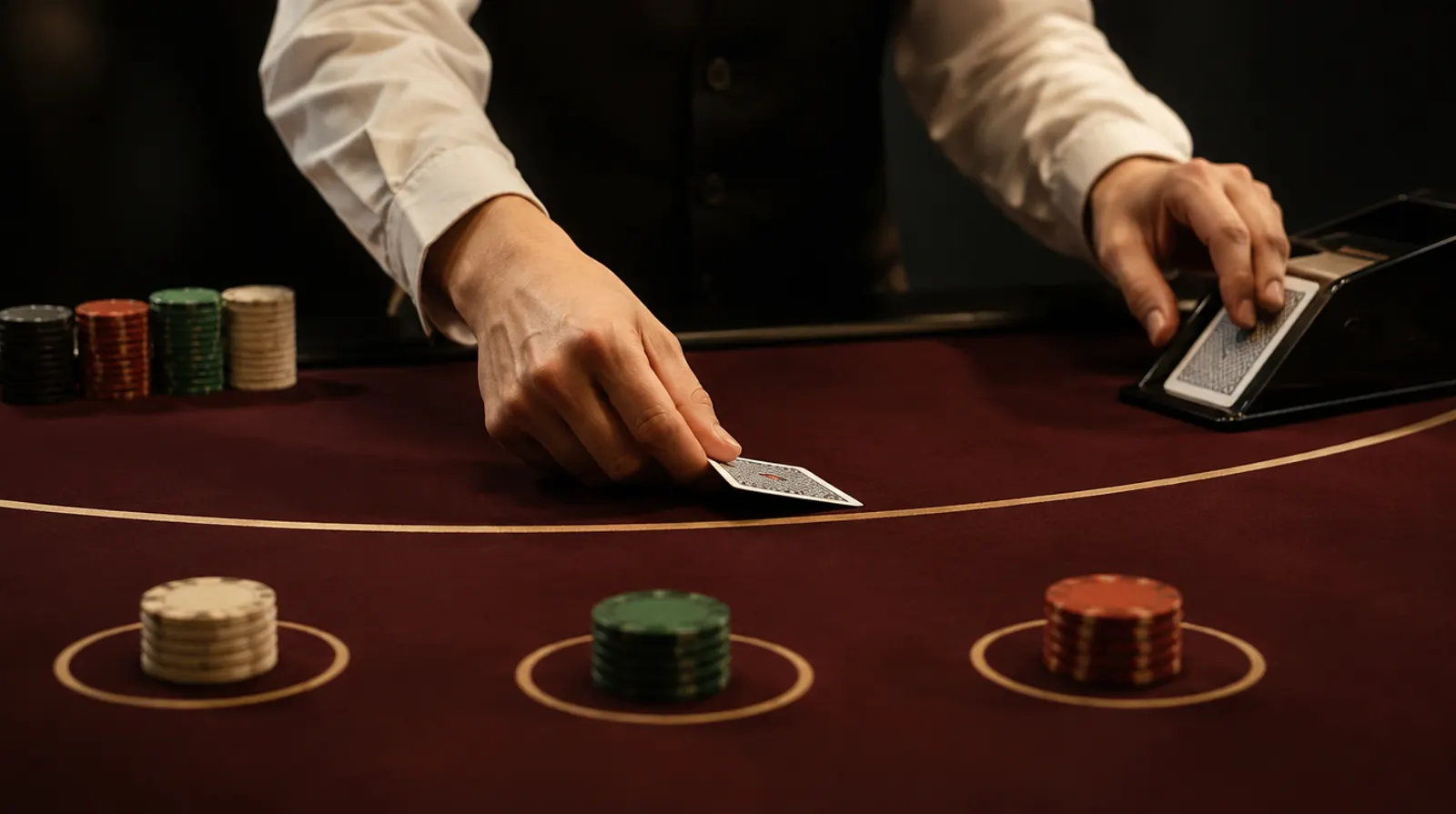
Most blackjack myths fall apart once you look at the maths. No hand is ever “due”, the goal is to beat the dealer rather than reach 21, insurance carries a house edge of about 7.5% in an 8-deck game, and no betting system changes the roughly 0.5% edge of a good live table played with basic strategy. This guide takes the most common myths one by one, including the ones specific to live dealer blackjack: shufflers versus 8-deck shoes, card counting online and “rigged” streams.
Updated October 2026. We checked every number against Wizard of Odds and our own live blackjack guide, corrected the old page’s soft 18 advice and its claim that card counting is “highly profitable”, and replaced casinos that do not accept US players.
Live Blackjack Sites for US Players (October 2026)
All four casinos below accept US players and run live blackjack tables. They are offshore operators without a US state licence, so there is no state regulator to complain to and your balance is not protected; each also excludes some states (see the card terms). In Massachusetts, the Attorney General sent a cease-and-desist letter to Bovada’s operators on 3 October 2024, and Michigan’s Gaming Control Board ordered MyBookie to stop serving Michigan players. Eight states have legalised online casinos: seven markets are live (New Jersey, Pennsylvania, Michigan, West Virginia, Connecticut, Delaware and Rhode Island), and Maine legalised a tribal-only market (LD 1164: became law without the governor’s signature in January 2026, effective 29 July 2026) that had not launched as of October 2026. If you live in a live state, a licensed casino is the regulated choice.
The shortlist
- 1

Bovada
Crypto: 125% up to $1,250 on each of your first 3 deposits ($3,750). Card: 100% up to $1,000 x3 ($3,000)
- 95 live tables and games: 38 blackjack, 10 VIP blackjack, 16 roulette, 15 baccarat (October 2026)
- Separate welcome offers for crypto and card deposits
- Crypto payouts within hours of approval, no Bovada withdrawal fees
Visit siteRead our review18+. 25x rollover on deposit + bonus. Live dealer games count 0% and bonus funds cannot be used at live tables. Not available in AZ, CO, CT, DE, KS, LA, MD, MA, MI, NV, NH, NJ, NY, OH, PA, RI, TN, VT, WV or DC (Bovada terms, October 2026). - 2

Ignition
Crypto: 300% up to $3,000 on your first deposit ($1,500 casino + $1,500 poker). Card: 200% up to $2,000
- Large live lobby: blackjack (incl. high-stakes tables), roulette, baccarat and game shows
- Large US poker room with Zone and Incognito poker on the same account
- Crypto payouts in about 1 hour after approval for most coins
Visit siteRead our review18+. $20 minimum deposit. Casino part 25x deposit + bonus; live dealer games count 0%. Poker part unlocks via Ignition Miles in 30 days. Not available in DE, MD, NV, NJ or NY. - 3

MyBookie
200% up to $2,000 + 50 free spins (code 200MB, $50 minimum deposit)
- More than 60 live tables: 20+ blackjack, 30+ roulette, 14 baccarat incl. Super 6
- Fee-free Bitcoin payouts, usually within 24 hours
- Sportsbook, racebook and casino on one account
Visit siteRead our review21+. Code 200MB, min deposit $50. Rollover 40x bonus + 1x deposit. Live dealer games excluded from bonus wagering. - 4

BetOnline
No Strings welcome: 50% of your first deposit as sportsbook Free Bets (up to $250) + 100 casino free spins
- Two live lobbies: Visionary iGaming and Fresh Deck Studios
- Live blackjack from $1 to $50,000 a hand
- 17 cryptocurrencies; crypto payouts processed within 24 hours
Visit siteRead our review18+. New customers, first deposit of $10+, North America only. Free Bet: sportsbook only, odds of -200 or longer, expires after 30 days. Spins: 10 a day for 10 days, $100 max winnings. Casino bonuses exclude baccarat, roulette, sic bo and craps. No published restricted-state list; Michigan, Tennessee and Massachusetts issued cease-and-desist orders in 2025.
Live dealer blackjack counts 0% towards the casino welcome bonus at Bovada and Ignition, MyBookie excludes live games from bonus wagering, and BetOnline’s welcome offer is sportsbook free bets plus slot spins, so plan to play live tables with cash. Minimums differ too: in our 6 October 2026 lobby check, BetOnline’s live blackjack started at $1, Bovada’s at $10 and Ignition’s at $15. Our rating method explains how we score each site.
Blackjack Myths vs Facts at a Glance
| Myth | What the maths says |
|---|---|
| “I’m due a win after a losing streak” | Past hands do not predict the next one; the edge stays the same |
| “The goal is to get 21” | The goal is to beat the dealer; copying the dealer’s style costs about 5.7% |
| “Always assume the dealer has a 10” | About 30.8% of cards are ten-value; basic strategy already accounts for it |
| “Insure a good hand” | Insurance costs about 7.5% in 8 decks, about 8.5% when you hold two tens |
| “Bad players ruin the table” | Other players’ choices do not change your long-run result |
| “Card counting is illegal” | It is legal; casinos can respond by limiting or barring players |
| “You can count cards online” | Not at RNG tables; impractical at most live tables |
| “Continuous shufflers are rigged against you” | They cut the edge by about 0.014% but speed up play about 20% |
| “Live streams are fake” | Real cards on camera; the bigger risk is the operator, not the deal |
| “A betting system beats the house” | No system changes the house edge; table limits break the Martingale |
You Are Never “Due” a Win
The gambler’s fallacy is the most expensive myth at any table. A run of losses does not make a win more likely on the next hand, and a run of wins does not mean a loss is coming. Think of a coin: the chance of seven heads in a row is 1 in 128, about 0.8%, which sounds rare, yet over thousands of flips it happens again and again, and the eighth flip is still 50/50.
Blackjack has one twist: cards come from a shoe, so the cards already dealt slightly change what is left. That effect is tiny with six or eight decks, it cuts both ways, and it has nothing to do with whether you won or lost the last hand. If you notice yourself raising your bet because you “must” win soon, that is the moment to stop.
Hot and Cold Tables Do Not Exist
Dealers have winning and losing streaks just as players do, because random sequences contain streaks. A dealer who has busted five times in a row is not “cold”, and a table where the dealer keeps drawing to 21 is not “hot”. Picking a seat by recent results, or leaving a table because of them, changes nothing about the next hand. At a live table the round history on screen makes streaks easy to see, which makes the illusion stronger, not more real.
21 Is Not the Goal: Beating the Dealer Is
You win by finishing higher than the dealer without busting, or by staying in while the dealer busts. Chasing 21 makes you hit hands you should stand on. The clearest proof is the “mimic the dealer” strategy: hit to 17 every time, never double or split. Ed Thorp put its house edge at about 5.7%, ten times the cost of basic strategy, largely because you bust first and lose even when the dealer would also have busted (the “double bust”, worth about 8% to the house). The 3:2 payout on blackjack wins back about 2.3 points of that, which is how the net figure ends near 5.7%.
A natural blackjack is also rarer than many players think. In an 8-deck shoe the chance of being dealt one is 2 x (32/416) x (128/415), about 4.75%, or roughly one hand in 21. Our guide to when to hit shows how basic strategy decides between hitting and standing.
New or Bad Players Do Not Ruin Your Hand
When a player at third base hits a 16 that “should” stand, they may take the card that would have busted the dealer. Just as often, they take the card that would have given the dealer 21. Over many hands the effects cancel out, because nobody can know the next card. The same is true when a player joins or leaves mid-shoe: the order of the cards changes, but the odds do not. Your long-run result depends on your decisions and the table rules, not on anyone else’s.
The Dealer Does Not Always Have a 10 in the Hole
Sixteen of the 52 cards in each deck are worth 10, so a ten-value card is the most likely single value for the dealer’s hidden card, at about 30.8%. That still means the hidden card is something else about 69% of the time. Basic strategy already builds the real probabilities into every decision, so there is no need to “assume a ten”. The old version of this page also suggested a dealer could hide an extra card; at a live studio every card is dealt on camera and read by card recognition software, so that is not a realistic concern. Our page on hole card versus no-hole-card blackjack explains how live tables handle the dealer’s second card.
Insurance Does Not Protect a Good Hand
Insurance is a side bet that pays 2:1 if the dealer’s ace turns into a blackjack. In an 8-deck shoe, after the dealer’s ace, 128 of the remaining 415 cards are tens. Three times 128/415 is 0.925, so the bet returns 92.5 cents per dollar: a house edge of about 7.5%. Holding a 20 made of two tens makes it worse, not better: 126 tens remain among 413 cards, which works out to an edge of about 8.5% (our calculation). “Even money” on your own blackjack is the same bet with a different name. More detail is in our blackjack insurance guide.
Card Counting: Legal, but Not a Money Machine
Counting cards in your head is not illegal anywhere in the US. Casinos still decide who plays: in Nevada a casino can refuse to deal to a counter, and Nevada law (NRS 465.075) makes it a crime to use a device to count cards. In New Jersey, the state Supreme Court ruled in Uston v. Resorts International (1982) that Atlantic City casinos could not bar counters on their own authority, so casinos there rely on countermeasures such as shuffling earlier or limiting bets.
The old page called counting “a highly profitable way to play”. For most people it is not. A counter gains only a small edge, needs a large bet spread and a big bankroll to ride out variance, and must play many hours without being noticed. Photographic memory is not required, but disciplined practice is. Read whether you can get banned for winning before you try.
You Cannot Count Cards at Online Blackjack
RNG blackjack effectively shuffles a fresh virtual deck for every hand, so there is nothing to count. Live blackjack is different in theory, because cards come from a physical shoe. In practice it is very hard to profit online:
- Most live tables deal from eight decks, which dilutes the count.
- The cut card is usually placed well before the end of the shoe, so the high-count positions you need rarely arrive.
- The casino records every bet, so a large bet spread is easy to spot, and offshore sites can limit or close accounts under their terms.
- At Infinite-style tables everyone shares the same first two cards, which does not change the maths but makes bet-sizing patterns obvious.
Related techniques such as shuffle tracking and edge sorting face the same problems on camera.
Continuous Shufflers vs 8-Deck Shoes
A continuous shuffling machine (CSM) returns used cards to the stack after every round, so the count never builds. Many players assume that makes the game worse for them. For a basic strategy player the opposite is true by a hair: according to Wizard of Odds, a CSM lowers the house edge by about 0.014% compared with a shoe dealt to a cut card, because it removes the “cut-card effect”. That is about 14 cents per $1,000 wagered.
The real cost is speed. Blackjack writer Don Schlesinger estimates that a CSM game plays about 20% faster because there is no break for shuffling, and more hands per hour means a bigger expected loss per hour at the same stake. An 8-deck shoe with a cut card is the standard format at live studios; neither format changes basic strategy, only whether counting is possible.
Is Live Blackjack Rigged?
A stream from a major studio is not a pre-recorded video. Cards come from a physical shoe on camera, and card recognition software reads each card and displays the totals. Evolution, the largest supplier, is licensed by the Malta Gaming Authority (MGA/CRP/187/2010/01) and the UK Gambling Commission, among others, and those licences require game testing. In the US, though, Evolution supplies only state-licensed casinos. The offshore sites in our list use other studios: Bovada’s tables are labelled Gold Tier Gaming and Dynamite Interactive, MyBookie’s Visionary iGaming, and BetOnline’s Visionary iGaming and Fresh Deck Studios.
No US regulator audits those offshore studios or the operators. So the realistic risk is not a dealer switching cards on camera; it is an operator delaying a withdrawal or voiding winnings under its own terms. Our pages on whether live casinos are rigged and fair dealer games cover what you can check yourself.
Live Blackjack Does Not Change the Odds, the Rules Do
A common belief is that live tables pay better than RNG games, or the other way round. The game format matters less than the rules on the felt. Wizard of Odds measures each rule against an 8-deck baseline:
| Rule | Effect on house edge |
|---|---|
| Blackjack pays 6:5 instead of 3:2 | +1.39% |
| Dealer hits soft 17 | +0.22% |
| No doubling after a split | +0.14% |
| Six decks instead of eight | -0.02% |
| Late surrender | -0.07% |
So the deck-count myth (“more decks make it unbeatable”) is mostly wrong for basic strategy players: six versus eight decks moves the edge by only 0.02%, while a 6:5 payout costs seventy times as much. Pace is the other difference. A busy 7-seat live table deals about 50 to 70 hands an hour, while RNG blackjack can run several hundred, so the same edge costs far more per hour at a software table.
Betting Systems Do Not Beat the House Edge
Raising your bet after wins, or doubling after losses, changes how your results are spread out but not the expected loss per dollar bet. The Martingale shows why. Start at $5 and double after each loss: seven losses in a row cost $635, and the eighth bet of $640 is already above a typical $500 table maximum, so the system cannot recover. Every unit you bet still faces the same house edge. Our progressive betting guide walks through more examples.
Basic Strategy Myths: Soft 18, Splits and Side Bets
- “Always stand on soft 18.” Wrong at a table where the dealer stands on soft 17. Double against a 3 to 6, stand against a 2, 7 or 8, and hit against a 9, 10 or ace. The old page said to stand only against a 2 or 7, which was also wrong.
- “Split tens to win twice.” Never split tens: a 20 wins most of the time already. Do always split aces and 8s. See when to split.
- “Never hit a 12.” Hit 12 against a dealer 2 or 3 and against 7 to ace; stand only against 4, 5 or 6.
- “Side bets improve your odds.” They do the opposite: Perfect Pairs runs at about 4.1% and 21+3 at about 3.7% in 8 decks, against about 0.5% for the main game. Our 21+3 guide has the pay table.
- “Skill means you can win long term.” Basic strategy is the best decision for every hand, and it brings the edge down to about 0.5% at a good table, but the edge stays with the house.
What the Truth Costs: A Worked Example
Take a $10 bet, about 60 hands an hour at a 3:2 live table where the dealer stands on soft 17, played with basic strategy. You wager about $600 an hour and lose about $3 an hour on average. Move to a 6:5 table and the expected loss is about $11.40 an hour. Add a $2 Perfect Pairs bet on every hand and that adds about $4.92 an hour. Take insurance every time the dealer shows an ace and you pay an extra 7.5% on those bets. Each myth has a price, and the cheapest way to play is plain basic strategy at a 3:2 table with no side bets.
Play Responsibly
Blackjack keeps a house edge even when you play perfectly. Decide your budget and session time before you sit down, avoid raising stakes to win back losses, and use deposit limits where the casino offers them. If gambling stops being fun, call or text the National Problem Gambling Helpline at 1-800-MY-RESET (1-800-697-3738), run by the National Council on Problem Gambling. See our responsible gambling page for more help.
Blackjack Myths FAQ
Is card counting illegal?
No. Counting cards in your head is legal in the US. Casinos can still refuse to deal to counters in states such as Nevada, where using a device to count cards is a crime, while New Jersey casinos cannot bar counters and use countermeasures instead.
Can you count cards in online blackjack?
Not at RNG tables, which reshuffle for every hand. At live tables it is possible in theory, but eight-deck shoes, early cut cards and the casino’s view of every bet make it impractical for nearly everyone.
Is live dealer blackjack rigged?
Major studios deal real cards on camera and are tested under their licences. At offshore casinos no US regulator audits the studio or the operator, so the larger risk is a dispute over withdrawals rather than a fixed deal.
Should you always take insurance with a good hand?
No. Insurance has a house edge of about 7.5% in an 8-deck game, and holding two tens makes it worse, about 8.5%, because fewer tens are left for the dealer.
Do continuous shuffling machines hurt your odds?
Not per hand. Wizard of Odds puts the reduction in house edge at about 0.014% for a basic strategy player. They do speed up the game by about 20%, which raises the expected loss per hour.
Does a bad player at the table hurt your chances?
No. Their decisions are as likely to help you as to hurt you on any given hand, and over time the effect averages out to zero.
What is the house edge in blackjack with basic strategy?
About 0.5% at a standard 8-deck live table that pays 3:2 with the dealer standing on soft 17. A 6:5 payout adds about 1.39 percentage points.
More Blackjack Guides
Sources
- Wizard of Odds: blackjack rule variations and house edge
- Wizard of Odds: blackjack insurance
- Las Vegas Advisor: house advantage with a shuffling machine (Wizard of Odds 0.014%; Schlesinger 20% faster)
- Las Vegas Advisor: mimic-the-dealer strategy (-5.6%, Thorp -5.73%, double bust about 8%)
- Nevada Revised Statutes 465.075: use of device to count cards
- Uston v. Resorts International Hotel, Inc., 89 N.J. 163 (1982)
- Evolution: licences (MGA/CRP/187/2010/01, UK Gambling Commission)
- Bovada, Ignition, MyBookie and BetOnline live lobbies via US proxy, 6 October 2026
- Gambling Insider: Maine LD 1164 tribal online casinos
- Massachusetts AG: cease-and-desist letter to offshore casino operator (Bovada)
- Michigan Gaming Control Board orders MyBookie to cease operations
- NCPG: National Problem Gambling Helpline 1-800-MY-RESET
Spotted an error? Email [email protected] with the page address. Verified corrections are made with a dated note.