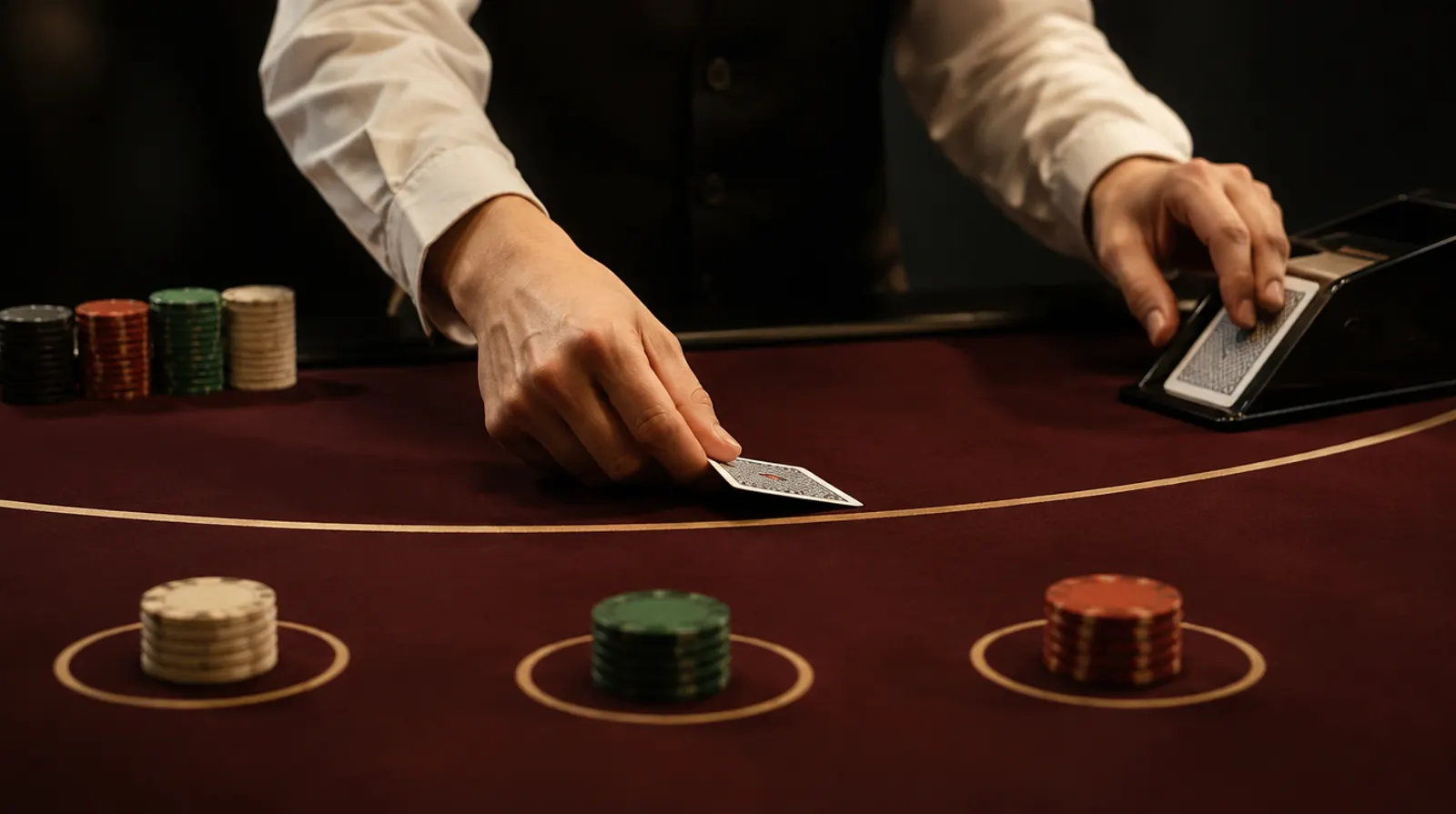
Blackjack variations change one or more of the standard rules, such as how many cards are in the deck, what a blackjack pays or what happens when the dealer reaches 22, and each change moves the house edge. A classic eight-deck table that pays 3:2 and where the dealer stands on soft 17 has a house edge of roughly 0.5% with basic strategy. Spanish 21 can come in slightly lower at 0.40%, while Super Fun 21 runs from 1.16% to 1.40%, so the variant you pick matters more than most players think.
Updated October 2026. We rechecked every rule and payout on this page against the Wizard of Odds rule sheets and the studios’ own game pages, corrected several old claims (Blackjack Switch was not invented in 2009, and Double Exposure does carry a house edge), and added the modern live formats you will meet online.

Blackjack Variations at a Glance
The table compares the variations covered below. House edges assume correct strategy for that game and no side bets. They come from the Wizard of Odds unless another source is named, and the rules listed are the most common version; casinos can and do change them.
| Variation | Key rule changes | Blackjack pays | House edge |
|---|---|---|---|
| Classic (8 decks, dealer stands on soft 17) | The baseline game | 3:2 | About 0.5% |
| Spanish 21 | Tens removed; player 21 always wins; bonus payouts; late surrender | 3:2 | 0.40% (S17) to 0.76% (H17, no redouble) |
| Pontoon (Australian casino) | Tens removed, no hole card, Spanish 21-style bonuses | 3:2 | 0.34% to 0.64% by location |
| Blackjack Switch | Two hands, swap the second cards; dealer 22 pushes | 1:1 | 0.58% (6 decks, H17) |
| Double Attack Blackjack | Tens removed; raise after seeing the dealer’s up card | 1:1 | 0.62% |
| Double Exposure | Both dealer cards face up; dealer wins most ties | 1:1 | 0.26% to 0.96% by casino rules |
| Free Bet Blackjack | Free doubles and splits; dealer 22 pushes | 3:2 | 1.04% (6 decks, H17) |
| Super Fun 21 | Double on any number of cards; six-card 20 or less wins | 1:1 (2:1 in diamonds) | 1.16% to 1.40% |
| Chinese Blackjack (Ban Luck) | Home game; special hands pay 2:1 or 3:1 | 2:1 (ban-luck) | Not published, banker rules vary |
The pattern is easy to spot. Whenever a game hands the player a big advantage, such as seeing both dealer cards or swapping cards between hands, it takes something back, usually by paying blackjack at even money or by turning a dealer 22 into a push. None of these variants beats the house over time when played as dealt, and our blackjack odds and probability guide shows how the underlying numbers work.
Pontoon Packs a British Punch
Pontoon is two different games that share one name. In Britain it is a home and pub game descended from the French vingt-et-un; in Australia and Malaysia it is a casino table game that plays almost exactly like Spanish 21. Neither one is simply “British blackjack”, and the rules below show why.
How do you play British Pontoon?
According to Wikipedia’s account of the traditional rules, each player receives one card face down and places a stake before the second card arrives. The banker may double all stakes after looking at their own card. From there the vocabulary changes:
- Stick means stand. You may not stick on a total below 16.
- Twist means take a free card, dealt face up.
- Buy means take a card face down by adding to your stake. Once you twist, you can no longer buy.
- A pontoon (an Ace with a ten-value card) is paid double unless it comes from a split hand.
- A five-card trick (five cards without busting) beats every hand except a pontoon.
All ties go to the banker, which is the main source of the bank’s advantage. Its name is thought to be a First World War soldiers’ corruption of the French name, and by 1981 Pontoon was reported as Britain’s third most popular card game after rummy and whist.
How is casino Pontoon different?
The casino version found in Australia and Malaysia uses four to eight Spanish decks, which are standard 52-card decks with the four tens removed (jacks, queens and kings stay). The dealer takes no hole card and hits soft 17, while a player 21 or blackjack wins immediately. Bonuses mirror Spanish 21: a five-card 21 pays 3:2, a six-card 21 pays 2:1 and a 21 with seven or more cards pays 3:1. Doubling is limited to 9, 10 and 11 in the version the Wizard of Odds analyses, and late surrender plus “double down rescue” are allowed.
House rules differ from one Australian venue to the next, so the edge does too: the Wizard of Odds lists 0.34% for Canberra, 0.42% for Sydney and 0.64% for Adelaide. If you have played Spanish 21 in an American casino, you already know casino Pontoon.
Spanish 21 Pays for Missing Tens
You will find Spanish 21 in casinos all over the US, according to the Wizard of Odds, and it is the template for several others on this page. It uses six or eight Spanish decks, each with 48 cards. Removing the tens hurts the player, because ten-value cards make blackjacks and good doubles, so the game compensates with a long list of player-friendly rules.
Spanish 21 rules and bonus payouts
- A player 21 always wins, and a player blackjack beats a dealer blackjack.
- You may double on any number of cards, and some casinos allow redoubling up to three times.
- Late surrender is allowed, and so is surrender after doubling (“double down rescue”), where you forfeit an amount equal to your original bet.
- Five-card 21 pays 3:2, six-card 21 pays 2:1 and seven or more cards pays 3:1.
- 6-7-8 or 7-7-7 pays 3:2 in mixed suits, 2:1 suited and 3:1 in spades.
- Suited 7-7-7 against a dealer 7 pays $1,000 on bets of $5 to $24 and $5,000 on bets of $25 or more, and every other player at the table receives a $50 “envy bonus”.
None of the card-count or 6-7-8 bonuses is paid after doubling. With the dealer standing on soft 17 the Wizard of Odds puts the edge at 0.40%. If the dealer hits soft 17 and redoubling is allowed it rises only to 0.42%, but without redoubling it jumps to 0.76%, so check both rules on the felt.
A quick worked example: you bet $10 and draw 5, 4, 3, 2, 7 for a five-card 21. Ordinary tables pay $10. Spanish 21 pays 3:2, or $15, as long as you did not double on the way.
Blackjack Switch Is 21 with a Twist
Blackjack Switch was created by game inventor Geoff Hall. Wikipedia records that he showed it at the G2E trade show in Las Vegas in October 2000, that it was first installed at Harvey’s Casino in Iowa in February 2001, and that the “push on 22” rule was added in 2003 before the game reached the Four Queens in Las Vegas that December. The patent was granted in 2009, which is where the old “invented in 2009” claim came from.
How do you play Blackjack Switch?
You place two bets of equal size and receive two hands, all cards face up. Before playing either hand you may swap the second card of one hand with the second card of the other. The Wizard of Odds gives this example: holding 5-10 and 10-6, you swap the 10 and the 6 to make 11 and 20, a far better pair of hands than 15 and 16.
Two rules pay for that freedom:
- A winning blackjack pays even money (1:1) instead of 3:2, and a blackjack made by switching counts only as an ordinary 21.
- A dealer total of 22 pushes against any player total of 21 or less. Only a natural player blackjack still beats it.
The game uses six or eight decks, the dealer usually hits soft 17, and you may double on any two cards, double after a split and resplit to four hands. Under those Las Vegas rules with six decks the house edge is 0.58% with optimal strategy, close to a good classic table. Because you always play two hands, you wager twice as much per round, so the cost per hour is roughly double that of a single hand at the same edge. An optional Super Match side bet pays on pairs and better among your four cards, from 1:1 for a pair to 40:1 for four of a kind, with a house edge of 2.55% on the paytable the Wizard of Odds analyses.
Double Exposure Blackjack Is One for the Pros
In Double Exposure both of the dealer’s cards are dealt face up, so you always know the total you must beat. It sounds like a licence to print money, and an older version of this page went as far as saying there was no house edge. That is wrong. The house wins its edge back with three rules:
- The dealer wins all ties, except a tied natural blackjack.
- Player blackjack pays even money.
- You may usually split only once, and many casinos restrict doubling.
Other rules vary, including whether the dealer hits soft 17 and whether a tied blackjack pushes or goes to the player. The Wizard of Odds measures how much each one is worth: the dealer standing on soft 17 adds 0.39% to your return, double after split adds 0.32%, and a tied blackjack paid as a win adds 0.22%. Limits on doubling hurt far more, costing 1.04% when you may double only on 9 to 11 and 1.44% when doubling is limited to 10 and 11.
Real casino versions show the range. Atlantic City’s Tropicana, Claridge and Taj Mahal ran an eight-deck game with a 0.66% edge. The Stratosphere in Las Vegas offered a 0.68% version before removing the game, the Grand in Tunica ran one at 0.96%, and the long-closed Lady Luck in Las Vegas had a 0.26% version. Today the game is scarce and sometimes appears as “Dealer Disclosure” or “Face Up 21”. Strategy is very different from standard blackjack, because you never guess at the hole card: you hit any hand that is losing to the dealer’s visible total, and you stand on a stiff hand when the dealer must draw to a likely bust.
Bonus Blackjack Is Big on the Bonus Action
Despite the name, this is not one fixed game. It covers several side bets added to an otherwise normal table, and the Wizard of Odds lists five different versions with very different value. The common idea is a small extra wager that pays when your first two cards form a blackjack, with more for a suited blackjack and the most when you and the dealer both have one.
| Bonus Blackjack version | Example payouts | House edge |
|---|---|---|
| Single deck, two-card hand | Player and dealer blackjack 25, suited blackjack 10, unsuited blackjack 3, pair 2, suited cards 1 | 6.36% |
| Six decks, blackjack only | Player and dealer blackjack 25, suited blackjack 15, unsuited blackjack 5 | 15.01% |
| Six decks, 777 / 678 / suited blackjack | 777 pays 500, 678 pays 50, suited blackjack pays 20 | 40.78% |
| Player or dealer blackjack, 15 to 1 | Each blackjack wager pays 15 to 1 | 22.78% (1 deck) to 24.08% (8 decks) |
The old claim that these games use only two decks and attract card counters does not hold up: the bonus is a side bet, the deck count varies, and every version above costs far more than the main game. Buster Blackjack, which the old page compared it to, is a different side bet that wins when the dealer busts, paying more the more cards the dealer takes (up to 250:1 for eight or more). Its six-deck version carries a 6.21% house edge, and Evolution’s Bust It bet on Infinite Blackjack works the same way at about 6.18%. Our 21+3 side bet guide covers the most common live side bet.
Double Attack Blackjack Is Double the Fun
Double Attack Blackjack borrows the Spanish deck from Spanish 21 and adds one unusual option. The Wizard of Odds notes it was popular in Atlantic City, where about half the casinos once carried it.
How do you play Double Attack?
- Eight 48-card Spanish decks are shuffled together, so there are no tens in the shoe.
- The dealer’s up card is dealt first, before you receive any cards.
- After seeing it, you may “Double Attack” by raising your bet by up to the original amount.
- Your hand is then dealt and played. You may double or surrender at any time, including after splitting, and surrender returns half of both your original and Double Attack bets.
- Standing on soft 17, the dealer also peeks for blackjack. A winning player blackjack pays even money.
The Wizard of Odds’ strategy says to raise when the dealer shows 2 through 8 and to decline against 9, 10 or an Ace. The overall house edge is 0.62%, and because you raise your bet in good spots, the edge measured against your total wager (the “element of risk”) is 0.35%. An optional Bust It side bet pays when the dealer busts with exactly three cards, up to 200 to 1 for a suited 8-8-8, with an 8.01% house edge. Note too that insurance in this game pays 5 to 2.
Free Bet Blackjack Hands Out Free Doubles
Free Bet Blackjack is another Geoff Hall design, and according to the Wizard of Odds it first launched at the Golden Nugget. Online, it is part of Evolution’s live line-up, which includes both a seated and an Infinite version.
- Free doubles on two-card hard totals of 9, 10 or 11. The casino matches your bet with a “free bet” button.
- Free splits on every pair except ten-value cards.
- Dealer 22 pushes against any player hand of 21 or less.
Here is how a free double works in practice. You bet $10, receive 6-4 for a hard 10 and take the free double. Win, and you collect $20 in winnings plus your $10 back. Lose, and only your original $10 goes. That sounds like a pure gift, but the dealer 22 rule turns some of your wins into pushes, and dealer 22 is not rare. According to the Wizard of Odds, the house edge of the six-deck game (dealer hits soft 17) is 1.04%, roughly double a good classic table, and CasinoScores lists Evolution’s version at a 98.45% RTP. The optional Push 22 side bet, which wins when the dealer makes 22, carries a house edge of about 11.8% under the same six-deck rules. Because the free bets change the maths, correct strategy doubles and splits more often than at a classic table.
Super Fun 21 Is Generous on Paper
This game throws almost every player-friendly rule into one game. You may double on any number of cards, resplit to four hands including Aces, take late surrender on any number of cards and surrender half your total bet after doubling. A hand of six or more cards totalling 20 or less wins automatically, and a 21 of five or more cards pays 2:1 instantly (neither bonus applies after doubling). A player blackjack always wins.
The catch is the blackjack payout. Every blackjack pays even money, except one in diamonds, which pays 2:1. Since blackjacks are where a classic player earns most of the 3:2 premium, losing that payout costs more than the extra rules give back. The Wizard of Odds puts the house edge at 1.16% with one deck, 1.30% with two and 1.40% with six, all with the dealer hitting soft 17.
Chinese Blackjack Promises Far East Fun
Chinese Blackjack, known as Ban Luck in Singapore and also called Kampung Blackjack, is played across South East Asia, mostly as a home and festive game, especially around Chinese New Year. An older version of this page said nearly all Asian casinos offer it. We found no evidence of that; it is a social game played with a rotating banker, and house rules differ from one table to the next. The common rules, as summarised by Wikipedia, are:
- Each player and the dealer start with two cards.
- An Ace counts as 1, 10 or 11 in a two-card hand, 1 or 10 in a three-card hand and only 1 in a hand of four or more cards.
- Ban-ban (two Aces) wins at 3 to 1, the best hand in the game.
- Ban-luck (an Ace with a ten-value card) wins at 2 to 1.
- A five-card hand that stays at 21 or less wins at 2 to 1.
- Players must reach at least 16 before they may stand.
The dealer’s options are what make it feel different. Once the dealer reaches at least 16, they may choose individual players to reveal their hands and settle with them, then draw again before facing the rest of the table. That selective settling gives the dealer real decisions, unlike a casino dealer who follows fixed rules. Because the rules are informal, no reliable house edge exists, and payouts such as “2 to 1” are sometimes read as total return rather than profit, so agree on the rules before anyone puts money down.
Live Dealer Blackjack Variations Online
Most US players looking for variations online will find the live dealer formats built by the major studios, and our live blackjack hub covers them in depth. The headline numbers, using the same figures as the hub:
| Live format | What is different | RTP (optimal play) |
|---|---|---|
| Classic (Evolution standard) | 7 seats, 8 decks, dealer stands on all 17s, 3:2 | About 99.5% |
| Infinite Blackjack | Unlimited players share the first two cards; Six Card Charlie | 99.47% |
| Power Blackjack | 9s and 10s removed; double, triple or quadruple down | 98.8% |
| Free Bet Blackjack | Free doubles and splits; dealer 22 pushes | 98.45% |
| Lightning Blackjack | 100% Lightning fee on every initial bet; 2x to 25x multipliers | Not published on Evolution’s game page |
RTP sources are the same as on our hub: Evolution’s game pages for the rules, casinos.com for Infinite Blackjack, CasinoScores for Free Bet Blackjack and SlotCatalog for Power Blackjack. Infinite Blackjack is the closest live game to the classic maths, while Lightning Blackjack’s fee doubles the money on the table every round, so a $10 hand costs $20. Many live tables also use the no-hole-card rule; our guide to hole card vs no hole card blackjack explains what that costs you.
How Rule Changes Move the House Edge
Every variant above is really a bundle of rule changes. Measured against an eight-deck baseline where the dealer stands on soft 17, the Wizard of Odds rule tables used on our hub give these effects (a plus sign means worse for you):
| Rule change | Effect on house edge |
|---|---|
| Blackjack pays 6:5 instead of 3:2 | +1.39% |
| Dealer hits soft 17 | +0.22% |
| No doubling after a split | +0.14% |
| Six decks instead of eight | -0.02% |
| Late surrender | -0.07% |
| Single deck instead of eight | -0.48% |
The payout on blackjack dwarfs everything else, which is why even-money games like Switch, Double Exposure and Super Fun 21 must give back a lot elsewhere. Surrender options appear in Spanish 21, Pontoon and Double Attack because they are a cheap way to make a game look generous; our guide on when to surrender in blackjack shows when to use them.
Worked example: what each variant costs per hour
Take $10 a hand at about 60 hands an hour, which puts $600 into action before doubles and splits. The expected loss is the amount wagered multiplied by the house edge:
- Spanish 21 (0.40%): about $2.40 an hour.
- Classic 8-deck table (about 0.5%): about $3.
- Free Bet Blackjack (1.04%): about $6.24.
- Super Fun 21, six decks (1.40%): about $8.40.
- Blackjack Switch (0.58%) with two $10 hands: $1,200 wagered, so about $6.96.
- A $5 Bonus Blackjack side bet at 15.01% on every hand: another $300 wagered and about $45 more expected loss.
Those are long-run averages; any single session can swing far above or below them. The example also shows why side bets, not the base variant, usually decide how expensive a session is. If you are tempted by insurance at any of these tables, our blackjack insurance guide explains why its roughly 7.5% edge in an eight-deck game makes it a poor bet.
Where Can US Players Play Blackjack Variations?
Eight states have legalised online casinos; seven markets are live (NJ, PA, MI, WV, CT, DE, RI); Maine legalised a tribal-only market (LD 1164: became law without the governor’s signature in January 2026, effective 29 Jul 2026) that has not launched (Oct 2026). In those live states, licensed casinos stream Evolution’s tables, including the Infinite, Free Bet, Power and Lightning formats in its portfolio, though each casino chooses which tables it carries. Spanish 21, Double Attack and similar shoe games are mostly found in land-based casinos. Outside the regulated states, US-facing offshore sites hold no US state licence, so there is no state regulator to complain to and your funds are not protected. Our blackjack hub lists the live tables and sites that accept US players.
Whichever variant you choose, set a budget and a time limit before you play. If gambling stops being fun, the National Problem Gambling Helpline is available on 1-800-MY-RESET (1-800-697-3738), and our history of blackjack traces how the game and its many variations developed.
Blackjack Variations FAQ
Which blackjack variation has the lowest house edge?
Among widely available games, Spanish 21 with the dealer standing on soft 17 (0.40%) and Australian casino Pontoon in Canberra (0.34%) are among the lowest, alongside a classic table at about 0.5%. Rare single-deck or Double Exposure games with good rules can be lower, but they are hard to find.
What is the difference between Pontoon and blackjack?
British Pontoon deals one card before betting, uses stick, twist and buy instead of stand and hit, forbids standing below 16 and gives the banker all ties. Casino Pontoon in Australia and Malaysia is a Spanish 21-style game with the tens removed and bonus payouts.
Is Spanish 21 better than regular blackjack?
It can be. With the dealer standing on soft 17 the Wizard of Odds puts the edge at 0.40%, slightly below a classic table, but it rises to 0.76% if the dealer hits soft 17 and redoubling is not allowed. Correct strategy also differs from standard basic strategy.
Is Free Bet Blackjack worth playing?
The free doubles and splits are real, but the dealer 22 push costs more than they give. The Wizard of Odds calculates a 1.04% house edge for the six-deck game, and CasinoScores lists Evolution’s live version at 98.45% RTP, both worse than a good classic table.
Why does Blackjack Switch pay only even money on blackjack?
Switching cards between your two hands is a large advantage, so the game pays blackjack at 1:1 and lets a dealer 22 push against your hand. With six decks and the dealer hitting soft 17, the house edge ends up at 0.58%.
Can I play blackjack variations online in the US?
Yes, in the seven live states with regulated online casinos, where licensed sites carry live formats such as Infinite and Free Bet Blackjack. Classic shoe variants like Spanish 21 and Double Attack are mainly found in land-based casinos.
Sources
- Wizard of Odds: Spanish 21 rules and house edge
- Wizard of Odds: Pontoon (Australian casino version)
- Wizard of Odds: Blackjack Switch
- Wizard of Odds: Double Exposure blackjack
- Wizard of Odds: Double Attack Blackjack
- Wizard of Odds: Free Bet Blackjack
- Wizard of Odds: Super Fun 21
- Wizard of Odds: Bonus Blackjack side bets
- Wizard of Odds: Buster Blackjack side bet
- Wizard of Odds: blackjack rule variations
- Wikipedia: Blackjack switch (history, Geoff Hall)
- Wikipedia: Pontoon (card game)
- Wikipedia: Chinese Blackjack
- Evolution: live blackjack variants
- Casinos.com: Infinite Blackjack RTP
- CasinoScores: Free Bet Blackjack RTP
- SlotCatalog: Power Blackjack RTP
- SBC Americas: Maine legalises online casinos (January 2026)
- NCPG: National Problem Gambling Helpline (1-800-MY-RESET)
Spotted an error? Email [email protected] with the page address. Verified corrections are made with a dated note.