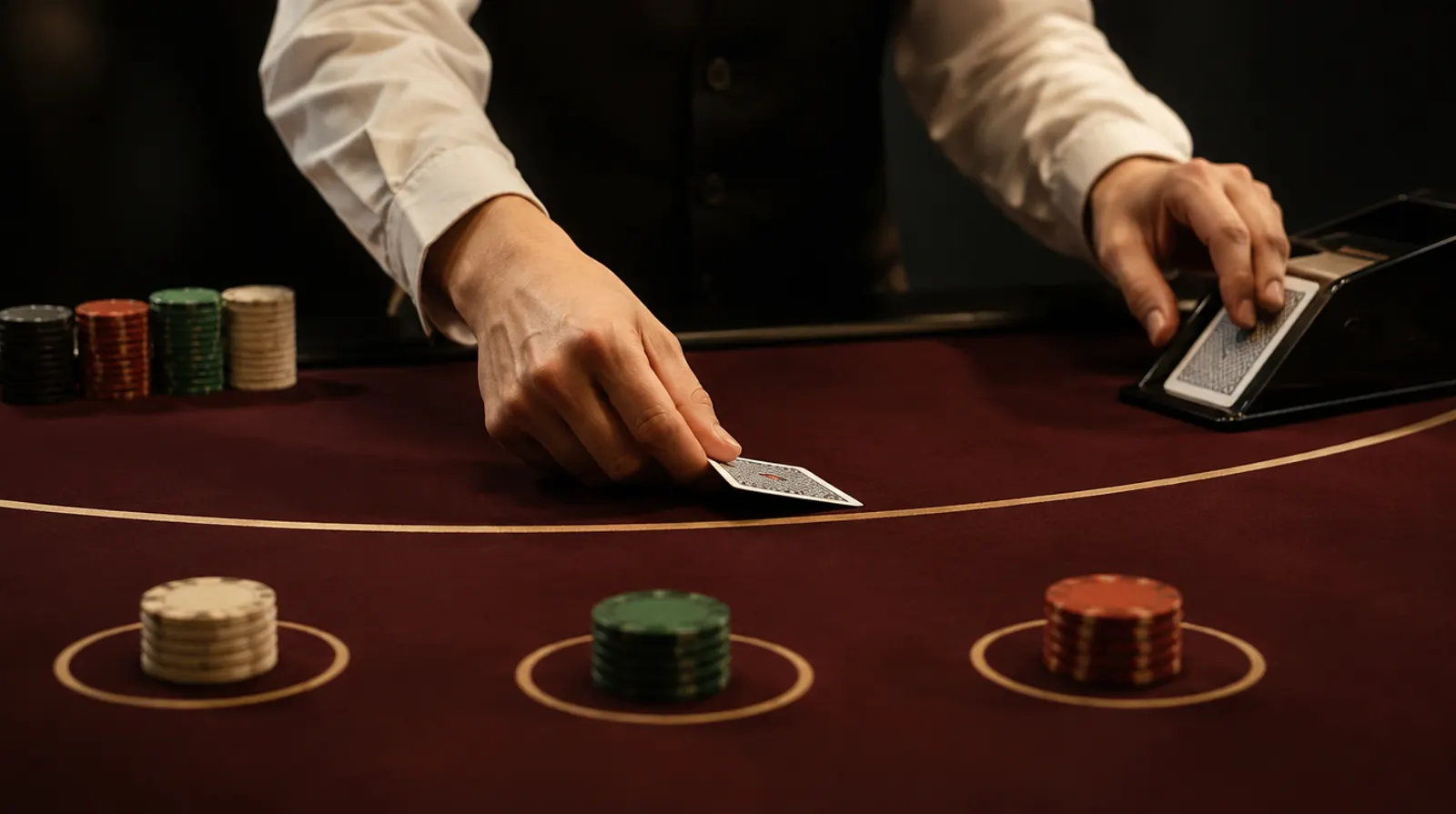
To deal blackjack the way a casino does, you shuffle and offer the cut, burn the first card, then deal one card face up to each betting spot clockwise from your left, one card to yourself, and a second card to each spot. Your own second card comes either face down as a hole card or after the players have acted, depending on the house rules. Players then decide in turn from first base, you play your hand by fixed rules, and you settle the bets, paying a blackjack at 3:2 and other wins at 1:1. The steps below follow the procedures written into New Jersey’s casino regulations (N.J.A.C. 13:69F), with notes where other casinos and live studios differ.

If you only want to play, our live blackjack guide covers the rules, table types and where US players can play legally. This page is about the dealer’s side of the table: equipment, shuffle, deal, payouts and the hand signals that keep it all on camera.
The Table and Equipment
Most blackjack tables are half-moons with up to seven betting spots. The seat on the dealer’s left, which receives the first card, is called first base; the seat on the dealer’s right, which acts last, is third base. Several pieces of kit sit in front of the dealer:
- Shoe: a box holding several decks, usually four to eight, and lets the dealer slide out one card at a time. Under New Jersey’s rules the dealer takes each card from the shoe with the left hand, turns it face up and places it with the right.
- Discard rack: used cards go here, in order, until the shoe is finished and the cards are shuffled again.
- Cut card: plastic, playing-card sized, and used to cut the shuffled stack and to mark where the shoe ends.
- Chip tray: holds the table’s bank, from which winning bets are paid.
- Shuffling machine (optional): either a batch shuffler, which shuffles one set of cards while the other is in play, or a continuous shuffling machine (CSM), which takes used cards back after each round and mixes them in again.
The felt itself carries the key rules, typically “Blackjack pays 3 to 2”, “Insurance pays 2 to 1” and either “Dealer must draw to 16 and stand on all 17s” or a line saying the dealer hits soft 17. Those three lines tell a player most of what they need to know about the table’s house edge.
Opening the Table and Washing the Cards
New cards arrive at the table sealed and are checked before play. New Jersey’s rules require the dealer to spread them face up for the first players to see, in fan-shaped columns by deck, sorted by suit and in sequence. That lets anyone confirm the decks are complete.
Next comes the wash, also called a chemmy shuffle. The dealer turns the cards face down, spreads them across the felt and mixes them with flat, circular movements of both hands, then gathers them into a stack. A wash is the first stage of randomising brand-new decks, which arrive in order.
Shuffling: Riffle, Strip, Box and Cut

Regulators set the goal rather than the choreography. New Jersey’s rule says only that the cards must be shuffled “so that they are randomly intermixed”, and it lets each casino set its own shuffle, cut card placement and burn procedures in its internal controls. A typical hand shuffle for a multi-deck shoe uses these moves:
- Break the stack: split the cards into manageable working stacks, because six or eight decks are too many to shuffle in one go.
- Riffle: cut a stack into two halves and let the corners interleave as they fall together.
- Strip: pull small packets off the top and drop them into a new pile, reversing their order.
- Box: cut the stack into a few blocks and restack them in a different order.
- Repeat and recombine: riffle again and merge the working stacks into one.
- Offer the cut: hand the stack to a player with the cut card.
Many casinos now skip most of this with machines. A batch shuffler mixes the next shoe while the current one is dealt. A CSM goes further: used cards go back in after each round, so there is no fixed end to the shoe. That makes card counting ineffective, since the composition of the remaining cards never drifts far from normal.
The Cut and the Cut Card
After the shuffle the dealer offers the stack to a player, backs facing away. Under New Jersey’s rules the player inserts the cut card at least 10 cards in from either end. The dealer moves all cards in front of the cut card to the back, then inserts the cut card again at least about one quarter of the way in from the back of the stack, and loads the shoe.
That second cut card controls penetration, the share of the shoe dealt before a reshuffle. With the cut card a quarter from the back, roughly three quarters of the cards are dealt. When the cut card comes out, the dealer finishes the current round and then shuffles.
New Jersey also sets who cuts: the first player at a new table, otherwise the player on whose spot the cut card appeared, or the player farthest to the dealer’s right if it appeared on the dealer’s hand or the casino called the shuffle. If that player declines, the cut passes clockwise; if everyone declines, the dealer cuts.
Burning a Card
Before the first round of a new shoe, the dealer removes the top card face down and puts it straight into the discard rack. This is the burn card. New Jersey’s rules also require each new dealer who comes to the table to burn one card before dealing, and the burn card must be shown to a player who asks to see it. Burning makes it harder for anyone who glimpsed the bottom of the stack during the cut to know the first card in play.
Dealing the First Two Cards
Once bets are down, the deal follows a fixed order. Wikipedia’s summary and New Jersey’s rules agree on it:
- One card face up to each spot with a wager, starting at first base and moving clockwise to third base.
- One card face up to the dealer.
- A second card face up to each spot, in the same order.
- The dealer’s second card, if the house deals a hole card at this point (see the next section).
After the deal the dealer announces each player’s total, starting from first base. New Jersey’s rules still make players responsible for checking their own totals.
Shoe Game vs Pitch Game
| Feature | Shoe game | Pitch game (hand-held) |
|---|---|---|
| Decks | Usually 4 to 8 | Usually 1 or 2 |
| How cards are dealt | From a shoe | From the dealer’s hand |
| Players’ cards | Face up | Face down |
| May players touch their cards? | No | Yes, with one hand |
| Burn card | One card per new shoe and per new dealer (NJ) | Optional at casino’s choice (NJ) |
In a pitch game under New Jersey’s rules, a player who busts turns the first two cards over face down at once, and the dealer collects the losing bet immediately. At the end of the round the dealer turns over the remaining players’ cards and settles.
The Dealer’s Second Card: Hole Card or Not
This step is where casinos differ most. New Jersey’s regulations offer three versions:
- Default: the dealer has only the up card while players act. After the last player finishes, the dealer announces “Dealer’s Card” so everyone at the table can hear and then draws the second card face up. This is the no hole card order used in Europe.
- Unseen hole card: the dealer deals the second card face down after the players’ second cards but does not look at it until the players are done.
- Card reader: the dealer deals the hole card face down and, when the up card is an Ace or a ten-value card, slides it face down into a card reader that shows only whether it makes blackjack. If it does, no more cards are dealt and the round is settled.
Where the dealer’s blackjack comes after players have doubled or split, New Jersey’s rules let the dealer collect only the original wager, not the extra amount. Our guide to hole card vs no hole card blackjack explains what each version costs the player and how basic strategy changes.
Insurance and Even Money
When the dealer’s up card is an Ace, insurance is offered before any player acts. Players may place up to half their original bet on the insurance line. In New Jersey the bet wins if the dealer’s second card is a ten-value card and pays 2:1; losing insurance bets are collected as soon as the dealer’s second card is revealed and before the dealer draws further cards. A player holding blackjack may be offered even money instead: an immediate 1:1 payout in place of waiting for the dealer’s card.
Insurance is a poor bet for players. In an eight-deck game, 128 of the 415 unseen cards are ten-value after the dealer’s Ace, which gives the bet a house edge of about 7.5%. Our blackjack insurance guide has the full working.
Player Decisions and Hand Signals
Players act one at a time from first base. Casinos ask for hand signals as well as words, because the overhead cameras record gestures but not speech. Wikipedia notes that this video settles disputes, catches dealer mistakes and protects against chip theft and cheating. The standard signals are:
| Decision | Shoe game (cards face up) | Pitch game (cards in hand) |
|---|---|---|
| Hit | Tap the table with a finger, or wave a hand toward the body | Scrape the cards lightly on the felt |
| Stand | Wave the hand horizontally over the cards | Slide the cards face down under the chips |
| Double down | Place chips beside the original bet, outside the betting box, and point with one finger | Same chip placement |
| Split | Place chips next to the original bet, outside the box, and make a V with two fingers | Same chip placement |
The dealer completes each decision before moving on. A double gets one card only. On a split, the dealer finishes the hand on the dealer’s left first, and split Aces receive one card each with no further draws. Where surrender is offered, New Jersey requires the player to choose it before any other decision. Our strategy guides to hitting, splitting pairs and surrendering explain when each move is correct.
How the Dealer Plays the Hand
The dealer has no choices. In New Jersey a casino picks one of two drawing rules and posts it:
- Stand on all 17s (S17): the dealer draws until reaching any total of 17 to 21.
- Hit soft 17 (H17): the dealer also draws to a soft 17, such as Ace-6, and stands on soft 18 or more.
New Jersey’s 6:5 tables must use the hit soft 17 rule. If every player has already busted or the result is settled, the dealer draws no more cards. For players the difference matters: according to the Wizard of Odds rule tables, hitting soft 17 adds about 0.22 percentage points to the house edge, and a 6:5 payout adds about 1.39 points.
Paying and Collecting
A player blackjack is handled as soon as the dealer can be sure of the result. In New Jersey, if the dealer’s up card is 2 through 9, the dealer pays the blackjack at 3:2 straight away and removes the cards. With an Ace or ten-value card showing, the dealer announces the blackjack but waits until the dealer’s own second card is known: if the dealer also has blackjack, the hand is a push.
Everything else is settled after the dealer’s hand is complete. Winning hands are paid 1:1, ties push, and a dealer blackjack beats a player’s 21 made with three or more cards. Dealers learn the 3:2 amounts by heart:
| Bet | Blackjack at 3:2 | Blackjack at 6:5 | Regular win (1:1) |
|---|---|---|---|
| $5 | $7.50 | $6 | $5 |
| $10 | $15 | $12 | $10 |
| $25 | $37.50 | $30 | $25 |
| $100 | $150 | $120 | $100 |
The player keeps the original bet on top of each payout. On New Jersey’s 6:5 tables all bets must be in multiples of $5, which keeps the 6:5 payout in whole dollars.
Clearing the Table
At the end of the round the dealer picks up the cards in a set order so that every hand can be rebuilt if there is a dispute. New Jersey’s rules require the dealer to start with the player on the far right (third base), move counterclockwise around the table, then place the dealer’s own cards beneath the players’ cards and put the whole packet in the discard rack. If the cut card appeared during the round, the dealer then empties the shoe into the discard rack, checks that no cards are missing and shuffles.
How Live Dealer Blackjack Is Dealt
Online live tables follow the same choreography with a few changes. Bets are placed through the screen during a countdown, and decisions are made with buttons instead of hand signals. Each card is read electronically as it leaves the shoe so that totals and results appear on screen, and the dealer does not need to announce them. Evolution’s standard live tables use eight decks and the dealer stands on all 17s; check each table’s help screen for its dealing procedure and any peek rule. Our explainer on how live dealer casinos work covers the studio side, from cameras to card recognition.
Dealing Blackjack at Home
A home game does not need a shoe or a pit boss, but borrowing the casino order keeps it fair and fast:
- Use at least two decks, wash and riffle thoroughly, and have a player cut.
- Burn the top card and place a cut card about three quarters of the way through.
- Deal clockwise from the player on your left, all cards face up, and agree before play whether the dealer takes a hole card.
- Write the house rules down: blackjack pays 3:2, dealer stands on all 17s, double on any two cards, split once.
- Rotate the deal so no one player is the house all night, because the dealer has the edge.
Whether you deal or play, set a budget before the first hand. For real-money play, use only casinos licensed in your state, and if gambling stops being fun, call 1-800-MY-RESET (1-800-697-3738).
How to Deal Blackjack: FAQ
Which direction do you deal cards in blackjack?
Clockwise from the dealer’s left. The first card goes to the player at first base (the dealer’s left), then around the table to third base, then one card to the dealer, then a second card to each player in the same order.
Does the blackjack dealer burn a card?
Yes, in casinos. After each new shoe is loaded the dealer removes the top card face down and places it in the discard rack. Under New Jersey’s rules every new dealer who comes to the table also burns one card, and the burn card must be shown to a player who asks.
Is the dealer’s first card face up or face down?
The dealer’s first card is dealt face up and is called the up card. The second card is either a face-down hole card or, in no hole card games, a card drawn only after all players have finished.
How do you pay a blackjack at 3:2?
Pay one and a half times the bet: $15 on a $10 bet, $37.50 on a $25 bet and $150 on a $100 bet, with the player keeping the original stake. On a 6:5 table the same $10 blackjack wins only $12.
Can players touch the cards in blackjack?
Not in a shoe game, where all player cards are dealt face up and only the dealer handles them. In a hand-held pitch game, cards are dealt face down and players may pick them up with one hand.
Why do blackjack dealers use hand signals?
Overhead cameras record gestures but not speech, so hand signals give a clear video record of every hit, stand, double and split. That record is used to settle disputes, spot dealer mistakes and guard against cheating.
When does the dealer reshuffle in blackjack?
When the cut card comes out of the shoe, the dealer finishes that round and then shuffles. In New Jersey the cut card is placed at least about one quarter of the way in from the back of the stack, so roughly three quarters of the shoe is dealt. Tables with a continuous shuffling machine have no fixed reshuffle point.