The difference between hole card and no hole card blackjack comes down to one question: when does the dealer get a second card? In the American hole card game the dealer takes it face down at the start and checks it for blackjack, so you never double or split into a hand that has already lost. European no hole card blackjack (often shortened to ENHC) delays that second card until every player has acted, so money you added by doubling or splitting can still be lost to a dealer blackjack. The Wizard of Odds puts the cost of that rule at about 0.11 percentage points of house edge, and it changes four basic strategy plays.
This guide explains how each procedure works, what it costs, which hands you should play differently, and how to check the rule at a live table before you sit down. For the full rules, table types and where US players can play legally, see our live blackjack guide.
What Is the Hole Card in Blackjack?
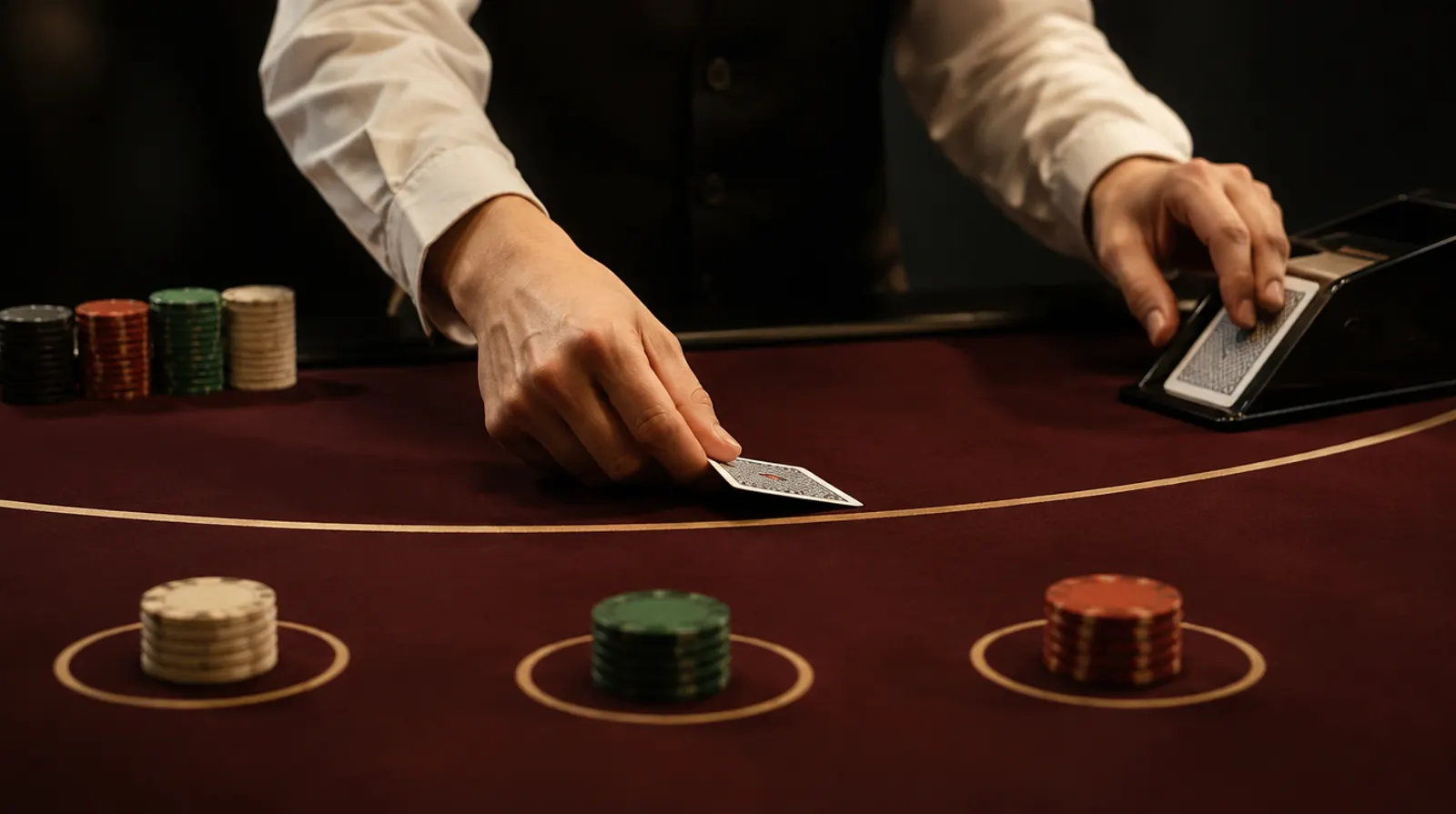
The hole card is the dealer’s face-down card. In a standard American game each player and the dealer receive two cards; the dealer’s first card is dealt face up (the up card) and the second is dealt face down. Players see the up card and nothing else.
That face-down card matters because of the peek. When the up card is an Ace or a ten-value card (10, Jack, Queen or King), the dealer checks the hole card for blackjack before anyone plays. Most casino tables use a small peek window or mirror device so the dealer can do this without lifting the card. If the dealer has blackjack, the hand ends at once: every player without a blackjack loses the original bet, and a player with blackjack pushes. Without a dealer blackjack, play continues and you know for certain that the dealer cannot have a natural.
When an Ace shows, insurance is offered first, then the peek follows. Our guide to how blackjack is dealt walks through the full dealing order step by step.
What Is No Hole Card Blackjack?
No hole card blackjack is the version long used in European casinos. The dealer takes one card face up during the initial deal and draws the second card only after every player has finished their hand. Since there is no second card yet, there is nothing to peek at.
Under the usual European rule the player loses the full amount on the table if the dealer then makes blackjack, including money added by doubling and splitting. Wikipedia’s blackjack article describes no hole card games as prevalent in European casinos, and the Wizard of Odds notes that many online casinos offer the rule as well.
Two claims you may see elsewhere are wrong. No hole card blackjack is not tied to a two-deck shoe: the rule appears with any number of decks, and the Wizard of Odds European strategy chart assumes six decks. Nor does it limit you to splitting tens once. Split rules are set separately by each casino.
Hole Card vs No Hole Card: Side by Side
| Feature | Hole card (American) | No hole card (European) |
|---|---|---|
| Dealer’s second card | Dealt face down at the start | Drawn after all players have acted |
| Peek for blackjack | Yes, with an Ace or ten-value up card | No |
| Dealer blackjack vs your double or split | Cannot happen, the round ends before you act | You lose the original bet plus the doubles and splits (unless OBO applies) |
| Effect on house edge | Baseline | About +0.11 percentage points (Wizard of Odds) |
| Basic strategy | Standard chart | Four plays change against a 10 or Ace |
How Much Does the No Hole Card Rule Cost?
The Wizard of Odds measures rule changes against a baseline of eight decks, dealer stands on soft 17, double on any first two cards, double after split allowed and splitting to four hands. On that scale the European no hole card rule costs the player about 0.11 percentage points. Roughly 0.08 points of that comes from doubled bets and 0.03 points from split bets.
| Rule (vs the hole card baseline) | Effect on house edge |
|---|---|
| European no hole card, lose all doubles and splits | +0.11% |
| No hole card, doubling losses only | +0.08% |
| No hole card, splitting losses only | +0.03% |
| No peek with a ten showing | +0.10% |
| No peek with an Ace showing | +0.01% |
| Original bets and busted bets only (OBBO) | +0.03% |
| BB+1 (Australian rule) | +0.01% |
Source: Wizard of Odds rule-variation tables. A plus sign means the rule is worse for you. For scale, the same tables put a 6:5 blackjack payout at +1.39% and a dealer who hits soft 17 at +0.22%, the figures we also use on our blackjack hub. On a classic table with a house edge of roughly 0.5%, the no hole card rule nudges the edge to around 0.6%. The Wizard of Odds lists 0.62% for its six-deck European game, which also restricts doubling to hard 9 to 11.
Most of that cost sits with a ten up, not an Ace, because with an Ace showing basic strategy rarely doubles or splits anyway, while 11 against a 10 and a pair of 8s against a 10 are common, expensive situations.
How Often Does the Dealer Have Blackjack?
The risk is easy to put in numbers. In an eight-deck shoe, once the dealer’s up card is out, 415 cards remain unseen (ignoring the players’ cards).
- Ten-value card showing: 32 Aces remain, so the chance of a dealer blackjack is 32/415, about 7.7%.
- Ace showing: 128 ten-value cards remain, so the chance is 128/415, about 30.8%. That same figure is why insurance, which pays 2:1, carries a house edge of about 7.5% in an eight-deck game. Our blackjack insurance guide shows the working.
Worked Example: 11 Against a 10
You bet $10 and hold 11 against a dealer 10.
- Hole card game: the dealer peeks first. About 7.7% of the time the dealer has blackjack and you lose only $10, before you could double. The rest of the time you double to $20 knowing the dealer has no natural.
- No hole card game, lose all: if you double, about 7.7% of the time the dealer draws an Ace for blackjack and you lose $20. That extra $10 at risk is why the correct play becomes a hit.
- No hole card game with OBO: the dealer blackjack takes only your original $10 and returns the $10 double, so you double just as you would in a hole card game.
Basic Strategy Changes for No Hole Card Blackjack
According to the Wizard of Odds, a no hole card game where you lose doubles and splits to a dealer blackjack needs four changes to multi-deck basic strategy:
| Your hand | Dealer up card | Hole card game | No hole card (lose all) |
|---|---|---|---|
| Hard 11 | 10 | Double | Hit |
| Pair of 8s | 10 | Split | Hit |
| Pair of 8s | Ace | Split | Hit |
| Pair of Aces | Ace | Split | Hit |
Everything else stays the same, including hit and stand decisions. The general lesson is to be more conservative about adding money when the dealer shows a 10 or an Ace. Splitting Aces against a 10 is still correct, and so is splitting 8s against a 2 through 9. For the reasoning behind each split, read when to split in blackjack, and for doubling decisions see our guide to doubling down.
Surrender interacts with the rule too. In hole card games that offer late surrender, the dealer checks for blackjack before surrender is allowed, so you cannot surrender a hand that has already lost. If a no hole card table offers surrender at all, read the help screen to see whether it applies against an Ace or ten. Our surrender guide covers the standard plays.
OBO, OBBO and BB+1: The Halfway Rules
Some no hole card games soften the blow with a protective rule:
- OBO (original bets only): if the dealer makes blackjack, you lose only the original stake on each hand and doubles and splits are pushed. That makes the game play like a hole card game, so standard strategy applies.
- OBBO (original and busted bets only): you lose your original bets plus any hands that already busted. Its cost, per the Wizard of Odds, is about 0.03 points.
- BB+1: the Australian version, where you lose all busted bets plus one unit if the dealer gets blackjack, costing about 0.01 points.
Hole Card Rules in US Casinos
Even in the US, the American hole card game is not universal. New Jersey’s blackjack regulations (N.J.A.C. 13:69F-2.6) describe a default procedure in which the dealer announces “Dealer’s Card” and draws the second card only after every player has finished, which is the European order. The same rules protect players against a later dealer blackjack: the dealer collects only the original wager, not the extra amount from doubling down (13:69F-2.10(b)) or splitting pairs (13:69F-2.11(d)). That is OBO by regulation.
New Jersey casinos may instead deal a face-down hole card that the dealer does not look at until the players are done, or use a card reader device. With a card reader, when the up card is an Ace or a ten-value card, the dealer checks whether the hole card makes blackjack before any more cards go to the players (13:69F-2.6(j)). Other states write their own rules, so read the felt or the rules screen at each table.
Which Rule Do Live Dealer Tables Use?
Live tables vary by studio and by table, so the help screen is the only reliable answer. Descriptions of Evolution’s classic live blackjack say the dealer’s second card is dealt face down, and when the up card is an Ace the dealer checks for blackjack after insurance has been offered. Other studios may deal the dealer’s second card later. Look for these phrases in the rules panel:
- “Dealer peeks for blackjack” or “dealer checks for blackjack”: a hole card procedure, at least for the up cards listed.
- “Dealer’s second card is dealt after all players have acted” or “European rules”: no hole card.
- “Only the original bet is lost” or similar: OBO protection applies.
When the rules panel says nothing, assume the stricter version and skip doubling 11 against a 10. Other rules usually matter more than the hole card: a 6:5 payout or a dealer who hits soft 17 costs far more, as our blackjack odds guide explains. Play only at casinos licensed in your state, set a budget, and if gambling stops being fun, call 1-800-MY-RESET (1-800-697-3738).
What Is Hole Carding?
Hole carding means seeing the dealer’s hole card when it is accidentally exposed, for example when a dealer lifts it too high while checking for blackjack. A player who knows the hole card can make plays that would otherwise be wrong, such as standing on a stiff hand or doubling unusual totals, and gains a real edge. Wikipedia notes that taking advantage of carelessly exposed cards is generally legal, though the status varies by jurisdiction; using a device or a confederate to see the card is cheating. Peek windows and the no hole card procedure both close the door on it, which is one reason casinos use them.
Hole Card vs No Hole Card Blackjack: FAQ
What is the difference between hole card and no hole card blackjack?
In a hole card game the dealer takes a second card face down at the start and checks it for blackjack when an Ace or ten-value card is showing, so a dealer blackjack ends the round before you can double or split. A no hole card (European) game draws the dealer’s second card only after every player has finished, so any extra money you put out by doubling or splitting can still lose to a dealer blackjack.
Is no hole card blackjack worse for the player?
Slightly. The Wizard of Odds puts the cost of the European no hole card rule at about 0.11 percentage points of house edge, made up of roughly 0.08 points from doubling and 0.03 points from splitting. That is much less than a 6:5 payout (about 1.39 points) or a dealer who hits soft 17 (about 0.22 points).
Should you double 11 against a dealer 10 in European blackjack?
No. In a no hole card game where you lose doubled bets to a dealer blackjack, the Wizard of Odds strategy is to hit 11 against a 10. With a hole card and a peek, doubling is correct because you already know the dealer does not have blackjack.
What does OBO mean in blackjack?
OBO stands for original bets only. With OBO in a no hole card game, a dealer blackjack takes only your original stake on each hand, and the extra money from doubles and splits is returned. That removes the extra cost of the no hole card rule for doubles and splits, so you can use normal hole card basic strategy.
Does the dealer check for blackjack with a 10 showing?
In a standard American hole card game, yes: the dealer peeks when the up card is a ten-value card or an Ace. Nobody checks in a no hole card game, because the dealer has no second card until the players are done.
Is hole carding illegal?
Spotting a dealer’s hole card that is exposed through sloppy dealing is generally treated as legal advantage play, although the status varies by jurisdiction and casinos can still bar players. Using a device or a confederate to see the card is a different matter and is cheating.
What's the worst card in blackjack?
For the player, the dealer up card you least want to see is an ace: the dealer may already hold blackjack and rarely busts. Among your own totals, a hard 16 is the worst, because any card worth 6 or more busts it if you hit, yet loses whenever the dealer makes 17 or more if you stand. At a no hole card table an ace or 10 up card hurts even more, since a dealer blackjack can also take the extra money you put out on doubles and splits.